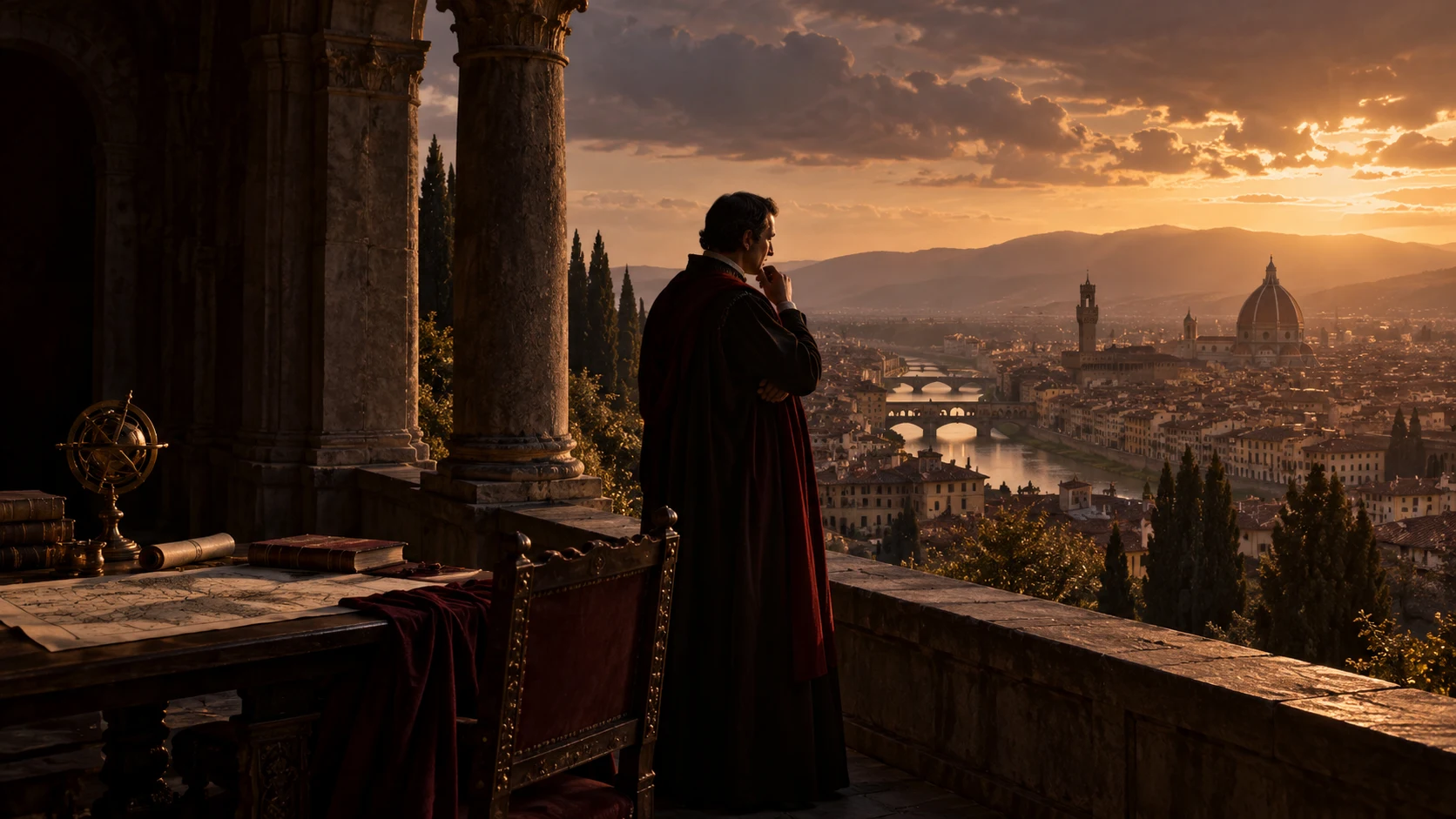
Every evening, Machiavelli told his friend, he came home from a day of trapping thrushes, quarrelling with woodcutters and playing cards in the roadside inn, and went into his study. At the door he took off his peasant clothes, “covered with dust and dirt”, and put on the robes he had once worn at court. Then, for four hours, he talked with the great men of antiquity, forgot his poverty and lost his fear of death.
That letter, written to Francesco Vettori in December 1513, is where we first hear of The Prince. Out of those evenings, Niccolò Machiavelli wrote, he had composed a little work on principalities. And in the same letter he says plainly what he hoped it would do: persuade the Medici, the family who had just thrown him out of office, to give him work again.
Why did Machiavelli write The Prince?
For fourteen years Machiavelli had been one of the busiest officials of the Florentine republic, running its chancery business and travelling as an envoy to kings, popes and Cesare Borgia. Then, in 1512, the Medici came back to power, and he was dismissed. Months later his name turned up on a list of supposed conspirators. He was arrested and tortured with the strappado, admitted nothing, and was freed only when the new Medici pope, Leo X, declared an amnesty.
He withdrew, broke and idle, to his small farm at Sant’Andrea in Percussina, near San Casciano outside Florence. He had one asset left: what he knew about how states are won and lost. The Prince is that knowledge, packaged as a gift for a prince. In his letter he told Vettori he longed for the Medici to employ him, even if they began by making him roll a stone, and hoped the book would show them what he was worth:
And as to this little thing [his book], when it has been read it will be seen that during the fifteen years I have given to the study of statecraft I have neither slept nor idled; and men ought ever to desire to be served by one who has reaped experience at the expense of others.
Machiavelli to Francesco Vettori, December 1513, translated by W. K. Marriott

Who was The Prince dedicated to?
First to Giuliano de’ Medici, the letter says. After Giuliano died in 1516, Machiavelli readdressed it to his nephew, Lorenzo di Piero de’ Medici, the ruler of Florence. The dedication that survives reads like the covering letter it was. Courtiers bring princes horses and jewels, Machiavelli writes; he has nothing more valuable to offer than his knowledge of great men’s actions, gained from long experience and constant study. It ends with an unmistakable hint:
And if your Magnificence from the summit of your greatness will sometimes turn your eyes to these lower regions, you will see how unmeritedly I suffer a great and continued malignity of fortune.
Niccolò Machiavelli, dedication to The Prince, translated by W. K. Marriott
It did not work. There is no evidence that Lorenzo ever read the book, and he gave its author nothing.
- 1469
Machiavelli is born in Florence
- 1498
He enters the service of the Florentine republic’s second chancery
- 1512
The Medici return to Florence and he loses his post
- 1513
Arrested, tortured and released; he begins the little work on principalities
- 10 December 1513
He describes the book in his letter to Francesco Vettori
- 1520
Cardinal Giulio de’ Medici commissions him to write a history of Florence
- 21 June 1527
He dies, weeks after the Medici are expelled again
- 1532
The Prince is printed in Rome, five years after his death
- 1559
The book is placed on the papal Index of forbidden books
Did Machiavelli ever get his job back?
Only in part, and only slowly. He spent the next years writing: the Discourses on Livy, a comedy, The Art of War. In 1520 Cardinal Giulio de’ Medici, the future Pope Clement VII, commissioned him to write a history of Florence, and small official errands followed. It was patronage, not power.
Then came the cruellest turn. In 1527, after the Sack of Rome, the Medici were thrown out of Florence again and the republic Machiavelli had served was restored. He might have expected to return to office. Instead, proposals to give him a post were rejected because he had taken Medici favours. He died that June. The job application had finally succeeded with the wrong employer, and then cost him the right one.

Does knowing this change how you read The Prince?
It helps. Read as a job application, the book’s famous ruthlessness looks less like a confession of cruelty and more like a sales pitch from an expert in a hurry: short chapters, vivid modern examples, advice a new ruler could use at once. Read beside the Discourses, which favour republics, it also raises the question scholars still argue over: how much of The Prince Machiavelli believed, and how much he thought a Medici wanted to hear.
The Prince
Written 1513, printed 1532. Twenty-six short chapters on gaining and keeping power, written by an unemployed diplomat for the family that sacked him. Brisk, practical and still unsettling.
Utopia
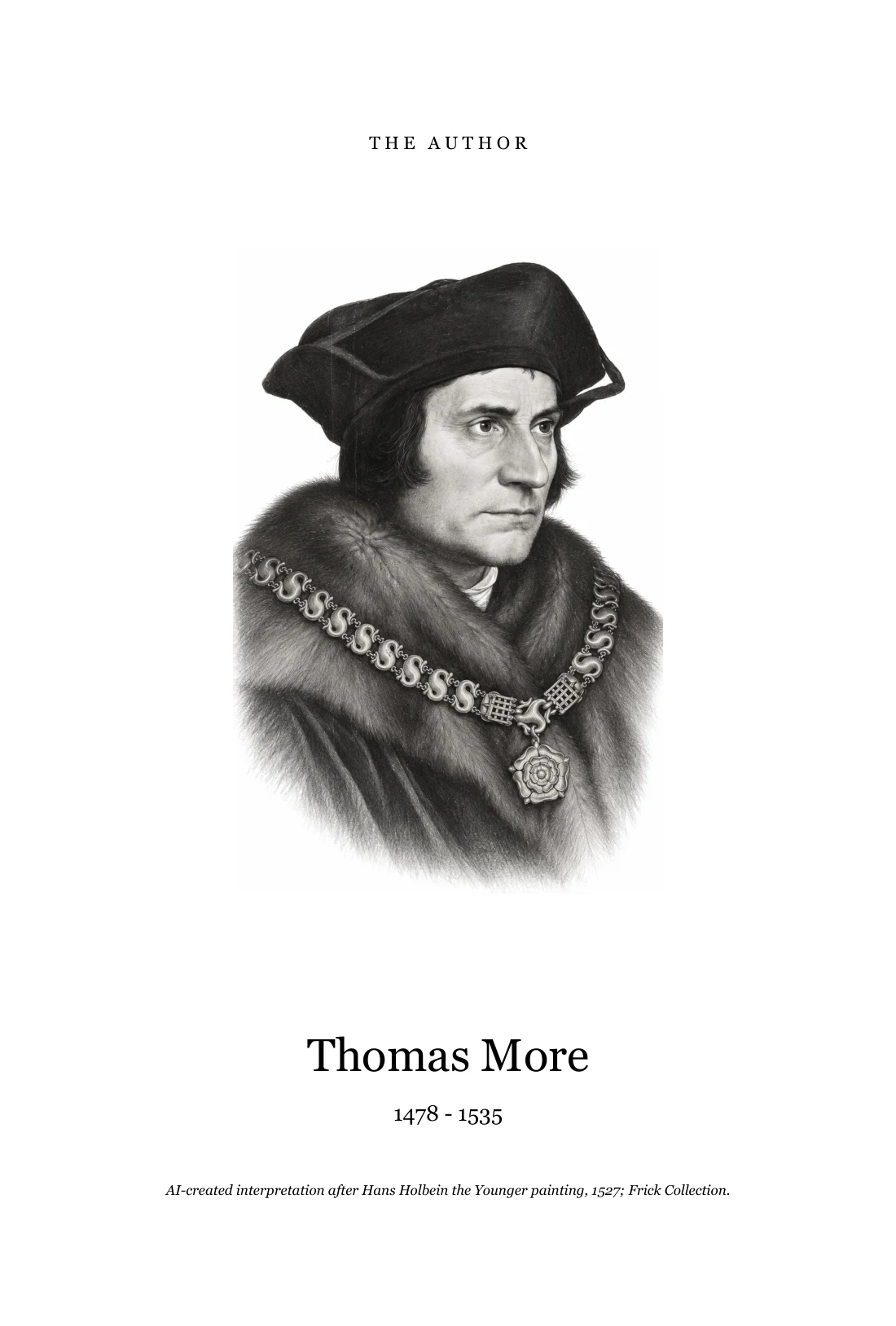
Thomas More’s Utopia, published in 1516, imagines the ideal state where Machiavelli studies the real one. The two books make a revealing pair.


Where to go next
The Prince is one of the shortest books on Philosophy books for beginners, and How to read philosophy without a degree has tips for its knottier chapters. For another classic too often reduced to a single adjective, see Did you know The Art of War is barely about battles?.
Then read it the way the Medici should have: as a pitch. The Prince takes an afternoon, and once you hear the job-seeker’s voice in the dedication, you will hear it on every page.
Questions readers ask
Why did Machiavelli write The Prince?
After losing his government post when the Medici returned to Florence in 1512, Machiavelli wrote The Prince in 1513 partly to show the Medici his expertise and win employment. He explains this in a letter to Francesco Vettori of December 1513.
Who was The Prince dedicated to?
Machiavelli first meant it for Giuliano de’ Medici, but the surviving dedication is to Lorenzo di Piero de’ Medici, ruler of Florence. There is no evidence Lorenzo read it.
When was The Prince published?
It was written in 1513 but only printed in 1532, five years after Machiavelli’s death, and was placed on the papal Index of forbidden books in 1559.
 Discourses on the First Decade of Titus Livius468 pages · $21.99