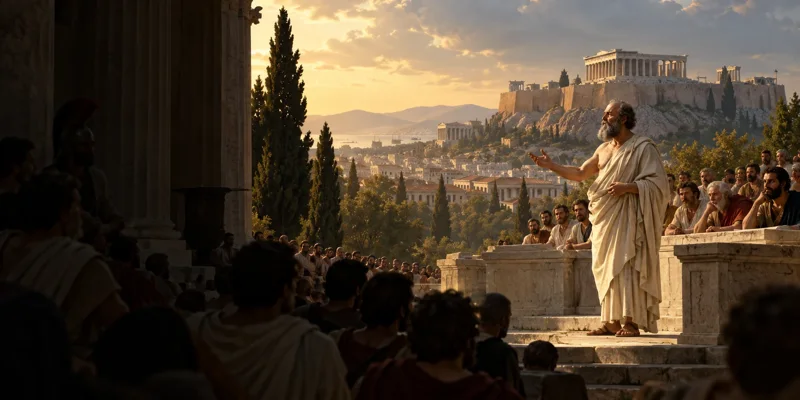
The most famous book of political philosophy ever written begins with a man going to a party. “I went down yesterday to the Piraeus with Glaucon the son of Ariston,” says Socrates at the start of Plato’s Republic, explaining that he wanted to see a new festival. Before long he is cornered by friends, invited to dinner and drawn into an argument about what justice is. Ten books later they are still talking.
That opening holds the key to how to read philosophy. The great philosophy books are not lists of answers to memorise. They are arguments in motion, and your job as a reader is to join them: to work out what question is being asked, what answer is offered, and whether you are convinced. You do not need a degree for that. You need a pencil, a slower pace than usual and a willingness to disagree.
How to read philosophy: the basic method
- Find the question first. Every good philosophy book is chasing one: what is justice, how should I live, when may society interfere with me? Write it at the top of a page before you begin.
- Read once quickly for the shape, then again slowly for the steps. On the first pass you learn where the argument is going; on the second you can see how it gets there.
- Summarise each section in a single sentence of your own. If you can’t, read it again. This is the most useful habit of all, and the one most beginners skip.
- Test the claims with examples from your own life. Philosophers generalise; you can check whether the general rule fits the particular case.
- Expect to be persuaded and then unpersuaded. Changing your mind twice in a chapter is not failure. It is the experience the book was designed to give you.
Then it helps to recognise what kind of book you are holding, because philosophy comes in several forms, and each wants reading differently. Our three featured books are a private notebook, a dramatic dialogue and a sustained argument.

The notebook: Marcus Aurelius
Marcus Aurelius was Roman emperor from 161 to 180, and the Meditations are notes he wrote in Greek for himself, never meant for publication. Some were set down on military campaign; one book ends with the note that it was written in the country of the Quadi, a people on the Danube frontier. There is no continuous argument. The same thoughts return again and again, because Marcus was not explaining Stoicism to anyone. He was trying to practise it.
So don’t read the Meditations straight through like a treatise. Read a few entries a day, slowly, and notice which ones you resist. Many are reminders, addressed to “thou”, that sound as if they were written on a bad morning:
In the morning when thou findest thyself unwilling to rise, consider with thyself presently, it is to go about a man’s work that I am stirred up.
Marcus Aurelius, Meditations, Book V, translated by Meric Casaubon (1634)
The dialogue: Plato’s Republic
Plato wrote in dialogues, and the first rule is to read them as drama. Characters have tempers, motives and blind spots. In Book I of the Republic the sophist Thrasymachus bursts in, impatient with the polite talk, and declares that “justice is nothing else than the interest of the stronger”. Watch how Socrates handles him, and how the mood changes after he is silenced. The arguments are inseparable from the people making them.
The second rule is not to assume that Socrates speaks for Plato in every line, or that every argument he wins is a good one. Readers have been arguing with the Republic’s ideal city for well over two thousand years. Argue with it too. Socrates himself sets the terms:
I really do not know as yet, but whither the argument may blow, thither we go.
Plato, The Republic, Book III, translated by Benjamin Jowett
At 520 pages in our edition, the Republic is a long read. Take it a book at a time, and if you want the most famous passage first, the allegory of the cave opens Book VII.

The argument: Mill’s On Liberty
John Stuart Mill’s On Liberty (1859) is philosophy as essay: one central claim, defended across five chapters against every objection Mill can think of. Here the method is to find the thesis and then follow the defence. Mill states it plainly in the first chapter:
the only purpose for which power can be rightfully exercised over any member of a civilised community, against his will, is to prevent harm to others.
John Stuart Mill, On Liberty (1859), chapter I
Everything after that is a stress test. The second chapter argues that opinions should never be suppressed, even false ones; later chapters ask where the line between the individual and society should fall. Try to find the case where you think Mill is wrong, then see whether he has already answered it. Often he has. The book is dedicated to Harriet Taylor Mill, who died before it was published, and some modern scholars treat it as their joint work.
Meditations
An emperor’s private notebook on anger, duty, death and getting out of bed. Twelve short books; read a few entries a day and keep the ones that sting.
The Republic
Benjamin Jowett’s translation of Plato’s great dialogue on justice, from a festival in the Piraeus to the cave and beyond. Read it as a conversation you are allowed to interrupt.
On Liberty
1859. Mill’s case for freedom of thought and the limits of social power, still quoted in every argument about free speech. Short enough for a weekend.


Where to start
If you have never read philosophy before, begin with the Meditations: the entries are short and the stakes are personal. Then read On Liberty for the experience of following a single argument from start to finish, and save the Republic for when you are ready to live with a book for a few weeks. For more starting points, see Philosophy books for beginners and the Stoicism reading list; if Plato hooks you, which Plato dialogue to read first suggests the next step.
Tonight, open Meditations anywhere, read a single entry, and write one sentence saying whether you agree. That is philosophy, and you have just done it.
Questions readers ask
How should a beginner read philosophy?
Start with a short primary text, identify the question it is asking, read it once for the overall shape and again for the steps, and summarise each section in your own words. Disagreeing with the author is part of the method.
Can you read philosophy without studying it?
Yes. Many classic philosophy books, such as Marcus Aurelius’s Meditations and Mill’s On Liberty, were written for general readers rather than specialists, and need no background to begin.
What is the easiest philosophy book to start with?
Meditations is a good first choice because its entries are short and personal. On Liberty is a good second, because it shows a single argument developed clearly from beginning to end.