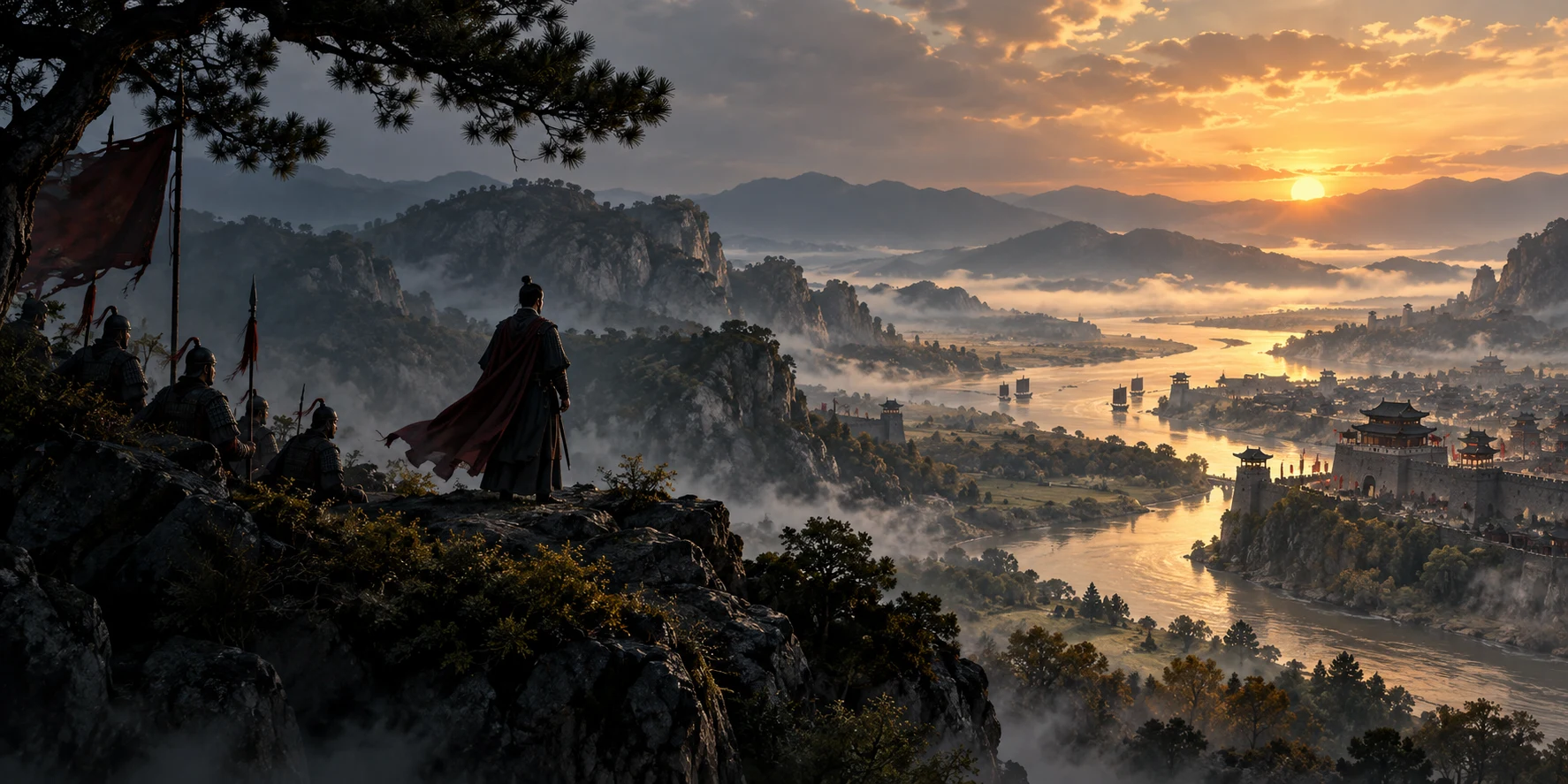
There is a story, told by the Han historian Sima Qian centuries after the fact, about how Sun Tzu got his job. The King of Wu had read his thirteen chapters and asked for a demonstration, using the palace women as soldiers. Sun Tzu divided them into two companies, put the king’s two favourite concubines in command, and gave the order to turn right. The women laughed. He explained the drill again, gave the order to turn left, and they laughed again.
So he had the two commanders beheaded, over the king’s protests, and after that the women drilled in perfect silence. It is a brutal tale, and nobody knows whether it happened. But it makes a point the book itself keeps making: Sun Tzu is less interested in bloodshed than in clarity, discipline and control. Victory, for him, is mostly decided before anyone reaches the field.
What is The Art of War about?
The Art of War is a short Chinese treatise on strategy in thirteen chapters, traditionally dated to around the sixth century BC and attributed to a general called Sun Wu, known as Sun Tzu, or Master Sun. It is a military book through and through: there are chapters on terrain, on marching, on attack by fire and on the use of spies. What surprises first-time readers is how little of it describes the clash of armies, and how often it warns against fighting at all.
The first chapter is about calculation. War, Sun Tzu says, is “a matter of life and death, a road either to safety or to ruin”, and it must be weighed in advance through five factors: the moral law, heaven, earth, the commander, and method and discipline. The second is about cost. Armies on campaign drain a state of money, food and people, and “there is no instance of a country having benefited from prolonged warfare.”
Hence to fight and conquer in all your battles is not supreme excellence; supreme excellence consists in breaking the enemy’s resistance without fighting.
Sun Tzu, The Art of War, translated by Lionel Giles, chapter III
Why does Sun Tzu say the best general avoids battle?
Because fighting is the most expensive and least certain way to get what you want. In the third chapter, “Attack by Stratagem”, he ranks the options. It is best to take an enemy’s country “whole and intact”; to shatter it is not so good. The highest form of generalship, in Lionel Giles’s translation, is “to baulk the enemy’s plans”, the next to stop his forces joining together, the next to attack his army in the field, and “the worst policy of all is to besiege walled cities.”
Everything else follows from that ranking. If you can win by knowing more than your opponent, deceiving him and choosing ground he cannot hold, you may never have to fight. Hence the two lines most people know, even if they have never opened the book: “All warfare is based on deception,” and “If you know the enemy and know yourself, you need not fear the result of a hundred battles.”
Who wrote The Art of War, and when?
Nobody can say for certain. Sima Qian presents Sun Wu as a general in the service of King Helü of Wu around 500 BC, but Chinese scholars were already doubting that account many centuries ago, and many modern historians date the text a little later, to the fifth century BC, possibly with additions after that. Whether one man wrote it, or it gathered the teaching of a school, is still debated.
Archaeology has at least settled how old the book is. In 1972, construction workers at Yinqueshan in Shandong province uncovered Han dynasty tombs containing bamboo slips with parts of The Art of War on them. The tombs were sealed in the second century BC, and the slips closely match the text that has come down to us.
- c. 500 BC
Traditional date for Sun Tzu’s service under King Helü of Wu
- c. 100 BC
Sima Qian includes Sun Tzu’s biography in his Records of the Grand Historian
- 1772
The Jesuit missionary Joseph-Marie Amiot publishes a French version, the first in a European language
- 1905
Captain E. F. Calthrop’s English translation appears in Tokyo
- 1910
Lionel Giles publishes his annotated English translation, the version most often cited
- 1972
Han dynasty bamboo slips of the text are found at Yinqueshan
How long does The Art of War take to read?
Slowly, and more than once. The thirteen chapters are made of short numbered sayings, and many readers get through the whole thing in an afternoon. The second reading is where it opens up, as you start to see how the chapters argue with each other: speed against caution, deception against discipline, the general’s independence against the ruler’s authority.
Read it as what it is, too. It is easy to treat Sun Tzu as a business guru, and boardrooms and sports coaches have certainly borrowed him. But the book was written for rulers deciding whether to send people to die, and its seriousness about that cost is what keeps it from being a list of clever tricks.
The Art of War
Thirteen short chapters of numbered maxims, from laying plans to the use of spies. More about knowledge, cost and restraint than about fighting.
The Prince
Machiavelli’s handbook for a new ruler, written in 1513. The obvious Western companion: as unsentimental as Sun Tzu about power, and far more cynical about people.
The Analects of Confucius
The sayings of Confucius, gathered by his followers. A view of good government built on ritual and virtue rather than strategy, from the same broad age of Chinese thought.


More ancient advice
Another ancient book its author never expected to become a modern self-help staple is the subject of Did you know Marcus Aurelius never meant Meditations to be read?. For a wider shelf, try Classics from Asia to read in English and Philosophy books for beginners.
Then go to the source. Open The Art of War at the third chapter, read the line about supreme excellence, and see how much of the rest of the book is built around it.
Questions readers ask
What is the main message of The Art of War?
That war is ruinously costly and should be won, if possible, before it is fought. Sun Tzu says supreme excellence lies in “breaking the enemy’s resistance without fighting”, through planning, deception and better knowledge of the enemy.
How many chapters are in The Art of War?
Thirteen. They run from “Laying Plans” to “The Use of Spies”, and each is made up of short numbered passages.
Did Sun Tzu really write The Art of War?
It is traditionally attributed to Sun Wu, a general of around 500 BC, but his life is known only from later accounts, and many scholars think the text took shape somewhat later. Bamboo slips found in 1972 show it existed in much its present form by the second century BC.
How long does it take to read The Art of War?
The text itself is short and many readers finish it in an afternoon or a couple of evenings. Editions with long commentaries take considerably longer.