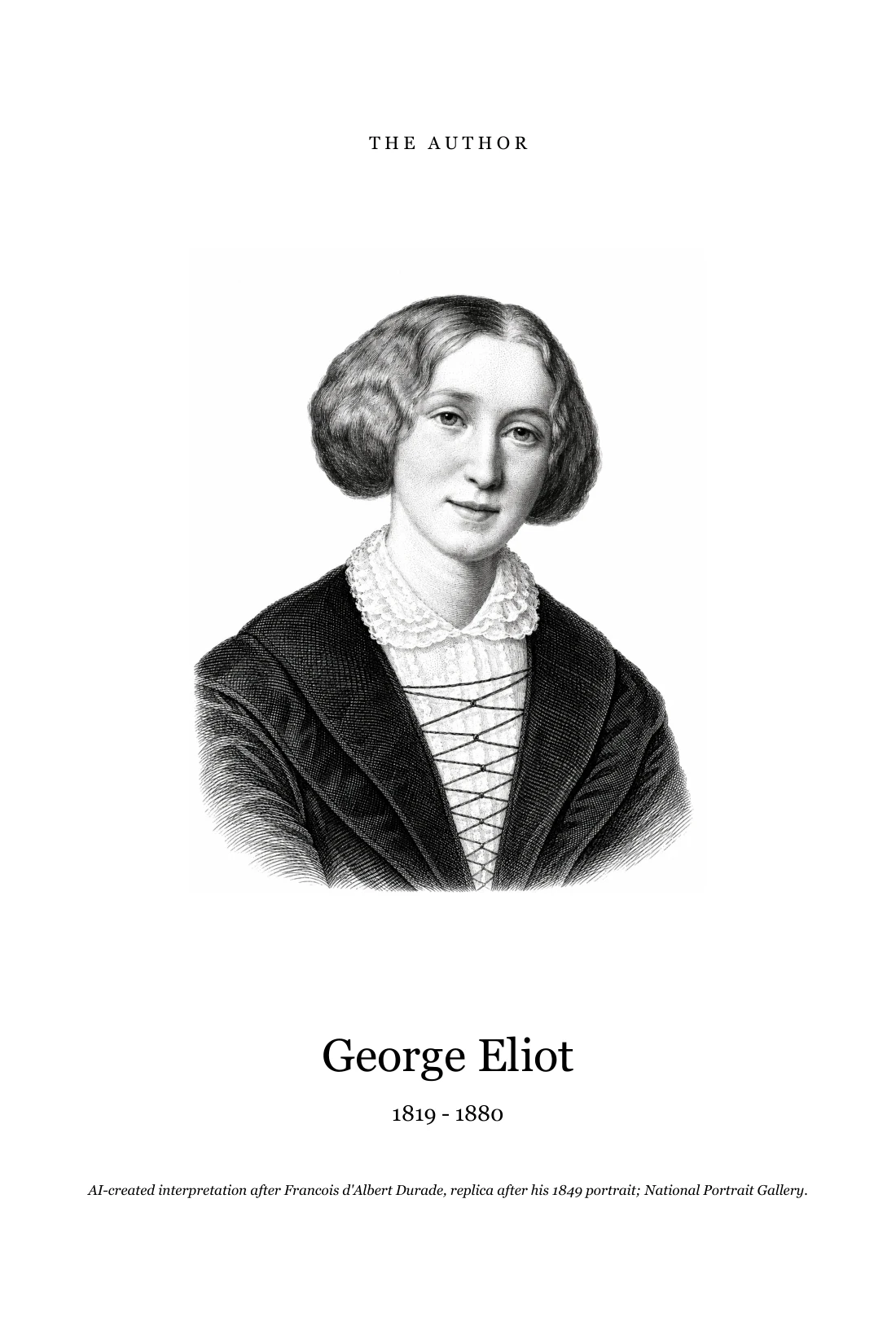
When Scenes of Clerical Life began appearing in Blackwood’s Magazine in 1857, nobody outside a tiny circle knew who had written it. The stories appeared anonymously, and readers assumed that the author was a man, perhaps a country clergyman. Behind the scenes she first signed herself “George Eliot” in a letter to her publisher in February 1857, and the name appeared on the title page when the stories were collected as a book in 1858. In fact she was Mary Ann Evans, a thirty-seven-year-old translator and critic living in London with the writer George Henry Lewes.
She chose the pseudonym for several reasons at once: to be taken seriously in a literary world that looked down on women’s novels, to keep her fiction separate from her reputation as a radical thinker, and above all to protect the books from the scandal of her private life. Each of those reasons tells you something about the Victorian world George Eliot wrote about so brilliantly.
Who was Mary Ann Evans?
She was born in Warwickshire in 1819, the daughter of an estate manager, and grew up devout and fiercely studious. In her twenties she lost her religious faith, to her family’s distress, and translated a controversial German study of the life of Jesus. By the early 1850s she was in London, effectively running the influential Westminster Review behind its official editor, and writing some of the sharpest criticism of the age.
She was known in intellectual circles as a formidable mind. That was precisely the problem. A novel by the translator of radical German theology would have been read, and condemned, as a work of theology.
Why did George Eliot use a male name?
First, she did not want to be dismissed as a “lady novelist”. In 1856, just before she began writing fiction, she published an essay called “Silly Novels by Lady Novelists” that mocked the fashionable romances many women were turning out. She knew reviewers would lump any woman’s book in with them, and she wanted her work judged on its merits.
Second, there was Lewes. He was married, but his marriage had broken down, and because he had accepted his wife’s children by another man as his own, the law of the time made divorce impossible for him. From 1854 Evans and Lewes lived openly as a couple. Respectable society shunned her, and her own brother cut off contact. Had readers known that the author of these gentle, moral country stories was a woman living with another woman’s husband, many would never have bought them.
Where did the name George Eliot come from?
“George” is generally taken to be a tribute to George Henry Lewes, who encouraged her to try fiction and handled her dealings with her publisher. As for “Eliot”, she is reported to have said she simply liked it as a good, full-sounding word that was easy to say. Even her publisher, John Blackwood, did not know her identity at first.
The secret did not last long. Charles Dickens wrote to the unknown author of Scenes of Clerical Life to say how much he admired the stories, and to hint that he suspected a woman had written them. By the end of 1859 her identity was an open secret, but by then the books had won their audience, and she kept the name for the rest of her career.
George Eliot’s novels
The name that began as a disguise became one of the most respected in English literature. Virginia Woolf would later call Middlemarch “one of the few English novels written for grown-up people”.
Adam Bede
1859. A proud young carpenter, a vain dairymaid and a Methodist preacher in a Midlands village. Her first full-length novel and her first great success.
The Mill on the Floss
1860. Maggie Tulliver, too clever and too passionate for her world, and her love for her rigid brother Tom. Her most autobiographical book.
Silas Marner
1861. A lonely, cheated weaver hoards his gold until a child toddles into his cottage. Short, warm and the ideal way in.
Middlemarch
1871–72. A whole provincial town, its marriages, ambitions and failures, seen with extraordinary sympathy. Many readers’ choice for the greatest English novel.


She was far from the only woman to hide behind a man’s name. The Brontë sisters had done the same a decade earlier, as we explain in Currer, Ellis and Acton Bell, and women writers who used male pen names gathers many more. If you are deciding which of her books to begin with, see where to start with George Eliot.
Did the pen name work?
Completely. The early reviews treated her as a major new talent, with no condescension to a “lady novelist”, and by the time the world knew who she was, the work spoke for itself. In 1880, after Lewes’s death, she married her friend John Cross, and she died that December, famous under a name that had once been a shield.
If you have never read her, start with Silas Marner. It is short enough for a weekend and has all her gifts in miniature: humour, compassion and a village you can see. Then, when you are ready, give yourself a month with Middlemarch.
Questions readers ask
Why did Mary Ann Evans use the pen name George Eliot?
She wanted her novels judged seriously rather than dismissed as women’s fiction, and she wanted to shield them from the scandal of her relationship with George Henry Lewes, a married man she lived with openly.
What was George Eliot’s real name?
Her real name was Mary Ann Evans. Over her life she also styled herself Mary Anne and Marian, and after her marriage in 1880 she became Mary Ann Cross.
When did people find out George Eliot was a woman?
Her identity became widely known in 1859, after the success of Adam Bede and a false claim to its authorship by a man named Joseph Liggins.
What is George Eliot’s most famous book?
Middlemarch (1871–72) is her most celebrated novel. Silas Marner and The Mill on the Floss are also widely read.
 Romola592 pages · $25.99
 Felix Holt, the Radical478 pages · $21.99