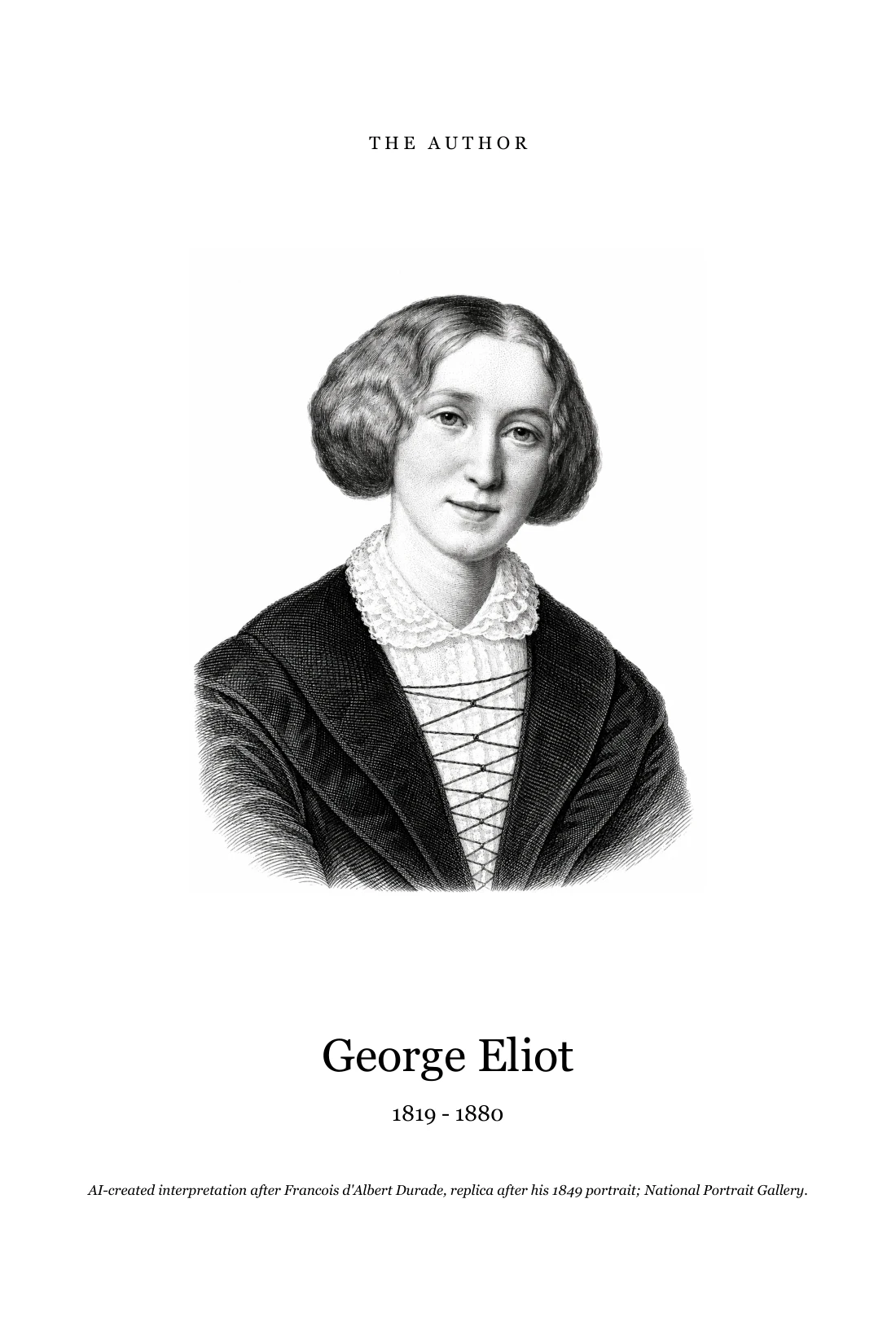
Middlemarch was too long for the shelf it was written for. By the spring of 1871 George Eliot could see that it would burst the three-volume format that publishers and circulating libraries expected. Her partner George Henry Lewes, acting as her agent, proposed a solution to her publisher, John Blackwood: issue it in eight separate books, every two months, as Victor Hugo’s Les Misérables had been. Blackwood agreed, though he worried about “complaints of a want of the continuous interest in the story”. The eight books came out between December 1871 and December 1872.
Those eight books are still the best way to measure Middlemarch. In our edition the whole novel runs to 736 pages, which the book card estimates at about fifteen hours. By our count of the Project Gutenberg text it is about 316,000 words, which at an average reading pace comes to roughly twenty hours. Most readers will need between fifteen and twenty-six.
How long does it take to read Middlemarch?
Everyone reads at a different speed, so take these figures as a guide rather than a target. The fifteen hours on our card rests on a rate of fifty pages an hour, which is brisk for prose this rich. In 2019 the psychologist Marc Brysbaert pooled the research on reading rates and found that adults read fiction at about 260 words a minute on average, with most between 200 and 320. Applied to Middlemarch, that suggests about 16½ hours for a fast reader, 20 for an average one and 26 for a slow one.
Eliot rewards the slow end of that range. Her sentences are long and carefully balanced, and her narrator often pauses to reflect, which is where much of the book’s wisdom lives. Readers who skim those passages save time and lose the point.
How long is each book of Middlemarch?
Remarkably even. By our word count, the eight books range from about 35,000 words (Book III, “Waiting for Death”) to about 43,000 (Book I, “Miss Brooke”), so each takes roughly two and a quarter to three hours at an average pace. The Prelude is a single page, and the Finale only a few. The 86 chapters average around 3,600 words, or about fourteen minutes each.
That evenness makes Middlemarch one of the easiest long novels to plan. A book a week takes you through in two months, which is close to the rhythm of its first readers, minus the two-month waits. Two chapters a night will finish it in about six weeks.
the magnificent book which with all its imperfections is one of the few English novels written for grown-up people.
Virginia Woolf, “George Eliot” (1919), collected in The Common Reader (1925)
Why is Middlemarch so long?
Because it is really several novels woven into one. Eliot began two separate projects in 1869 and 1870: a story about a young doctor in a provincial town, and a long story called “Miss Brooke” about an idealistic young woman. By 1871 she was combining them. To those two lines she added the Vincy family, the banker Bulstrode and the Garths, until the novel became a portrait of a whole community between 1829 and 1832. Its subtitle, A Study of Provincial Life, is a fair description of its scope.
The size is the point. Eliot wanted to show how lives that seem separate press on one another, how a marriage in one house and a debt in another can end up shaping the same events. That needs room, and it needs you to hold a lot of people in mind at once, which is the real reason to keep a list of characters for the first book or two.
Middlemarch
736 pages, eight books, 86 chapters. Dorothea Brooke, Tertius Lydgate and a whole Midlands town on the eve of reform. Read “Miss Brooke” first and decide by the end of it.
The Mill on the Floss
Eliot’s earlier novel, rich in autobiographical elements, at 524 pages: Maggie Tulliver, her brother Tom and the mill on the river. A shorter way into the same intelligence.



Is Middlemarch worth the time?
Woolf thought so, and generations of readers have agreed. It is long, but it is not slow in the way people fear: each book has its own crises, and the threads tighten steadily towards the end. If you would like a gentler introduction to Eliot first, see Where to start with George Eliot, and for advice on managing the length, How to read a long Victorian novel.
Among our long books, Middlemarch sits a little below David Copperfield and Anna Karenina; How long is David Copperfield? gives the comparison. But the best plan is the one Eliot and Lewes devised. Open Middlemarch, read the Prelude and Book I, “Miss Brooke”, this week, and see whether you want Book II after it.
Questions readers ask
How many pages is Middlemarch?
Our edition runs to 736 pages. Editions with larger type or extensive notes run longer.
How many words are in Middlemarch?
About 316,000 words, by our count of the Project Gutenberg text, including the short Prelude and Finale.
How long does it take to read Middlemarch?
Most readers need between about 15 and 26 hours. At an average fiction reading speed of 260 words a minute it takes around 20 hours, or about two months at one of its eight books a week.
How many books and chapters are in Middlemarch?
Middlemarch is divided into eight books containing 86 chapters, with a short Prelude at the start and a Finale at the end.
 Silas Marner180 pages · $13.99
 Adam Bede528 pages · $23.99
 Romola592 pages · $25.99
 Felix Holt, the Radical478 pages · $21.99