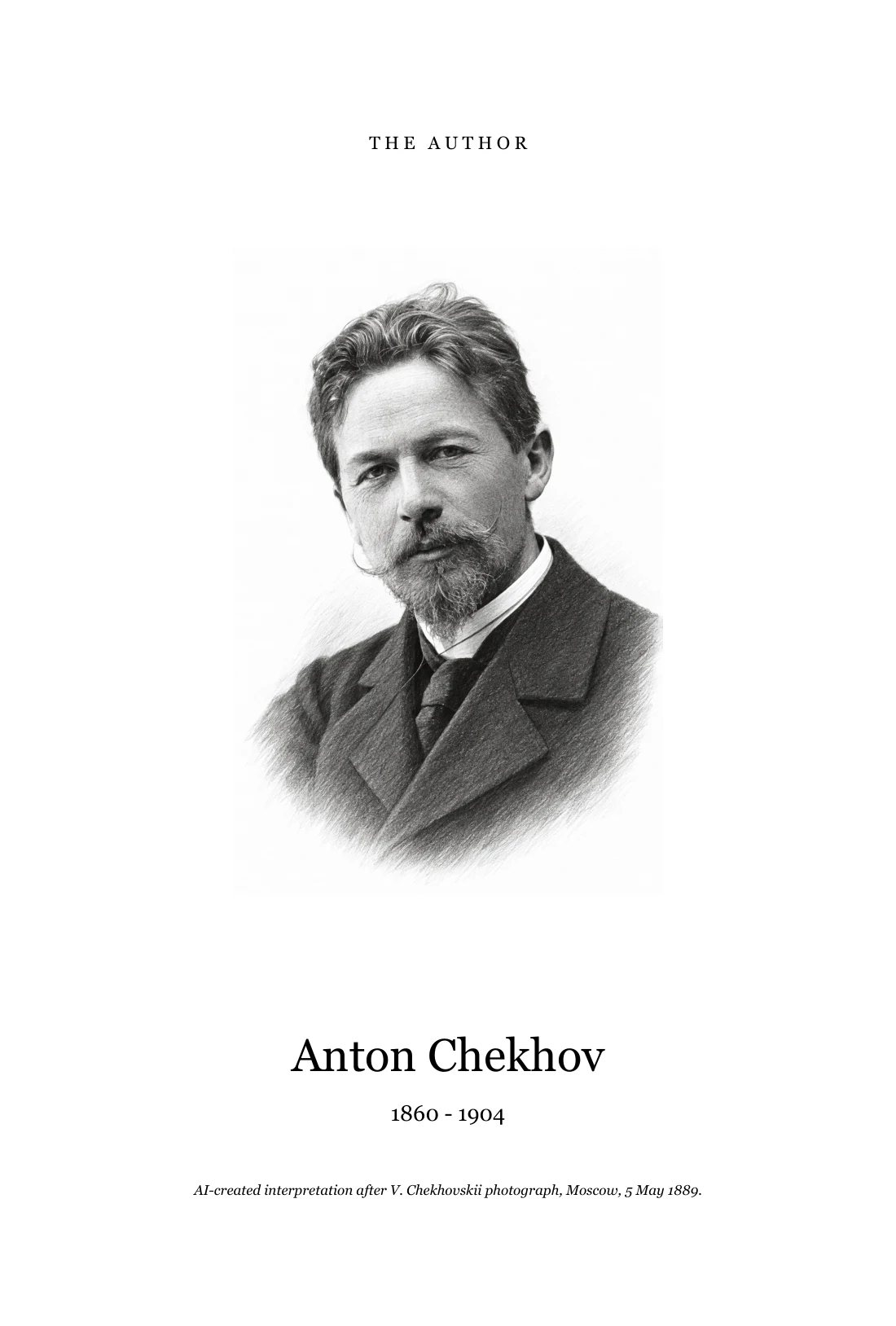
Should a young doctor with a gift for stories give up medicine? In 1888 the publisher Alexei Suvorin thought so, and told the twenty-eight-year-old Anton Chekhov to stop chasing two hares. Chekhov wrote back that he had no intention of doing anything of the kind.
Medicine is my lawful wife and literature is my mistress. When I get tired of one I spend the night with the other.
Chekhov to A. S. Suvorin, 11 September 1888, translated by Constance Garnett
He kept both for the rest of his life, treating patients, often for nothing, while writing stories that changed the form for good. Ask where to begin with Chekhov’s short stories and most readers will give the same answer: “The Lady with the Dog”, then the stories around it, then the plays.
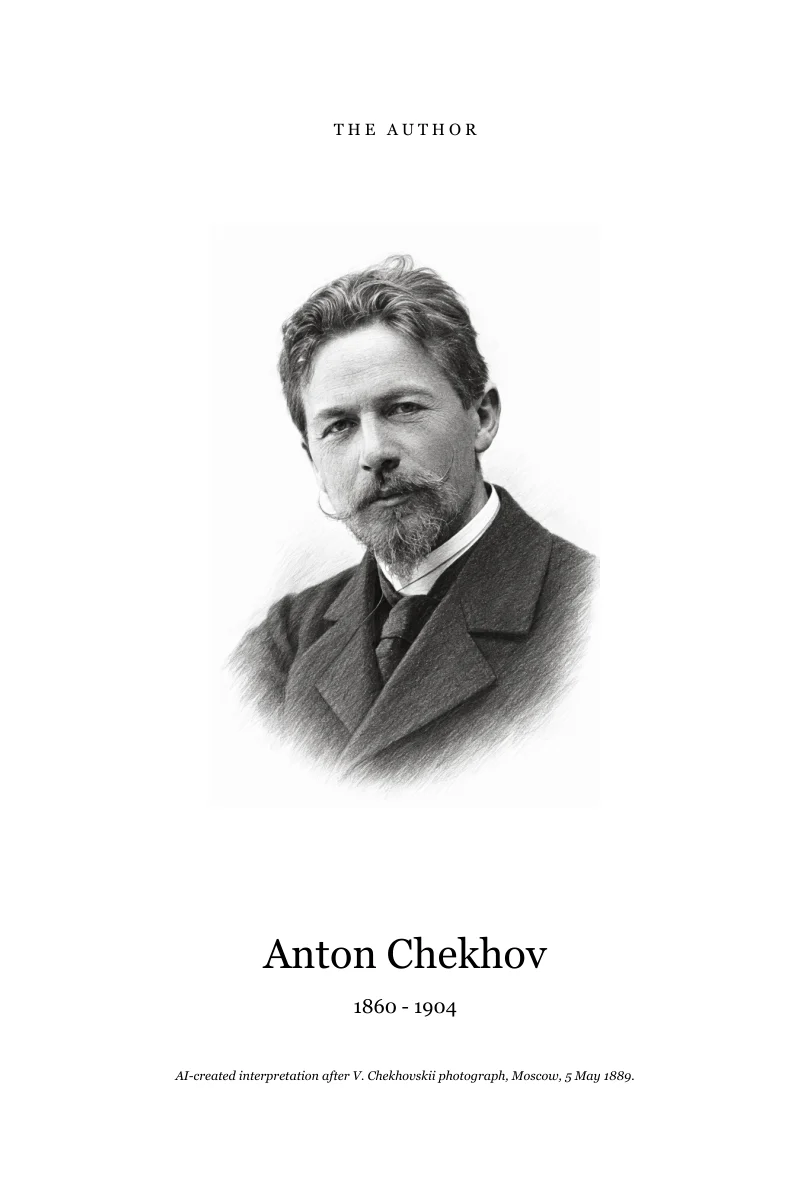
Who was Anton Chekhov?
Chekhov was the grandson of a serf and the son of a struggling grocer in Taganrog, a port on the Sea of Azov. As a medical student in Moscow he paid his way, and helped support his family, by turning out comic sketches for magazines under pen names such as Antosha Chekhonte. By the late 1880s he was writing seriously, and in 1888 his collection At Dusk won the Pushkin Prize.
In 1890 he crossed Siberia to the penal colony on Sakhalin Island and spent about three months interviewing convicts and settlers. Tuberculosis, which had troubled him since his twenties, eventually drove him south to Yalta, on the Crimean coast. He married the actress Olga Knipper in 1901, and died in a German spa town three years later. According to Olga’s account, his last act was to drink a glass of champagne.
Where to start with Chekhov’s short stories
Begin with the volume that takes its title from his most famous story. In Constance Garnett’s translation, The Lady with the Dog and Other Stories was the third volume of her Tales of Chekhov, and it gathers nine stories from the height of his career. Here is how the title story opens:
It was said that a new person had appeared on the sea-front: a lady with a little dog.
“The Lady with the Dog”, translated by Constance Garnett
Dmitri Gurov, a Moscow banker on holiday in Yalta and a practised seducer, begins a casual affair with a young married woman, Anna Sergeyevna, and goes home expecting to forget her. He doesn’t. First published in December 1899, the story was written in Yalta itself, and Vladimir Nabokov ranked it among the greatest short stories ever written. Read it, then try these from the same book:
- “The Black Monk”: a brilliant, overworked scholar starts to see a phantom monk who tells him he is a genius. Chekhov’s eeriest story.
- “Ionitch”: a young provincial doctor falls in love, is turned down, and over the years becomes someone his younger self would not recognise.
- “A Doctor’s Visit”: a physician called to a sick heiress in a factory town sees, in one night, what the factory does to everyone in it.
- “An Anonymous Story”: a revolutionary disguised as a footman takes service in an official’s house and finds his politics overtaken by his feelings.
Chekhov’s plays: start with The Seagull
The Seagull, written in 1895, is the play that nearly ended his career as a dramatist. Its premiere at the Alexandrinsky Theatre in St Petersburg on 17 October 1896 was a fiasco, and the audience booed. Two years later Konstantin Stanislavski’s new Moscow Art Theatre staged it again, and this time it was a triumph. The theatre still uses a seagull as its emblem.
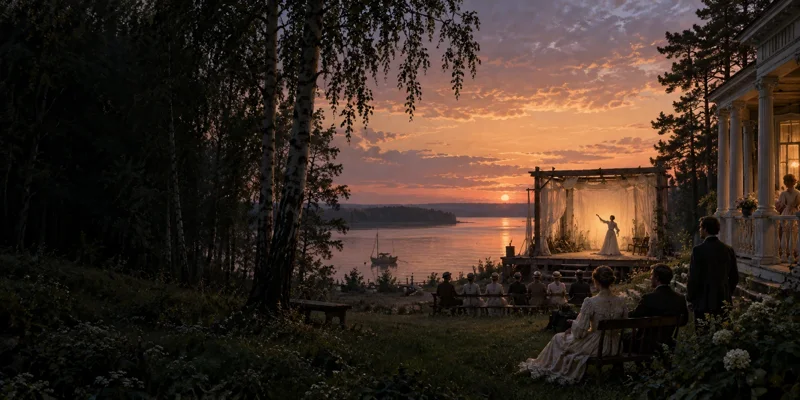
The play gathers an ageing actress, her restless son who wants to write a new kind of theatre, a celebrated novelist and a young girl who dreams of the stage, all on a country estate by a lake. Chekhov insisted it was a comedy. Its first exchange sets the tone:
MEDVIEDENKO. Why do you always wear mourning? MASHA. I dress in black to match my life. I am unhappy.
The Sea-Gull, Act I
The Sea-Gull
1896. Love, art and wasted lives on a lakeside estate, in four acts. The first of Chekhov’s four great plays, and the one to read first.
Uncle Vanya
An ageing professor, his young wife and the brother-in-law who has spent his life managing their estate. The natural next play after The Seagull.


What to read after Chekhov
Chekhov’s quiet, open-ended stories shaped much of the modern short story. Katherine Mansfield revered him; see Katherine Mansfield: where to start with her short stories. For the American writer who found the same hidden lives in a small Ohio town, try Sherwood Anderson and the small-town story, and for the Russians around him, Where to start with Dostoevsky and Tolstoy beyond War and Peace.
Go to the sea-front at Yalta first. The Lady with the Dog takes half an hour to read, and it is one of those stories that seems to grow longer every time you remember it.
Questions readers ask
Where should I start with Chekhov?
Start with the short story “The Lady with the Dog”, then read the other stories in the same collection, such as “The Black Monk” and “Ionitch”. For the plays, begin with The Seagull.
What are Chekhov’s best short stories?
Of Chekhov’s short stories, “The Lady with the Dog” is the most famous. “The Black Monk”, “Ionitch”, “Gooseberries”, “Ward No. 6” and “The Kiss” are also widely regarded as among his finest.
Was Chekhov a doctor?
Yes. Chekhov qualified as a physician in Moscow in 1884 and practised medicine, often without charge, for much of his life, calling medicine his lawful wife and literature his mistress.
What is Chekhov’s most famous play?
The Seagull (1896) and his last play, The Cherry Orchard, are his best-known plays, along with Uncle Vanya and Three Sisters.
 The Wife, and Other Stories240 pages · $15.99
 The Duel and Other Stories242 pages · $15.99
 Love, and Other Stories224 pages · $14.99
 The Horse-Stealers and Other Stories228 pages · $14.99