One of the most powerful men who ever lived learned his philosophy from a former slave. In the first book of his Meditations, the emperor Marcus Aurelius thanks his tutor Rusticus for many things, among them introducing him to “the discourses of Epictetus, which he furnished me from his own library”. Epictetus had spent his youth enslaved in Rome, and by Marcus’s day his teaching, written down by a devoted pupil, was among the most admired Stoic writing of the age.
That chain, from teacher to student to emperor, is the best way into Stoicism too. Start with Epictetus, go on to Marcus, then widen out. This reading list takes the books in that order.
What is Stoicism?
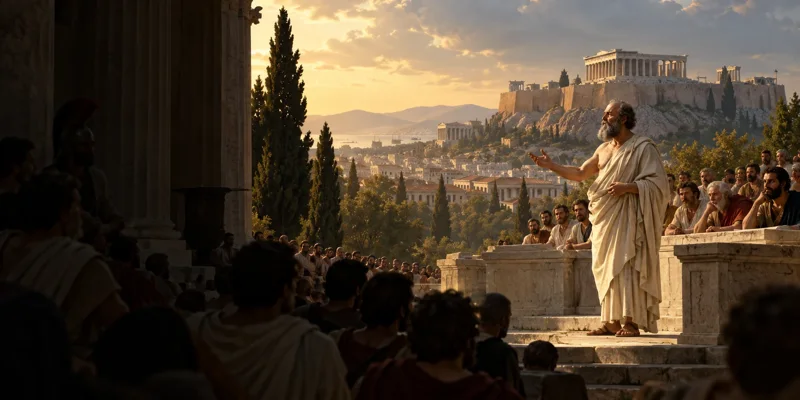
A school of philosophy founded in Athens around 300 BC by Zeno of Citium, who taught in the Stoa Poikile, the “painted porch” on the edge of the market square that gave the movement its name. The Stoics wrote about logic and physics as well as ethics, but what survives most vividly is their practical advice: that we cannot control what happens to us, only how we judge it and what we do next, and that a good life is built on that difference.
- 399 BC
Socrates is tried and executed in Athens; the Stoics later treat him as a model
- c. 300 BC
Zeno of Citium begins teaching at the Stoa Poikile in Athens
- c. AD 50
Epictetus is born at Hierapolis in Phrygia, into slavery
- c. AD 93
Domitian banishes philosophers from Rome; Epictetus opens a school at Nicopolis in Greece
- AD 161–180
Marcus Aurelius reigns as emperor, writing the Meditations in Greek
- c. AD 523
Boethius writes The Consolation of Philosophy in prison

Which Stoicism books should you read first?
- $9.99
The Enchiridion
Start here. Epictetus wrote nothing himself; his pupil Arrian condensed his teaching into this “handbook”, a few dozen short chapters you can read in an hour and return to for years.
- $13.99
Meditations
Next, the emperor’s notebook. Written in Greek and never meant for publication, partly in army camps on the Danube frontier. Repetitive, honest, often moving: a powerful man arguing with himself about how to be good.
- $12.99
The Consolation of Philosophy
Then this. Boethius was not a Stoic but a Christian Platonist, yet in his dialogue with Lady Philosophy, written while he awaited execution, the early arguments about Fortune and what truly belongs to us are ones Epictetus would have recognised at once.
- $9.99
Apology
Finally, go back to the source. Plato’s account of Socrates’ defence at his trial is short and electric, and it is the example the Stoics returned to again and again.


Why start with Epictetus?
Because he gets straight to the point. The Enchiridion opens with the idea on which everything else rests, and it is plain enough to remember on a bad day.
There are things which are within our power, and there are things which are beyond our power. Within our power are opinion, aim, desire, aversion, and, in one word, whatever affairs are our own.
Epictetus, The Enchiridion, I, translated by Thomas Wentworth Higginson
A few chapters later comes his most famous sentence: “Men are disturbed not by things, but by the views which they take of things.” The rest of the handbook is a set of exercises for living with that idea: how to think about loss before it happens, how to behave at a dinner party, how to take an insult. It ends with Socrates at his trial, saying that his accusers “may kill me indeed; but hurt me they cannot”, which is why Plato’s Apology belongs on this list.

How to read Marcus Aurelius’s Meditations
Slowly, and not in one go. The Meditations are twelve books of notes Marcus wrote to himself, probably in the last decade of his life, much of it spent on military campaigns along the Danube. A note at the end of the first book places it “in the country of the Quadi, by the Granua”, a river in modern Slovakia. They are not arranged as an argument, and they repeat themselves, because he was reminding himself of the same few things over and over.
Read a few entries each morning, as he seems to have written them. Book II opens in exactly that spirit, with Marcus preparing himself for the day. In George Chrystal’s translation: “Say this to yourself in the morning: Today I shall have to do with meddlers, with the ungrateful, with the insolent, with the crafty, with the envious and the selfish.” He goes on to remind himself that every one of them is his brother. It is hard to think of a more useful paragraph to read before work.
Where next?
Seneca, the third of the great Roman Stoics, is the obvious next step once you have finished these, especially his letters. For the wider world of ancient thought, see Philosophy books for beginners and Ancient wisdom beyond Plato. If the Meditations hooked you, read Did you know Marcus Aurelius never meant Meditations to be read?, and for practical advice on difficult texts, How to read philosophy without a degree.
But begin with the handbook. The Enchiridion is short enough to finish tonight, and its first chapter puts the heart of Stoicism on a single page.
Questions readers ask
What are the best Stoicism books for beginners?
Start with Epictetus’s Enchiridion. It is very short and lays out the core Stoic idea, the difference between what is and is not in our power. Read Marcus Aurelius’s Meditations next.
Who are the main Stoic philosophers?
The school was founded by Zeno of Citium around 300 BC. The best-known Stoics today are three writers of the Roman Empire in the first and second centuries AD: Seneca, Epictetus and the emperor Marcus Aurelius.
Is Marcus Aurelius’s Meditations hard to read?
Not in a modern translation. The entries are short and personal, but the book has no plot or argument, so most readers find it best taken a few pages at a time.
Is Boethius a Stoic?
No. Boethius was a Christian Platonist, but his Consolation of Philosophy, written in prison around AD 523, draws on Stoic as well as Platonic ideas about fortune, and is often read alongside the Stoics.