Plato wrote finished, polished dialogues and his work has come down almost complete. Most ancient wisdom was not so lucky. Aristotle’s Ethics may be a set of lecture notes. The Analects and the Enchiridion were compiled by followers. Lucretius’s poem was very nearly lost, and Thucydides’s history stops in the middle of a sentence.
That makes them the natural next ancient philosophy books once you have finished a dialogue or two and want to go further. Each one shows a different way of thinking that Plato did not offer: Aristotle’s practical good sense, the moral sayings of Confucius, the cool materialism of Lucretius, the Stoic self-command of Epictetus and, in Thucydides, a ruthless study of power.
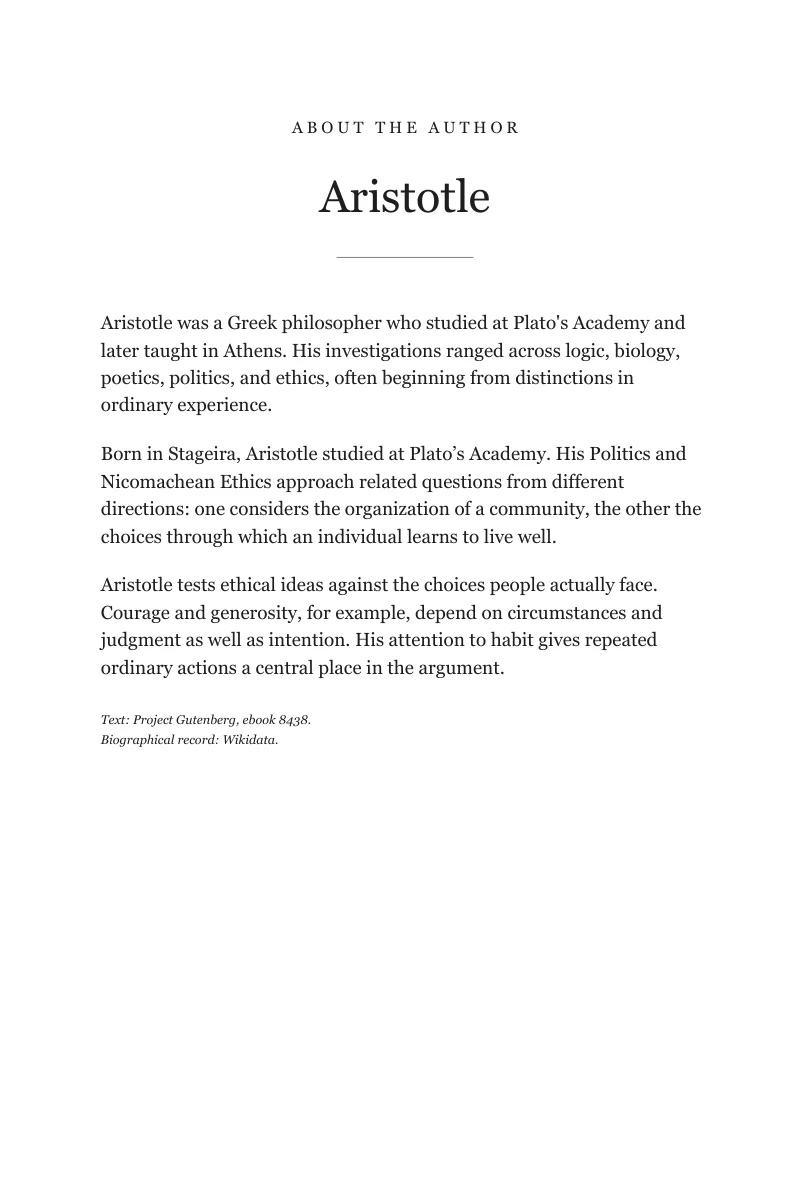
Aristotle: how to live well
Aristotle studied under Plato for years and then parted from him on fundamentals. The Nicomachean Ethics asks what a good human life is, and answers with eudaimonia, usually translated as happiness or flourishing. You get there, he argues, not by knowing the Good in the abstract but by practising good habits until they become character: courage, generosity, a sense of humour, each a mean between two extremes.
The title probably refers to his son Nicomachus, though his father had the same name, and the text reads in places like notes meant for teaching rather than a book meant for the public. Do not let that put you off. Books VIII and IX, on friendship, are among the warmest pages in ancient philosophy.

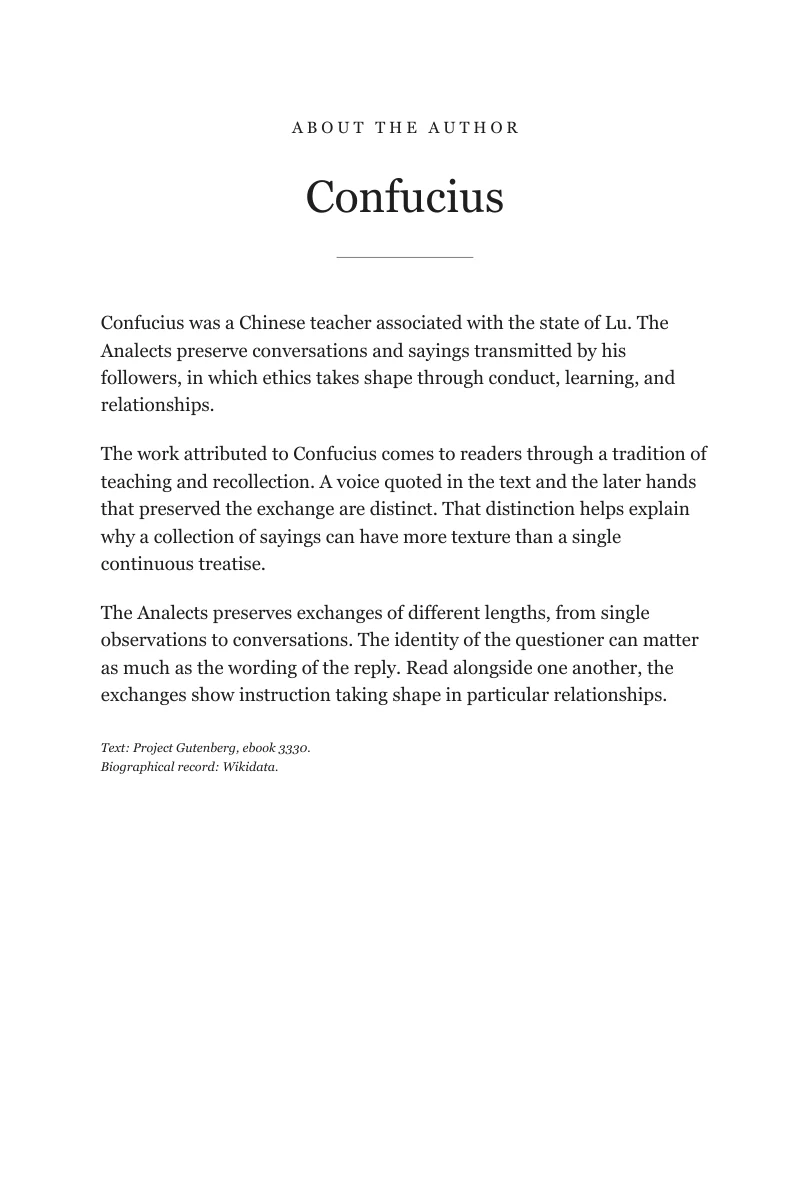
Confucius and Epictetus: sayings their students kept
Confucius died in 479 BC and wrote none of the Analects. Tradition says his disciples recorded their conversations with the Master and edited them after his death; modern scholars think the text grew over a couple of centuries. What survives is a collection of short exchanges, often only a line or two, on learning, ritual, family and government. James Legge’s translation opens with three questions.
The Master said, ‘Is it not pleasant to learn with a constant perseverance and application?’ ‘Is it not delightful to have friends coming from distant quarters?’
Confucius, *The Analects*, Book I (tr. James Legge)
Epictetus was born a slave at Hierapolis, in what is now Turkey, and taught Stoicism after he was freed. He wrote nothing either. His student Arrian took down his lectures as the Discourses, then picked out the most useful teachings for a pocket handbook, the Enchiridion. Its first sentence is the whole of Stoicism in miniature.
There are things which are within our power, and there are things which are beyond our power.
Epictetus, *The Enchiridion* (tr. T. W. Higginson)
The Nicomachean Ethics
Happiness, virtue, pleasure and friendship, argued step by step. Read Book I for the big question and Books VIII and IX for the friendship chapters.
The Analects of Confucius
Twenty short books of sayings and dialogues. Open anywhere; most entries take less than a minute to read and a good deal longer to think about.
The Enchiridion
Stoicism stripped to its essentials by the student who heard Epictetus teach. The shortest book here, and the one most often carried in a pocket.


Lucretius: the poem that nearly vanished
Lucretius is almost a blank: we know he dedicated his poem to a Roman named Memmius, and very little else. On the Nature of Things sets out the philosophy of Epicurus in six books of verse. Everything is made of atoms moving through empty space; the gods, if they exist, take no interest in us; death is nothing to fear, because there will be no one left to suffer it. The poem itself seems to have been left unfinished.
It survived the Middle Ages in a handful of manuscripts. In January 1417 the Italian book-hunter Poggio Bracciolini found a copy, probably in the monastery library at Fulda, and had it copied. From that copy the poem spread again through Renaissance Europe.
Is Thucydides philosophy?
Strictly, no. Thucydides was an Athenian general who wrote the history of the war between Athens and Sparta, and he would have called himself a historian. But he belongs on any shelf of ancient wisdom, because no one has looked harder at what fear, ambition and self-interest do to people and cities. He was exiled for twenty years after failing to save Amphipolis, which gave him, he says, the leisure to watch both sides.
He also caught the plague that struck Athens in 430 BC, survived it, and described its symptoms in clinical detail. In the Melian Dialogue, Athenian envoys explain to a small island why it must submit: “the strong do what they can and the weak suffer what they must.” The history ends abruptly in 411 BC, with six years of the war still to come.
This I can the better do, as I had the disease myself, and watched its operation in the case of others.
Thucydides, *History of the Peloponnesian War*, Book II (tr. Richard Crawley)
On the Nature of Things
Atoms, the soul, the senses and the birth of the world, in six books of verse. The ancient case for a universe without design, made with real passion.
The History of the Peloponnesian War
Plague, civil war, the Melian Dialogue and the disaster in Sicily. Thucydides meant it as “a possession for all time”, and it has been one.


Which ancient philosophy books should you start with?
Begin with the Enchiridion if you want something you can finish tonight, or the Analects if you prefer to dip. Aristotle repays a slower read, a book at a time. Lucretius suits anyone who likes ideas set to poetry, and Thucydides is for readers who would rather watch philosophy happen in politics than hear it argued.
If you have not yet read Plato himself, Which Plato dialogue should you read first? is the place to begin. Our philosophy books for beginners list ranges further, the Stoicism reading list follows Epictetus to Seneca and Marcus Aurelius, and How to read philosophy without a degree has practical advice for difficult texts.
Whichever you choose, read it the way its first audience did, a little at a time. The Enchiridion began as notes from a classroom, and it still works best with a pencil in hand.
Questions readers ask
What ancient philosophy books should I read after Plato?
Aristotle’s Nicomachean Ethics is the natural next step, since Aristotle was Plato’s student and argues with him throughout. The Enchiridion of Epictetus and the Analects of Confucius are shorter alternatives.
Did Confucius write the Analects?
No. The Analects collect sayings attributed to Confucius and his followers. Tradition says his disciples compiled them after his death in 479 BC, and modern scholars believe the text took shape over a couple of centuries.
Why is it called the Nicomachean Ethics?
The title is usually taken to refer to Aristotle’s son Nicomachus. Aristotle’s father was also called Nicomachus, so the dedication is not certain.
How did Lucretius survive?
On the Nature of Things survived in a few medieval manuscripts and was rediscovered in January 1417 by Poggio Bracciolini, probably at the monastery of Fulda in Germany.