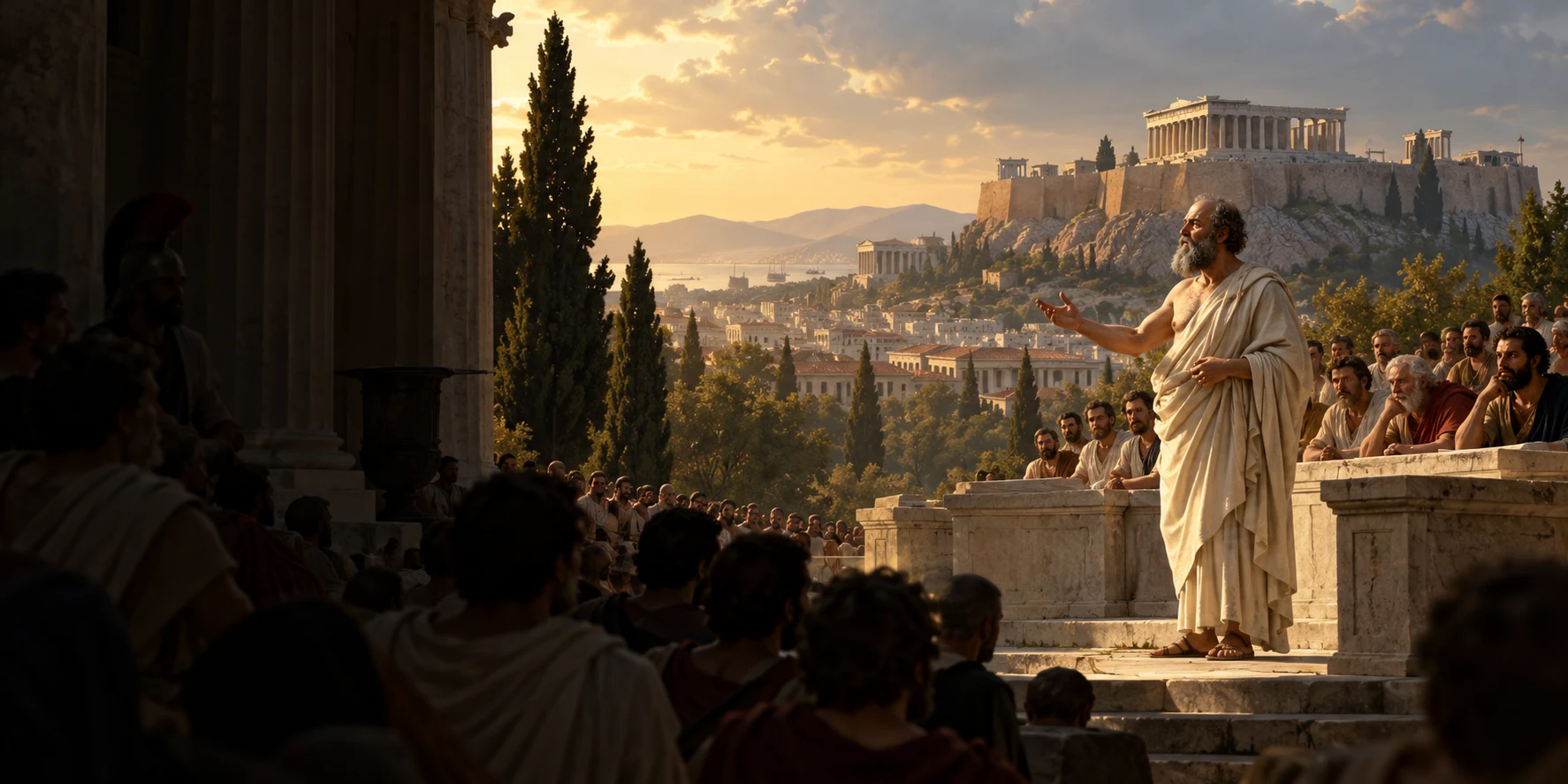
The Plato dialogue to read first is the Apology. It is Socrates’ speech in his own defence at his trial in Athens in 399 BC, charged with impiety and corrupting the young, and our edition runs to just 46 pages. You need no background, no glossary and no idea what a Form is. You only need to know that the man speaking is seventy years old and that the jury in front of him can sentence him to death.
Everything else in Plato makes more sense once you have heard that voice: ironic, stubborn, courteous and impossible to shut up. After the Apology, the best order is the one below, which moves from Socrates’ last days to his ideas about love, and only then to the long argument of the Republic.
Why start with the Apology?
Because it is barely a dialogue at all. Most of Plato’s works are conversations, with Socrates asking questions until someone’s confident definition falls apart. The Apology is mostly a speech in three parts: the defence, a short reply after the guilty verdict, and a last address after the sentence. It reads like a courtroom drama, which is what it is.
It also ends with one of the great exit lines in literature. Sentenced to death, Socrates tells the jurors he is not afraid, and takes his leave:
The hour of departure has arrived, and we go our ways—I to die, and you to live. Which is better God only knows.
Plato, Apology, tr. Benjamin Jowett
Notice who is in the audience. Socrates names his friends in the court, and one of them is Plato, there to offer money towards a fine. It is one of only a handful of times the author mentions himself anywhere in his work.
The best order for reading Plato
- $9.99
Apology
Socrates on trial. A defiant, often funny speech that sets out what philosophy cost him. One evening’s reading.
- $11.99
Phaedo
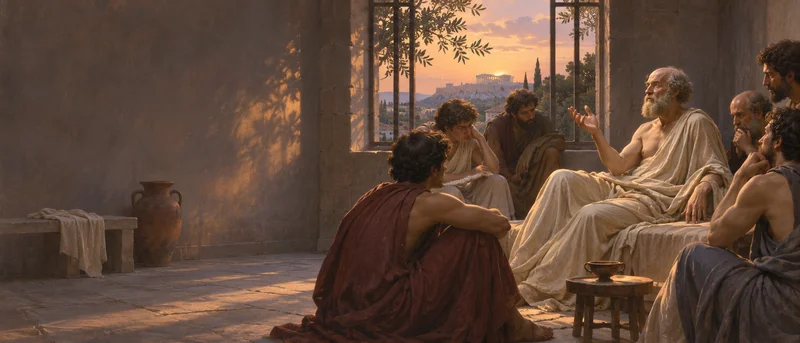
Socrates’ last day in prison, spent arguing with friends about whether the soul survives death, followed by one of the quietest death scenes in literature.
- $10.99
Symposium
A drinking party where each guest gives a speech in praise of love. Aristophanes’ tale of split humans searching for their other halves, and a drunken Alcibiades at the end.
- $11.99
Phaedrus
Two friends on a riverbank under a plane tree, talking about love and about how to speak and write well. Home of the charioteer driving two winged horses.
- $23.99
The Republic
Ten books on justice, the ideal city and the philosopher-king, with the allegory of the cave in Book VII. Save it for when you know the voice.


This order is not the order Plato wrote them in; scholars still argue about that. It is the order in which they are easiest to enjoy. If you want to fill out the story of the trial, two short dialogues sit either side of the Apology: Euthyphro, set in the weeks before the trial, and Crito, in which a wealthy friend offers to pay for Socrates’ escape from prison and Socrates refuses to go.
Phaedo: read it for the ending
The Phaedo is harder going than the Apology. Much of it is a run of arguments for the immortality of the soul, and Socrates’ friends raise serious objections to more than one of them. But it is framed as an eyewitness account of his death, told by Phaedo, who was there, and the frame is unforgettable. Plato, the narrator notes, was ill and absent. The last lines have been quoted ever since:
Such was the end, Echecrates, of our friend; concerning whom I may truly say, that of all the men of his time whom I have known, he was the wisest and justest and best.
Plato, Phaedo, tr. Benjamin Jowett
Symposium or Phaedrus next?
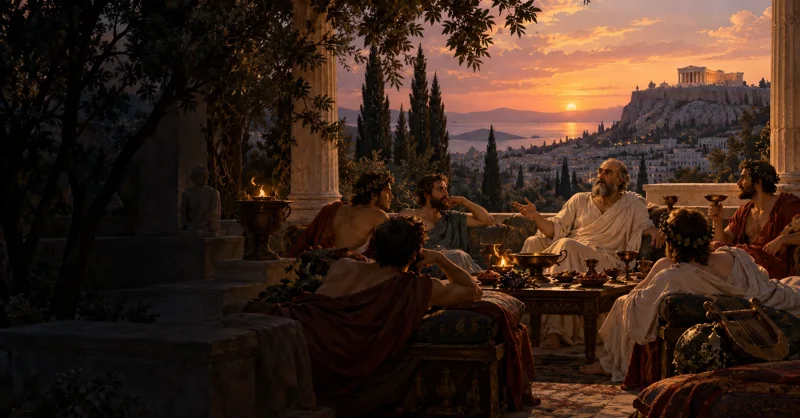
The Symposium first. It is the most purely enjoyable thing Plato wrote: a dinner party in the house of the tragic poet Agathon, a round of speeches on love, Aristophanes forced to swap turns because he has the hiccups, and Socrates reporting what a wise woman named Diotima taught him. Then Alcibiades bursts in drunk and gives a portrait of Socrates by a man who was in love with him.
The Phaedrus is a quieter companion piece, a walk outside the city walls and a conversation about love that turns into a conversation about rhetoric, writing and the soul. It is where you will find the image of the soul as a charioteer with one noble horse and one unruly one.
When should you read the Republic?
Last, and slowly. It is Plato’s best-known work and by far the longest here, and it repays a reader who already knows how Socrates argues. Read a book of it at a sitting, and expect to disagree; the ideal city it builds censors poets and does not allow its ruling class to know their own children. The allegory of the cave in Book VII is the part everyone knows, and it is better in context.
For a wider view of where to begin with philosophy, see Philosophy books for beginners, and for a method that works with any difficult text, How to read philosophy without a degree. After Plato, Ancient wisdom beyond Plato carries the story on to Aristotle and beyond, and the Plato page lists every dialogue we stock.
But begin in the courtroom. Open the Apology, and listen to an old man explain to a jury of perhaps five hundred Athenians why he will not stop asking questions.
Questions readers ask
Which Plato dialogue should I read first?
The Apology. It is short, needs no background, and introduces Socrates at his trial in 399 BC. After it, read the Phaedo, the Symposium, the Phaedrus and finally the Republic.
Is the Republic a good place to start with Plato?
It is better saved for later. It is long and builds an elaborate argument; the shorter dialogues about Socrates’ trial and death show you his method first, and make the Republic easier to follow.
Which Plato dialogues are about the death of Socrates?
Four are usually read together: Euthyphro, set just before the trial; the Apology, the trial itself; Crito, in prison; and Phaedo, his last day and death.