
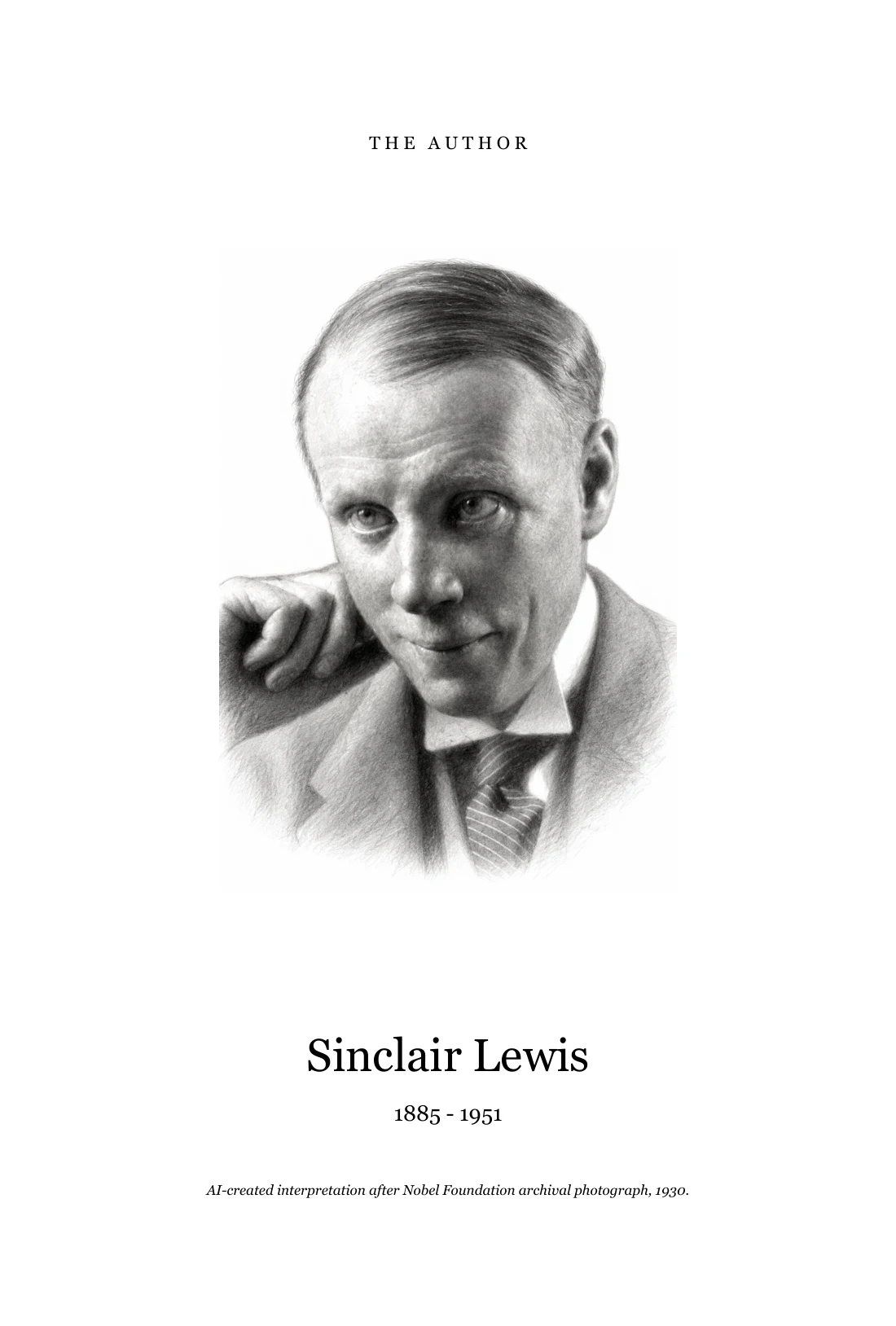
The high-school teams of Sauk Centre, Minnesota, have been called the Main Streeters since the mid-1920s. It is a handsome tribute from a town that did not, at first, enjoy being made famous. Sauk Centre was the model for Gopher Prairie, the dull, gossipy, self-satisfied prairie town of Main Street, and the novel that skewered it made its native son famous and put Sinclair Lewis’s books on shelves across America.
Ten years later, in 1930, Sinclair Lewis became the first American to receive the Nobel Prize in Literature. The Swedish Academy praised his vigorous, graphic powers of description and his ability to create, with wit and humour, new types of character. Among those new types were Carol Kennicott, the idealist trapped in Gopher Prairie, and George F. Babbitt, the businessman whose name became a dictionary word.
Main Street: the book that made his name
Main Street appeared in October 1920 and became a phenomenon. It reportedly sold 180,000 copies in its first six months, and Publishers Weekly counted it the best-selling novel in America for 1921. Its heroine, Carol Kennicott, is a bright young librarian who marries a country doctor and sets out to bring beauty and culture to his town. The town, politely and relentlessly, refuses. Lewis opens with a short foreword that tells you exactly what he is up to:
This is America—a town of a few thousand, in a region of wheat and corn and dairies and little groves.
Main Street (1920)
Not everyone was amused. The public library in Alexandria, Minnesota, banned the book. And the novel was at the centre of a famous prize dispute: the Pulitzer jury chose Main Street for the 1921 fiction award, but the board overruled them and gave it to Edith Wharton’s The Age of Innocence. We tell that side of the story in Did you know Edith Wharton was the first woman to win the Pulitzer Prize for fiction?

Babbitt: the man who became a word
Babbitt (1922) moves from the small town to the booming small city. George F. Babbitt sells real estate in Zenith, in the invented Midwestern state of Winnemac. He belongs to the right clubs, says the right things about business and progress, owns the right gadgets and has a growing suspicion that his life is empty. Lewis listens to him with deadly accuracy, and the result is both hilarious and oddly moving.
The book was so recognisable that “babbitt” entered the language. Merriam-Webster still defines it as a person, especially a business or professional man, who conforms unthinkingly to prevailing middle-class standards. When the Swedish Academy presented Lewis with the Nobel Prize, its presentation speech dwelt on Babbitt more than on any other character.
- 1920
Main Street makes Lewis famous.
- 1922
Babbitt, dedicated to Edith Wharton.
- 1925
Arrowsmith, about an idealistic doctor and medical research. Lewis later turns down the Pulitzer Prize awarded to it.
- 1927
Elmer Gantry, his satire of a hypocritical evangelist, is denounced from pulpits and banned in some American cities.
- 1929
Dodsworth, about a retired car maker whose European tour unravels his marriage.
- 1930
Lewis becomes the first American to win the Nobel Prize in Literature.
- 1935
It Can’t Happen Here imagines a fascist elected President of the United States.
Sinclair Lewis books to read first: Main Street or Babbitt?
- $21.99
Main Street
1920. A young wife with big ideas against a small town with none. The great American novel of small-town conformity, and the book that made Lewis a household name.
- $18.99
Babbitt
1922. A prosperous Midwestern realtor, a pillar of every club in town, begins to suspect there must be more to life. Lewis’s funniest novel and his most famous character.


Start with Babbitt if you want comedy, and with Main Street if you want a heroine to root for. Babbitt is tighter and funnier; Main Street is longer, angrier and set in a town modelled on the one Lewis grew up in. Both are full of the slogans, sales talk and civic boosterism Lewis heard all around him, which is why they still sound uncannily current. Once you have read both, the later novels widen the target: medicine and science in Arrowsmith, religion in Elmer Gantry, and the rich American abroad in Dodsworth.
In his Nobel lecture of December 1930, titled “The American Fear of Literature”, Lewis attacked the cautious literary establishment at home and praised contemporaries such as Theodore Dreiser, Willa Cather and the young Ernest Hemingway. For one of those writers see Hemingway’s first great novels, and for the small-town tradition Lewis shared with another Midwesterner, Sherwood Anderson and the small-town story. The first non-European laureate had been honoured seventeen years earlier; see Rabindranath Tagore.
Then step off the train at Gopher Prairie with Carol Kennicott. Main Street is a long book, but its first walk down the town’s one real street, taking in every shop and every stare, is as sharp a piece of comic observation as anything in American fiction.
Questions readers ask
Who was the first American to win the Nobel Prize in Literature?
Sinclair Lewis, in 1930. The Swedish Academy praised his descriptive power and his ability to create new types of character with wit and humour.
What are Sinclair Lewis’s most famous books?
The best-known Sinclair Lewis books are Main Street (1920), Babbitt (1922), Arrowsmith (1925), Elmer Gantry (1927), Dodsworth (1929) and It Can’t Happen Here (1935).
What does “a Babbitt” mean?
After Lewis’s 1922 novel, a babbitt came to mean a businessman or professional who conforms unthinkingly to middle-class values and opinions.
Is Gopher Prairie a real place?
No, but it is closely based on Sauk Centre, Minnesota, where Sinclair Lewis was born and grew up.
 Free Air210 pages · $14.99
 Arrowsmith598 pages · $26.99
 Elmer Gantry478 pages · $21.99
 Dodsworth344 pages · $18.99