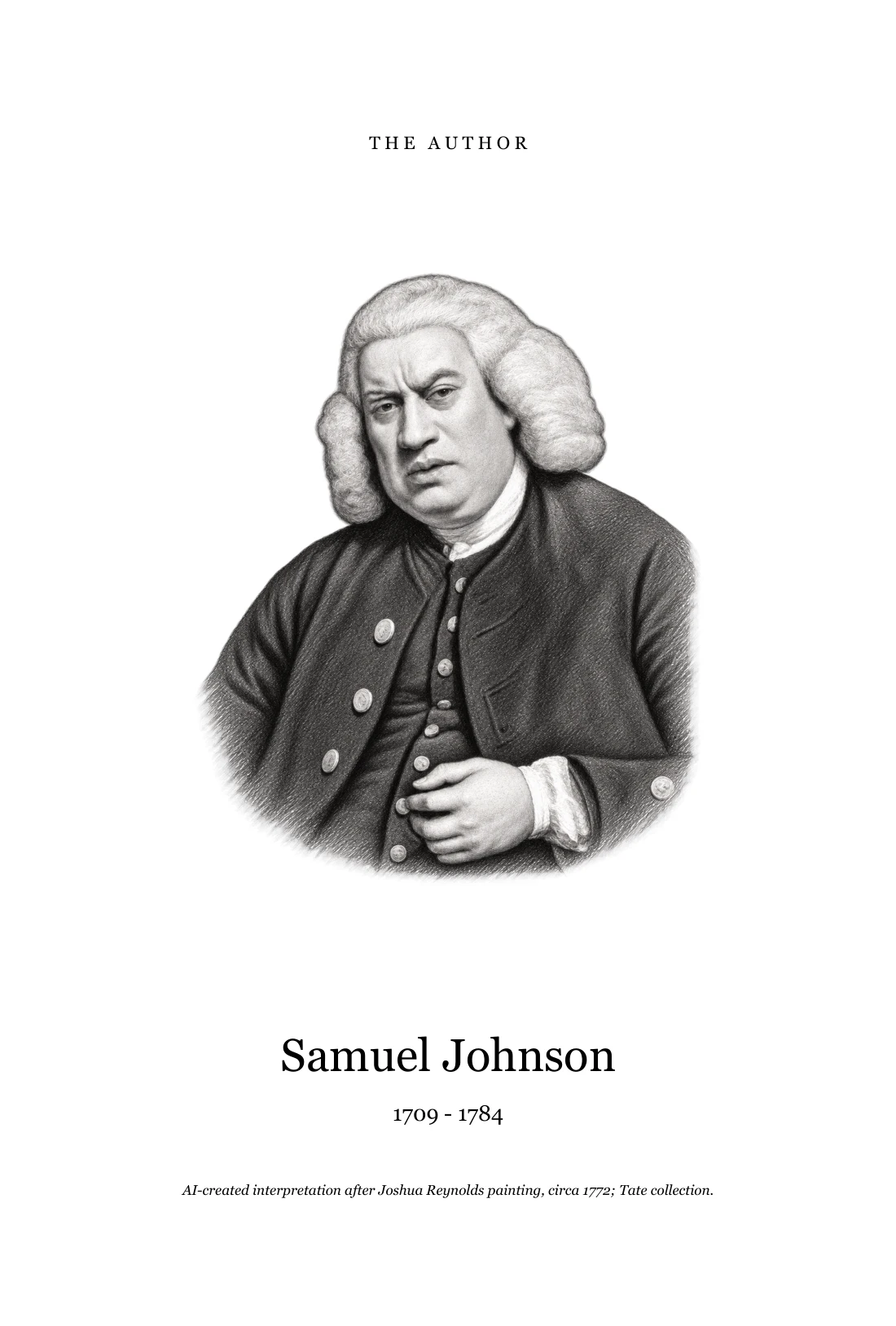
On 2 June 1781, in a carriage rattling north out of London, James Boswell took a book from his pocket, and Samuel Johnson seized it. It was his own Rasselas, Prince of Abyssinia, published twenty-two years earlier. Johnson read it intently for much of the journey, and told his companions that he had not looked at it since it first came out.
That detail belongs to one of the most famous stories in English letters, which Boswell set down in his Life of Johnson (1791). According to the printer William Strahan, Samuel Johnson wrote Rasselas to pay for his mother’s funeral and settle her small debts. And Johnson himself told the painter Sir Joshua Reynolds how he had done it.
He told Sir Joshua Reynolds that he composed it in the evenings of one week, sent it to the press in portions as it was written, and had never since read it over.
James Boswell, *The Life of Samuel Johnson* (1791)
A week’s evenings for one of the most admired books of its century is a good story, and Boswell had it from people who were there. But it is still Boswell’s account, and modern scholars have taken it apart.
Did Johnson really write Rasselas in a week?
Possibly. Nobody has disproved the week, and Rasselas is a short book of brief chapters that a writer as fast as Johnson could have produced at speed. What the surviving letters undermine is the order of events. Boswell says Johnson wrote it “soon after” his mother’s death. In fact he seems to have been writing it while she was dying.
- 13 Jan 1759
Johnson writes to his mother in Lichfield, sending twelve guineas, six of them borrowed
- 16 Jan
He writes again: “I know not how to bear the thought of losing you”
- c. 20–21 Jan
Sarah Johnson dies, aged about ninety, before he can visit
- 23 Jan
He tells his stepdaughter Lucy Porter of twenty pounds he “thought to have brought to my mother”
- Spring 1759
Rasselas is published; Strahan and two partners pay £100 for it
Johnson had not seen his mother for years. In the middle of January 1759 he learned she was gravely ill, and in a series of letters he poured out love, guilt and what money he could raise. At the same moment he was working on a book, its working title The Choice of Life. Scholars now think he meant it to pay for the costs he could see coming rather than ones he had already incurred, and that it was finished around the time of her death rather than after it. That makes the story less tidy and much more painful: a man writing a philosophical tale about the search for happiness against a deadline set by his mother’s dying.

What is Rasselas about?
Rasselas is the fourth son of the Emperor of Abyssinia, kept with the other royal children in the Happy Valley, a paradise enclosed by mountains where every pleasure is supplied and nobody is allowed out. He is bored and miserable. With his sister Nekayah, her maid Pekuah and the poet Imlac, he escapes through a tunnel and travels to Cairo to see the world and choose a way of life that will make him happy. They try them all: hermits and philosophers, the rich and the humble, marriage and solitude. None of them works out quite as advertised.
Johnson had translated a Portuguese Jesuit’s account of Abyssinia, Father Lobo’s Voyage, as a young man, which may explain the setting. The opening sentence tells you exactly what kind of book it is.
Ye who listen with credulity to the whispers of fancy, and pursue with eagerness the phantoms of hope; who expect that age will perform the promises of youth, and that the deficiencies of the present day will be supplied by the morrow, attend to the history of Rasselas, Prince of Abyssinia.
Samuel Johnson, *Rasselas* (1759)
It came out within a few months of Voltaire’s Candide, another short tale of a young man travelling in search of an answer to life’s misery. Johnson said that if the two had not been published so close together, it would have been impossible to deny that the later one was copied from the earlier. The spirit is very different, though: Voltaire laughs, and Johnson consoles. Our post on why Candide was banned tells the other half of 1759.
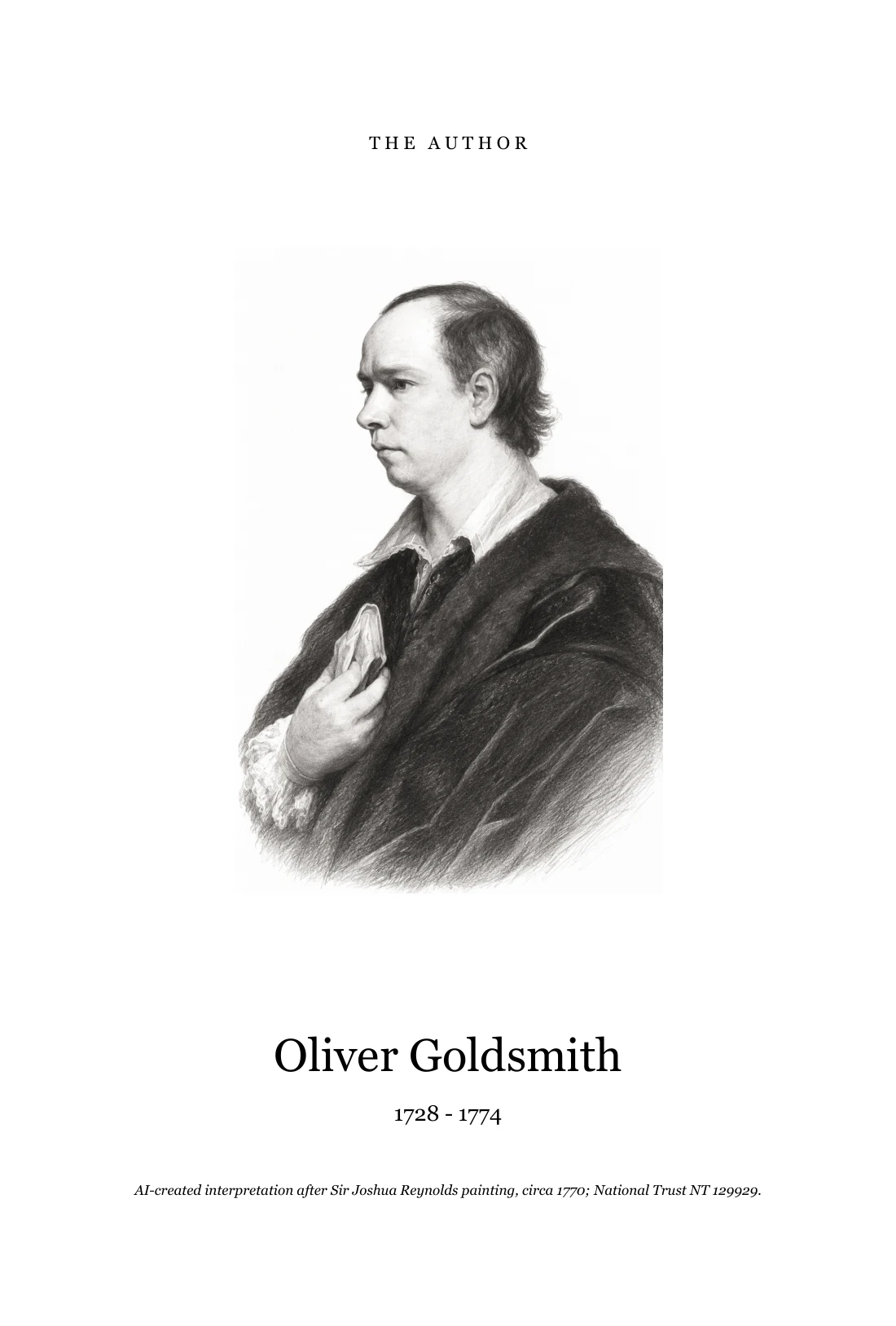
Johnson and The Vicar of Wakefield
Boswell records another Johnson story about a book written for money, this time in Johnson’s own words. One morning a desperate message arrived from his friend Oliver Goldsmith. Johnson sent a guinea and followed, to find that Goldsmith’s landlady had had him arrested for his rent, and that the guinea had already been changed for a bottle of Madeira. Johnson put the cork back in the bottle and began to talk about how his friend might be got out of trouble, at which Goldsmith produced a novel he had ready for the press. Johnson took it to a bookseller and sold it for sixty pounds, and Goldsmith paid his rent. The novel was The Vicar of Wakefield, which was not published until 1766.
Rasselas, Prince of Abyssinia
1759. A prince escapes a paradise to find out how to be happy. Short, grave and unexpectedly funny, with some of the most quotable sentences Johnson wrote.
The Vicar of Wakefield
1766. Dr Primrose, a kindly country vicar, loses his fortune and endures one disaster after another with his family. The manuscript Johnson sold to rescue Goldsmith from his landlady.


For more short books with big ideas, see classic novels about money and ambition or our guide to philosophy books for beginners. And for another famous eighteenth-century disappointment, read about Hume’s Treatise, which “fell dead-born from the press”.
Read Rasselas in a few sittings, the way its author wrote it. Then, like Johnson in Boswell’s carriage, you may find yourself unable to put it down.
Questions readers ask
Did Samuel Johnson write Rasselas in a week?
So he told Sir Joshua Reynolds, according to Boswell. The claim has never been disproved, but scholars think Boswell got the timing wrong: Johnson was writing the book while his mother was dying in January 1759, not after her death.
Why did Samuel Johnson write Rasselas?
Boswell says it was to pay for his mother’s funeral and her small debts. Johnson was short of money and needed to meet those costs, though he seems to have begun the book before she died.
What is Rasselas about?
It follows an Abyssinian prince who escapes from the Happy Valley, a royal paradise, and travels to Egypt with his sister and the poet Imlac to discover what way of life brings happiness.
Is Rasselas like Candide?
Both were published in 1759 and follow young men travelling in search of happiness, so they are often compared. Johnson’s book is a grave, consoling Christian fable, where Voltaire’s is a satire.