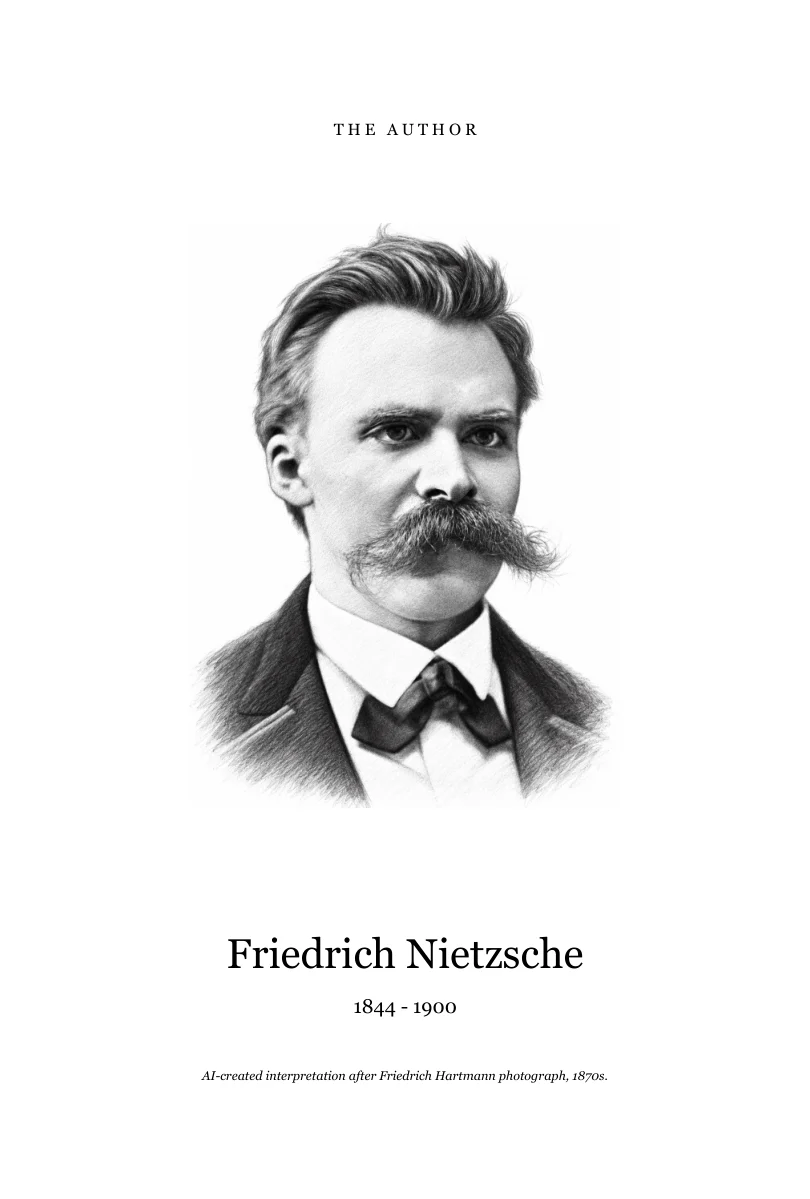
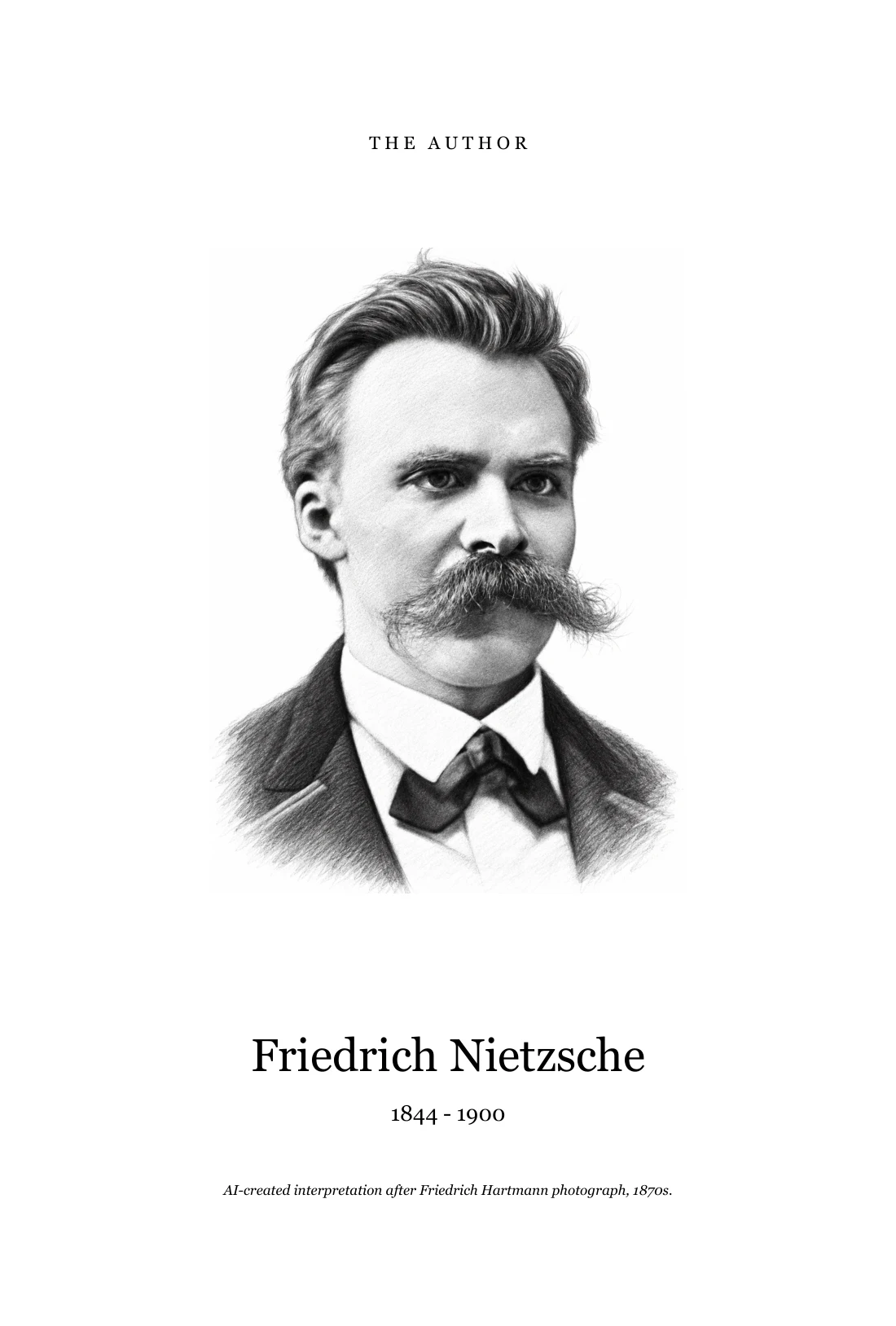
Should you start Nietzsche with Thus Spake Zarathustra? It is the book everyone has heard of, and the one he rated highest himself, and it is almost certainly the wrong place to begin. Order matters with Nietzsche more than with most philosophers, partly because he kept changing his mind about his own work.
Fourteen years after his first book came out, he reissued it with a new preface attacking it. The Birth of Tragedy had appeared in 1872, when Friedrich Nietzsche was a young professor of classical philology at Basel and a devoted friend of Richard Wagner. By 1886 he had broken with Wagner, left his chair and become a different writer, and the “Attempt at Self-Criticism” he added to the new edition does not spare his younger self:
I say again, to-day it is an impossible book to me,—I call it badly written, heavy, painful, image-angling and image-entangling…
Friedrich Nietzsche, “An Attempt at Self-Criticism” (1886), tr. William A. Haussmann
That is the first thing to know about how to read Nietzsche: there is no single, settled Nietzsche to read. He changed his style and his targets as well as his mind, and his books argue with one another.
Where to start with Nietzsche
Start with Beyond Good and Evil (1886) or On the Genealogy of Morals (1887). They are the two books in which his mature ideas are set out most directly, and they are short enough to finish. Save Thus Spake Zarathustra for later, and treat The Birth of Tragedy as a book for when you are curious about where he came from.
- $13.99
Beyond Good and Evil
1886. Nine parts of numbered sections, from the prejudices of philosophers to what is noble. The best map of his late thinking, and the funniest of his books.
- $12.99
The Genealogy of Morals
1887. Three linked essays on where our ideas of good and evil, guilt and asceticism came from. His most sustained argument, and the easiest to follow from start to finish.
- $19.99
Thus Spake Zarathustra
1883–85. Four parts of prophecy and parable, in which Zarathustra comes down from his mountain to preach the overman. Read it third, as poetry.
- $12.99
The Birth of Tragedy
1872. Greek tragedy as a meeting of Apollo and Dionysus, and a hymn to Wagner. Read it last, beside his later verdict on it.


Some readers prefer the Genealogy first, because it is the closest thing he wrote to an ordinary essay. Either way, read the two together before anything else.

Why not start with Zarathustra?
Because it is the hardest book to read without the others. Thus Spake Zarathustra is philosophical fiction: a prophet’s speeches, written in a mock-scriptural style, most of them ending with the refrain “Thus spake Zarathustra.” It introduces the ideas that made Nietzsche famous, the overman (the “Superman” of older translations), the death of God and eternal recurrence, but it introduces them as images rather than arguments.
Nietzsche himself later called it the greatest gift ever given to mankind, and he seems to have expected readers to struggle. When he finished the fourth part in 1885, he had just forty copies printed at his own expense and gave them to close friends. Come to it after Beyond Good and Evil, which covers much of the same ground in prose, and the parables start to open up.
Nietzsche’s own advice: read slowly
The best guide to reading Nietzsche is in the preface to the Genealogy, dated July 1887 at Sils-Maria. He admits the book may seem obscure to anyone who has not read his earlier work, and then says what his aphorisms need from a reader:
An aphorism properly coined and cast into its final mould is far from being “deciphered” as soon as it has been read; on the contrary, it is then that it first requires to be expounded…
Friedrich Nietzsche, The Genealogy of Morals (1887), tr. Horace B. Samuel
The art of reading he wants, he goes on, is one for which it is necessary “to be a cow”: rumination. In practice that means a few sections at a time, with time to chew. The third essay of the Genealogy even shows how it is done; it opens with a short aphorism and then spends the whole essay commenting on it.
- Read a handful of numbered sections, then stop and say in your own words what each one claims.
- Expect irony. Nietzsche often states a view in order to mock it, and the joke is part of the argument.
- Follow the questions rather than hunting for a system. He asks where values come from and whose interests they serve, and his answers shift from book to book.
- Keep a pencil for the lines that seem outrageous, then reread them in context. Many of his most quoted sentences mean something different on the page.

A short history of how he was read
Nietzsche collapsed in Turin on 3 January 1889 and never wrote again. He lived another eleven years in the care of his mother and then his sister Elisabeth, who founded a Nietzsche Archive in 1894 and controlled his papers. She had married a prominent antisemite, and the Nazis later claimed her brother for their own. Scholars still argue about how far she edited his writings to suit her politics, but readers should know that Nietzsche’s reputation passed through some ugly hands before it reached ours.
Once you have read the four books here, the others fall into place: Human, All Too Human (1878) and The Gay Science (1882) from the middle years, and the furious little books of 1888, Twilight of the Idols and The Antichrist. And one of his most famous lines turns up in Beyond Good and Evil as a single numbered section, which shows how much can hang on three lines:
He who fights with monsters should be careful lest he thereby become a monster. And if thou gaze long into an abyss, the abyss will also gaze into thee.
Friedrich Nietzsche, Beyond Good and Evil (1886), §146, tr. Helen Zimmern
For a gentler way into philosophy, start with Philosophy books for beginners, and for practical help with dense arguments, How to read philosophy without a degree. Nietzsche began as a classicist, so Which Plato dialogue should you read first? makes a good companion. His books are gathered on the Friedrich Nietzsche page, with The Birth of Tragedy under Friedrich Wilhelm Nietzsche.
Turn to the preface of Beyond Good and Evil, whose first line asks you to suppose that truth is a woman, and see how long it takes him to make you laugh.
Questions readers ask
Which Nietzsche book should I read first?
Beyond Good and Evil or On the Genealogy of Morals. Both set out his mature ideas directly and are short enough to finish; Thus Spake Zarathustra makes more sense after them.
Is Thus Spake Zarathustra a good introduction to Nietzsche?
It is his most famous book but a difficult first one. It presents his ideas as parables and prophecies rather than arguments, so most readers find it easier after Beyond Good and Evil.
Why is Nietzsche hard to read?
He writes in short numbered sections, uses irony constantly and changes his views between books. He asked to be read slowly, and taking a few sections at a time helps a great deal.