Edwin Reardon, the struggling novelist at the heart of New Grub Street, sells his books to a publisher for a single lump sum. His friend Jasper Milvain thinks that is the most old-fashioned thing a writer can do. A modern man of letters, Milvain explains, squeezes every possible payment out of every possible market.
Literature nowadays is a trade. Putting aside men of genius, who may succeed by mere cosmic force, your successful man of letters is your skilful tradesman.
Jasper Milvain in George Gissing, New Grub Street (1891)
George Gissing wrote that, and then sold New Grub Street outright to Smith, Elder for a single lump sum (accounts differ on whether it was £150 or £250). It became the first of his books to need a second printing, and the extra profit went to the publisher. Few writers have been so exactly like their own characters.
Of all the George Gissing books, New Grub Street is the one to start with: a novel about the business of writing that is also a story of marriage, ambition and failure. Follow it with The Odd Women, his novel about the women Victorian society had no use for.
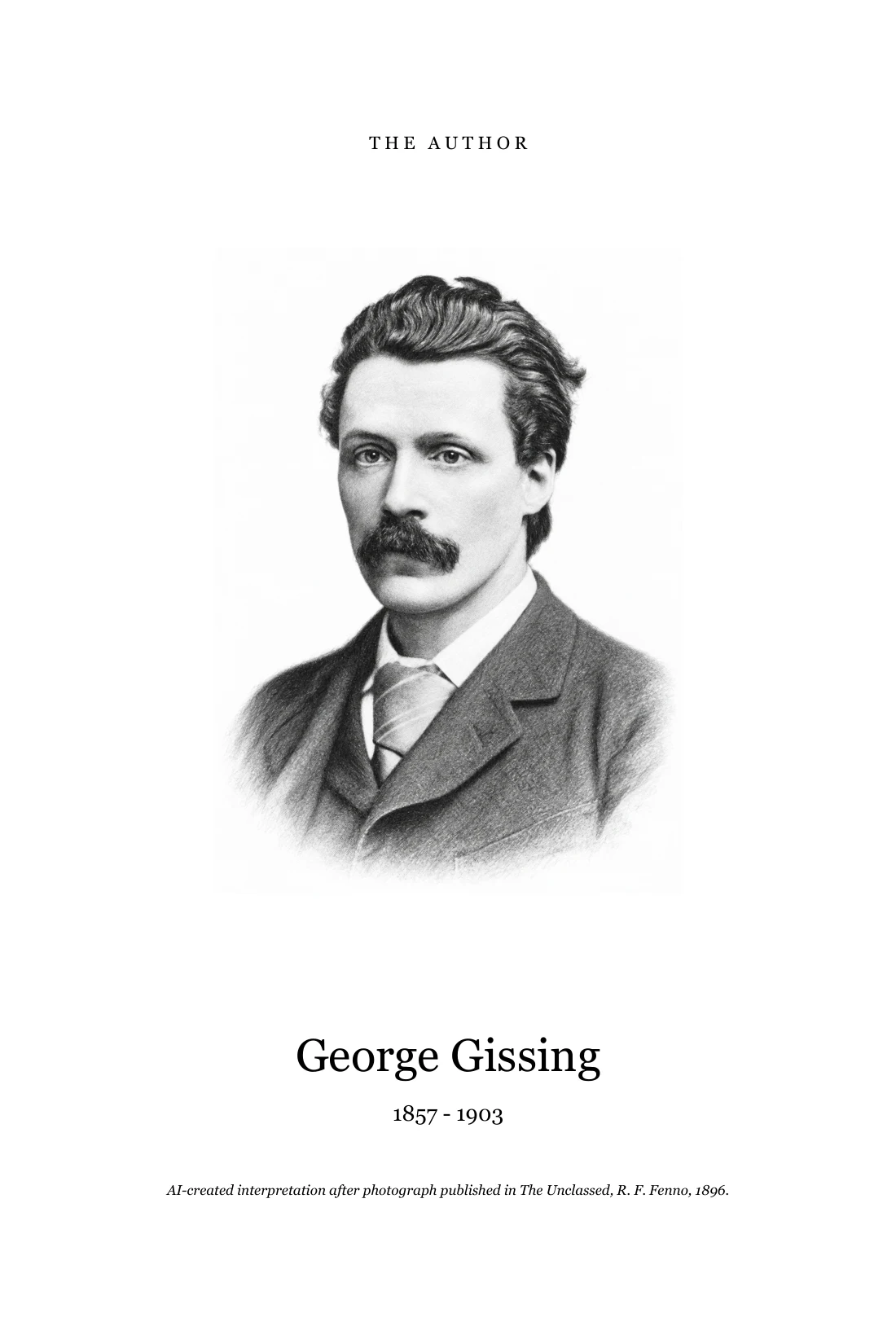
Who was George Gissing?
He was born in Wakefield in 1857, the son of a chemist, and was so gifted a schoolboy that he won a scholarship to Owens College in Manchester in his mid-teens. There he collected prizes and then threw it all away. He fell in love with a young woman named Nell Harrison, began stealing from his fellow students to give her money, and in 1876 was caught, expelled and sentenced to a month’s hard labour.
Friends paid his way to America, where he taught in Massachusetts and wrote stories for Chicago newspapers, barely scraping by. Back in London he married Nell, published his first novel, Workers in the Dawn, with money from an inheritance, and settled into the life he would later put into New Grub Street: lodgings, tutoring, the British Museum Reading Room and an endless race to finish the next book.
- 1857
Born in Wakefield, Yorkshire, on 22 November.
- 1876
Expelled from Owens College for theft and jailed for a month.
- 1880
Publishes his first novel, Workers in the Dawn, at his own expense.
- 1889
The Nether World, his novel of the London slums.
- 1891
New Grub Street appears in three volumes; he marries his second wife, Edith Underwood.
- 1893
The Odd Women.
- 1903
The Private Papers of Henry Ryecroft brings late acclaim; he dies in south-west France on 28 December.

What is New Grub Street about?
The real Grub Street was an eighteenth-century London byword for hack writing, and by Gissing’s day it had vanished from the map. His new one is the literary London of the 1880s: reviewers, editors, circulating libraries and the dreaded three-volume novel, which publishers wanted and Reardon can no longer manage to write.
Around Reardon and Milvain, Gissing builds a cast of people who all need money and most of whom need to marry for it. Reardon’s wife, Amy, cannot bear his failure. Marian Yule spends her days doing research in the Reading Room for her bitter father. Nobody is a villain, and that is what makes the book so uncomfortable: every character’s choices make sense. Gissing knew this world from inside, and some of its humiliations, the unsold manuscripts and the rooms that are too cold to write in, read like memory.
- $23.99
New Grub Street
1891. Two writers, one who will not compromise and one who will compromise on anything. The great novel about the literary trade, and about the price of integrity.
- $19.99
The Odd Women
1893. Three unmarried sisters, a radical who trains women for office work, and a marriage that turns into a cage. Gissing at his most modern.


The Odd Women: Gissing’s other masterpiece
The title comes from the arithmetic of Victorian England, where women outnumbered men and many would never marry. They were the “odd” ones, left over when everyone else had paired off. Gissing follows the Madden sisters, brought up as ladies and left with almost nothing, and Rhoda Nunn, who would rather train such women as typists than see them wait for a husband.
But do you know that there are half a million more women than men in this happy country of ours?
Rhoda Nunn in George Gissing, The Odd Women (1893)
It is a novel of ideas that never feels like one, thanks to a love affair between two clever, stubborn people who cannot agree on what marriage should be. Readers who come to it from Feminist classics everyone should read are often surprised by how much room it gives its women to argue.

Are George Gissing’s books depressing?
They are honest, which is not quite the same. Gissing writes about poverty, bad marriages and thwarted talent without consolation, but he is sharp and often darkly funny, and his money-minded characters are drawn with a precision that still stings anyone who has ever freelanced. H. G. Wells, who helped nurse him in his last days, called him a pessimist; George Orwell, who wrote two essays about him, went so far as to call him perhaps the best novelist England had produced.
For more fiction about the writing life, try Classic novels about writers and artists, and for the kind of long Victorian novel that Gissing’s publishers expected, see How to read a long Victorian novel. His cheerful opposite is Jerome K. Jerome.
New Grub Street opens at breakfast, with Jasper Milvain cracking an egg and remarking, cheerfully, that a man is being hanged in London at that very moment. One page of New Grub Street and you will know exactly who he is.
Questions readers ask
What is George Gissing’s best book?
New Grub Street (1891), his novel about writers struggling to make a living in 1880s London, is usually considered his masterpiece. The Odd Women (1893) is close behind.
What does New Grub Street mean?
Grub Street was an old London street whose name became shorthand for hack writers. Gissing’s title suggests a modern version of that world, run by editors, reviewers and the demands of the market.
How many novels did George Gissing write?
He published twenty-three novels between 1880 and 1903, as well as short stories, a study of Charles Dickens and the travel book By the Ionian Sea.
 The Nether World392 pages · $19.99