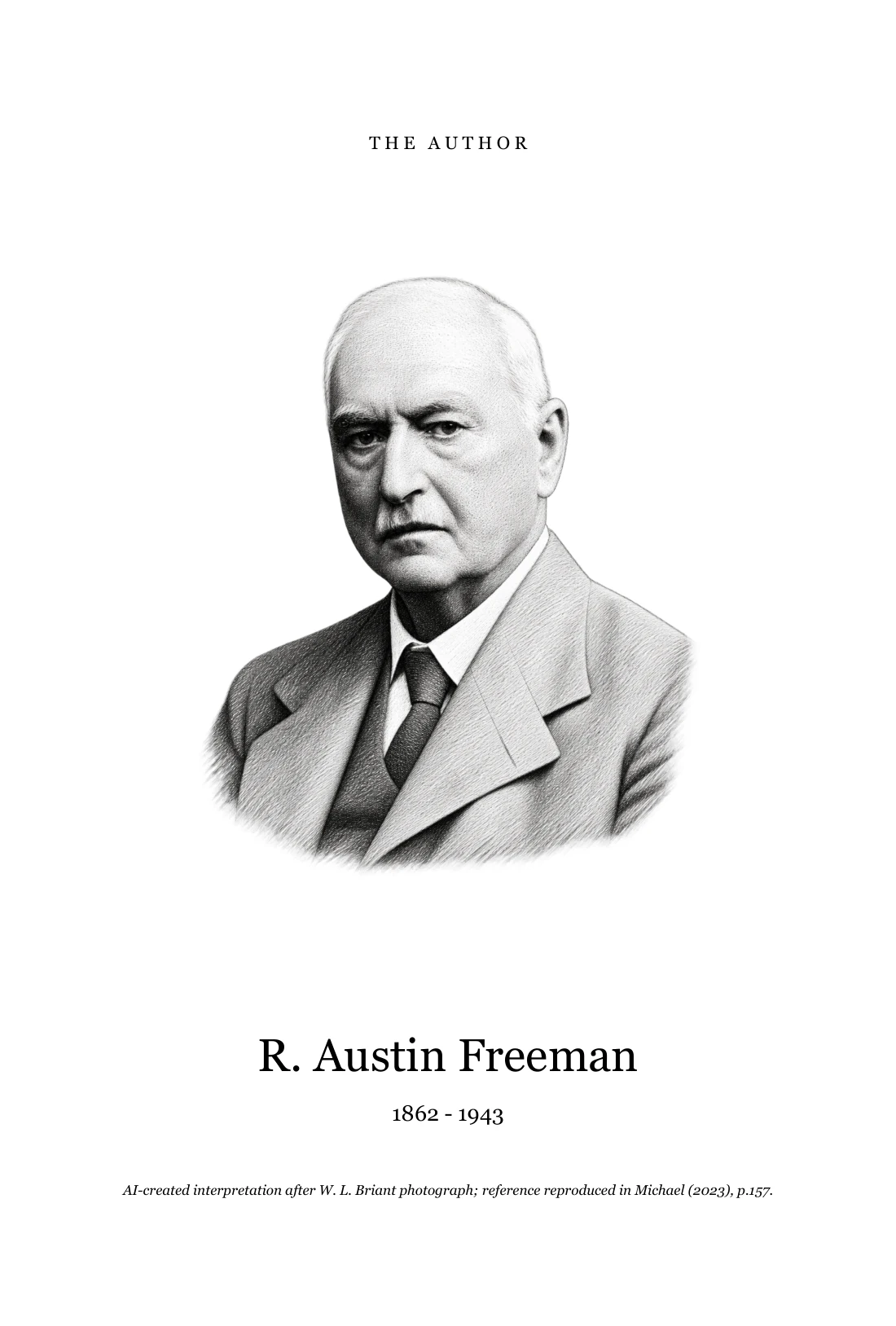
A crime writer who does his own laboratory work is a rarity even now. In a preface signed at Gravesend in September 1909, one doctor-turned-novelist promised his readers that every experiment in his stories had been carried out by him, and that the photographs taken through the microscope showed real specimens. The doctor was R. Austin Freeman, and his detective, Dr John Thorndyke, is the great ancestor of the forensic scientist on every crime show you have ever watched.
Freeman wrote about Thorndyke from 1907 until the 1940s, more than twenty novels and some forty short stories in all. Our shelf holds nine Thorndyke books from the first two decades, plus one non-Thorndyke novel. Publication order serves them best: the characters age a little and the supporting cast grows, but every book is a complete case.
The Dr. Thorndyke books in order
- $14.99
The Red Thumb Mark
1907. A young man is accused of a diamond theft on what seems the strongest evidence of all, his own thumbprint. Thorndyke’s debut, and a book about whether science can be trusted as well as used.
- $15.99
John Thorndyke's Cases related by Christopher Jervis and edited by R. Austin Freeman
1909. Eight stories turning on nailed shoes, a latchkey, a blue sequin and a cipher, illustrated in the original edition with real photographs taken through the microscope. The purest dose of Thorndyke’s method.
- $16.99
The Eye of Osiris
1911. An Egyptologist vanishes after bringing home a mummy from Egypt, and his will tangles his family in a legal nightmare. Freeman at his most elegant, with a love story running through the evidence.
- $14.99
The adventures of Dr. Thorndyke (The singing bone)
1912. The Singing Bone, here under its later American title. The first inverted detective stories: you watch the crime, then watch Thorndyke unpick it.
- $14.99
The Mystery of 31 New Inn
1912. Jervis is driven to a mysterious patient in a carriage with shuttered windows, and Thorndyke sets out to discover where he was taken. Grown from a shorter version Freeman wrote years earlier.
- $19.99
Helen Vardon's confession
1922. Narrated by Helen Vardon herself, a young woman whose life is overturned when her father is accused of misusing trust money. More psychological drama than puzzle, with Thorndyke arriving later.
- $15.99
The mystery of Angelina Frood
1924. A woman disappears from Rochester, and Thorndyke is called in. A sly, playful nod to Dickens’s unfinished Mystery of Edwin Drood, in name and setting.
- $15.99
The D'Arblay mystery
1926. A body in a woodland pool, a daughter determined to know the truth, and Thorndyke’s calm reconstruction of how it got there.
- $15.99
As a thief in the night
1928. A chronic invalid dies, arsenic is found, and suspicion settles on his household. Thorndyke challenges the evidence step by patient step.


Who was Dr. Thorndyke?
Thorndyke is a barrister and a doctor, a lecturer in medical jurisprudence with chambers in the Temple and a laboratory run by his ingenious assistant Polton. He is unfailingly courteous, patient and correct. Where Sherlock Holmes deduces, Thorndyke measures. Freeman said the character was not based on anyone, though he allowed that the great Victorian expert on poisons, Alfred Swaine Taylor, may have suggested the professional side.
I may add that the experiments described have in all cases been performed by me, and that the micro-photographs are, of course, from the actual specimens.
R. Austin Freeman, preface to John Thorndyke’s Cases (1909)
What is an inverted detective story?
Freeman’s other great invention was a form. In the conventional mystery the reader asks who did it. Freeman thought the more interesting question was how the detective found out, so in “The Case of Oscar Brodski”, first published in Pearson’s Magazine in 1910, he showed the crime first and the investigation second. In the preface to The Singing Bone he summed up the experiment: “the reader knows everything, the detective knows nothing, and the interest focuses on the unexpected significance of trivial circumstances.”
The idea outlived him. Every television detective who begins with the murder and lets the audience watch the net close owes something to these stories.
Where should I start with Dr. Thorndyke?
With The Red Thumb Mark if you want a novel, or John Thorndyke’s Cases if you want to see the method at its most concentrated. The Singing Bone is essential once you know him, because the inverted stories only work if you already trust Thorndyke to find the thread. The Eye of Osiris is the richest of the early novels.
The later books lean more on character and courtroom drama, and Helen Vardon’s Confession in particular shows Freeman trying something different. All of them share his scrupulous fairness: the clues are on the page, and they are real.
Freeman without Thorndyke
One book on our Freeman shelf is not a Thorndyke at all. The Uttermost Farthing (1914, also published as A Savant’s Vendetta) is told through the papers of Humphrey Challoner, a scientist who turns his learning to revenge after a burglar destroys his life. It is grim, strange and quite unlike the courteous world of the Temple.
In 1936 George Orwell put Freeman with Conan Doyle and Ernest Bramah among the few detective writers he thought worth rereading, and Raymond Chandler praised him in a letter in 1949. For Thorndyke’s contemporaries, see Max Carrados and Books like Sherlock Holmes; the Dickens mystery behind Angelina Frood is in Did you know Dickens died halfway through his last mystery?, and the man himself gets his own profile in R. Austin Freeman, the doctor who invented the inverted mystery.
The beginning is a thumbprint that seems to prove everything. The Red Thumb Mark shows Thorndyke testing the evidence everyone else takes on trust, and it is the clearest introduction to the most rigorous detective of his age.
Questions readers ask
What is the first Dr. Thorndyke book?
The Red Thumb Mark (1907) is the first Dr. Thorndyke novel. The first collection of stories, John Thorndyke’s Cases, followed in 1909.
What order should I read the Dr. Thorndyke books in?
Publication order works best: The Red Thumb Mark, John Thorndyke’s Cases, The Eye of Osiris, The Singing Bone and The Mystery of 31 New Inn, then the novels of the 1920s. Each book is a complete case.
Who invented the inverted detective story?
R. Austin Freeman, with The Case of Oscar Brodski (1910), later collected in The Singing Bone. The reader sees the crime first, then follows the detective’s investigation.
Is The Uttermost Farthing a Dr. Thorndyke novel?
No. Freeman’s 1914 novel, also published as A Savant’s Vendetta, is narrated through the papers of Humphrey Challoner and does not feature Thorndyke.
 The Magic Casket214 pages · $14.99
 The Blue Scarab194 pages · $13.99
 The Shadow of the Wolf218 pages · $14.99
 A Silent Witness298 pages · $16.99