
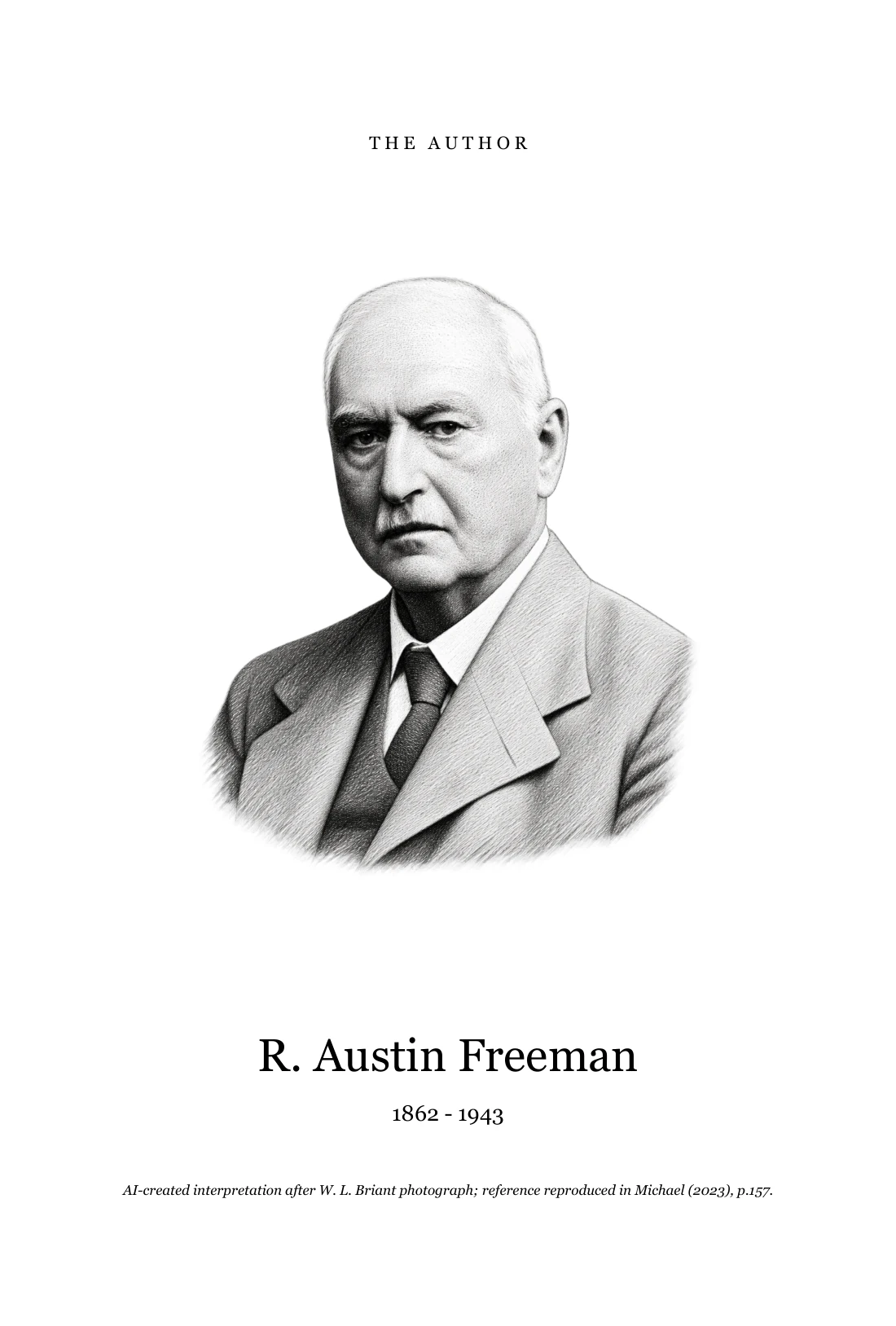
The experiment was “The Case of Oscar Brodski”. R. Austin Freeman told it in two halves: first the crime, committed in full view of the reader by a man we come to know rather well; then the investigation, in which his detective, Dr John Thorndyke, arrives knowing nothing. Pearson’s Magazine liked it enough to ask for more, and in 1912 Freeman gathered four such stories into The Singing Bone, with a preface explaining what he had done.
Here the usual conditions are reversed; the reader knows everything, the detective knows nothing, and the interest focuses on the unexpected significance of trivial circumstances.
R. Austin Freeman, preface to The Singing Bone (1912)
Crime writers call this the inverted detective story, or sometimes the “howcatchem”, and Freeman is generally credited with inventing it. It is what keeps his name alive. The other reason is Thorndyke himself, one of the first great scientific detectives of the twentieth century and the subject of a long series that began with The Red Thumb Mark in 1907.
Who was R. Austin Freeman?
A tailor’s son who trained at the Middlesex Hospital, qualified in 1886 and joined the Colonial Service as an assistant surgeon on the Gold Coast, in what is now Ghana. He served as doctor, naturalist and surveyor on an expedition inland to Ashanti and Jaman, then caught blackwater fever and was invalided home in 1891.
Back in London he worked in general practice and a run of temporary medical posts, including a spell at Holloway Prison. With John James Pitcairn, the prison’s medical officer, as “Clifford Ashdown”, they wrote the Romney Pringle stories about a gentleman crook. When Freeman’s health broke down again, in about 1905, he gave up medicine for writing. His first solo novel, The Golden Pool (1905), drew on his years in West Africa; two years later came Thorndyke, and Freeman had found the character he would write about for the rest of his life.

Why Dr Thorndyke still feels modern
Thorndyke is a doctor who became a barrister, and his evidence is physical: dust, fibres, pond weed, fingerprints, the things other investigators sweep aside. Freeman refused to let him do anything that would not work in real life. He kept a workshop and laboratory at the top of his house in Gravesend and carried out the experiments described in the stories himself before putting them on the page.
That makes the books an unusual pleasure for anyone who enjoys forensic television. The reasoning is laid out so fairly that a careful reader can follow every step, and the surprise comes from what an apparently trivial object turns out to prove.
R. Austin Freeman books to start with
The adventures of Dr. Thorndyke (The singing bone)
1912. The Singing Bone: four inverted stories, in which you watch the crime and then watch Thorndyke take it apart, plus one conventional case for comparison. The book that founded a form.
The Red Thumb Mark
1907. Diamonds vanish from a locked safe, and a thumbprint in blood points straight at the owner’s nephew. Scotland Yard regards fingerprints as proof beyond argument. Thorndyke is not so sure.
John Thorndyke's Cases related by Christopher Jervis and edited by R. Austin Freeman
1909. The first collection of short cases, narrated by Thorndyke’s friend Dr Jervis. The quickest way to meet the method.
The Eye of Osiris
1911. A well-known Egyptologist vanishes without trace, and two years on his family is still arguing over his will. Thorndyke’s patience at its most rewarding.


What is an inverted detective story?
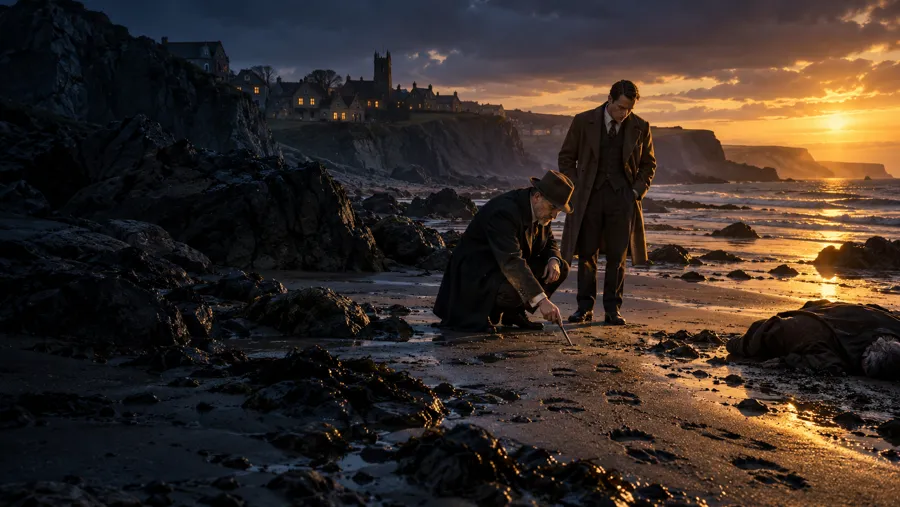
One where the reader sees the crime committed, and usually knows the culprit, before the detective appears. The suspense lies in how the truth will be proved, and in watching a criminal’s careful plan come apart through details he never thought to notice. Freeman returned to the form in later novels, and writers from Francis Iles to the creators of Columbo took it further.
If you prefer to be kept guessing, Freeman wrote plenty of conventional mysteries too, and the Thorndyke novels in order are set out in Dr. Thorndyke in order: the forensic detective who came before CSI. Like many writers of his time he could be ugly on the page: some of his later novels trade in anti-Semitic caricature, and his 1921 book of social theory argued for eugenics. The early Thorndyke books are largely free of that.
Freeman served as a captain in the Royal Army Medical Corps in the First World War, wrote a Thorndyke book almost every year afterwards, and was still writing in the Second, in an air-raid shelter he had built in his garden. He died in Gravesend in 1943.
For his place among the Holmes successors, see Books like Sherlock Holmes and The Golden Age of detective fiction, explained. Turn to “The Case of Oscar Brodski” in The Singing Bone, where a cheerful, round-faced man is strolling round his garden in the October dusk, and Freeman has already told you that he is a burglar.
Questions readers ask
Who invented the inverted detective story?
R. Austin Freeman is generally credited with it. His story “The Case of Oscar Brodski” showed the crime first and the detection second, and he collected it with three more in The Singing Bone (1912).
What is the first Dr Thorndyke book?
The Red Thumb Mark (1907) is the first Thorndyke novel. The first collection of short stories, John Thorndyke’s Cases, followed in 1909.
Was R. Austin Freeman a real doctor?
Yes. He qualified at the Middlesex Hospital in 1886, served as a colonial surgeon on the Gold Coast, and later worked in London, including at Holloway Prison, before ill health turned him to writing.
 The Mystery of 31 New Inn220 pages · $14.99
 The Uttermost Farthing: A Savant's Vendetta142 pages · $12.99
 The D'Arblay mystery236 pages · $15.99
 As a thief in the night250 pages · $15.99