The Red House Mystery was the only classic detective novel A. A. Milne wrote, though his later Four Days’ Wonder (1933) is sometimes counted as a mystery too. When it appeared in 1922 he was best known as a humorist and a successful playwright, not as a children’s author: Winnie-the-Pooh was still four years away. The book was well received and has a strong claim to a place among the early classics of the golden age of detective fiction.
Milne dedicated it to his father, the schoolmaster John Vine Milne, in a short letter. Like all really nice people, he wrote, his father had “a weakness for detective stories” and felt there were not enough of them, so the least his son could do was write him one.
What is The Red House Mystery about?
Mark Ablett, a wealthy and rather vain amateur of the arts, is entertaining a house party at the Red House, his country home. One summer afternoon his long-lost brother Robert, the black sheep of the family, arrives unexpectedly from Australia. Shortly afterwards a shot is heard. Robert is found dead in a locked room, and Mark has vanished.
Into this walks Antony Gillingham, a young man of independent means and restless curiosity who has come to visit his friend Bill Beverley, one of the guests. Antony appoints himself detective and Bill as his Watson, and the two set about solving the case with more enthusiasm than method and a great deal of cheerful banter.

Is The Red House Mystery any good?
Most readers think so. It is witty, briskly plotted and genuinely puzzling, with the relaxed, sunny tone of an Edwardian summer rather than the gloom of a Victorian crime. The clues are laid out fairly, and the pleasure lies in watching Antony fit them together.
It has had at least one famous detractor. In his 1944 essay “The Simple Art of Murder”, the American crime writer Raymond Chandler picked the book apart at length as an example of everything he thought was wrong with the English puzzle mystery. Whether you side with Chandler or with the book’s many admirers, the fact that he chose it as his target says something about how well known it was.
We will not say a word about the solution, which is the whole point. Go in knowing only what Antony knows.
Milne before Pooh
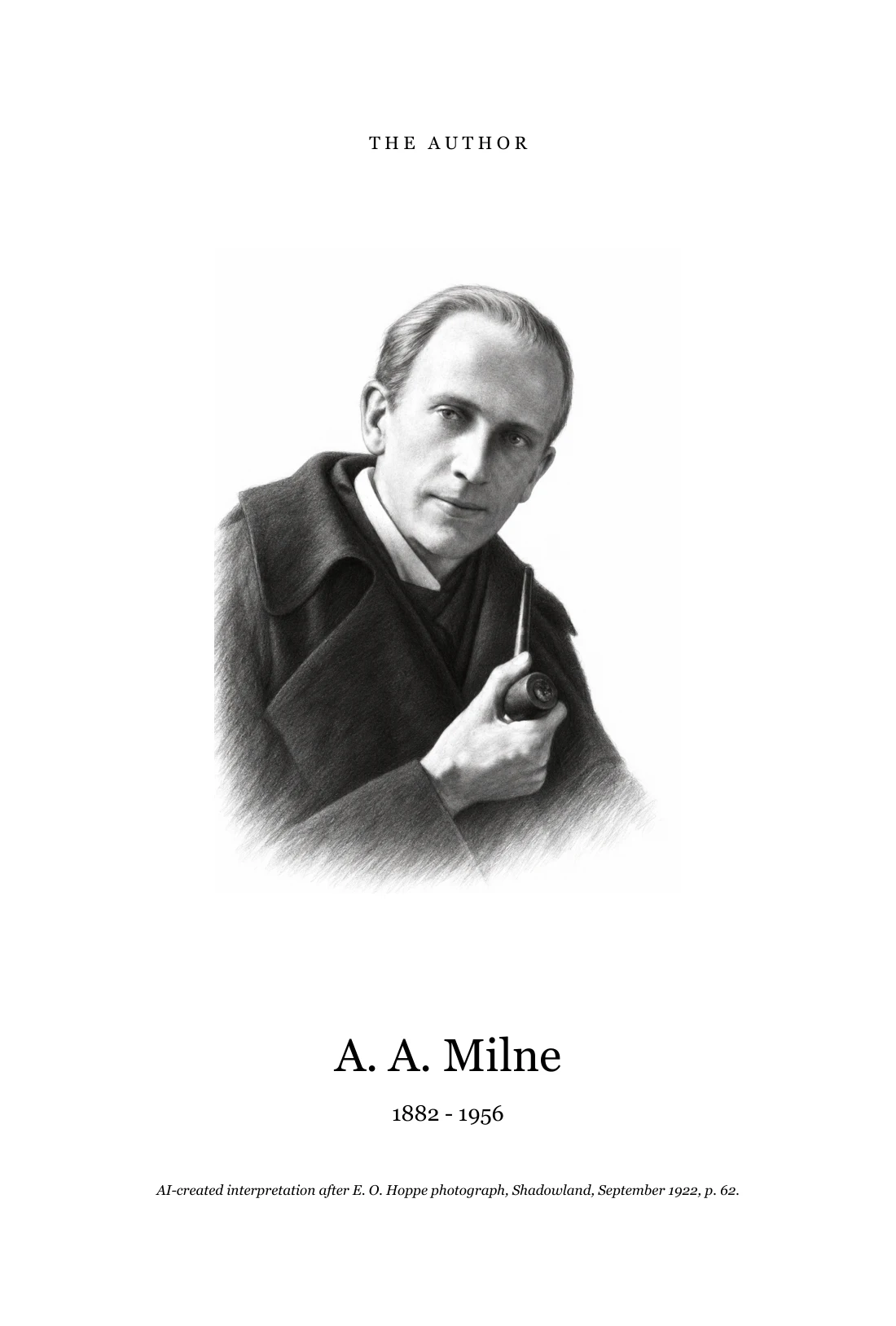
Alan Alexander Milne was born in London in 1882 and was taught for a time at his father’s school by a young H. G. Wells. After Cambridge he became a writer of light comic pieces, and in 1906 he joined the staff of Punch, the great British humour magazine, as assistant editor. He served as an officer in the First World War, and after it he turned to the theatre, where comedies such as Mr Pim Passes By were hits in London.
Then came his son, Christopher Robin, born in 1920, and his son’s toy animals. When We Were Very Young (1924) was a book of verse; Winnie-the-Pooh followed in 1926 and The House at Pooh Corner in 1928. Their success was so overwhelming that Milne, to his frustration, found the rest of his work overshadowed for the rest of his life.
The Red House Mystery
1922. A long-lost brother, a fatal shot, a locked room and a missing host. Milne’s classic whodunit, light, witty and fair to the reader.
Winnie-the-Pooh
1926. Pooh, Piglet, Eeyore and Christopher Robin in the Hundred Acre Wood. The book that made Milne immortal, and not quite the one he expected to be remembered for.
The House at Pooh Corner
1928. The second and last Pooh book, which introduces Tigger and invents Poohsticks.



Do the two books have anything in common?
More than you might expect. Both are full of affectionate comedy and gently absurd conversation, and both are built around a pair of friends having an adventure together: Antony and Bill investigating a death, Pooh and Piglet tracking a Woozle. Milne’s gift for dialogue, crisp, funny and always in character, is the same in both. You can read more about the bear in the Winnie-the-Pooh books and Winnie-the-Pooh was named after a real bear.
If The Red House Mystery leaves you hungry for more country-house puzzles, our guide to golden age detective novels to start with is the natural next step, and locked-room mysteries collects more of the impossible kind. Or browse the whole mystery shelf.
Either way, give The Red House Mystery an afternoon. It is the perfect book for a long weekend, and you will never quite look at Christopher Robin’s father the same way again.
Questions readers ask
Did A. A. Milne write a mystery novel?
Yes. The Red House Mystery (1922) is a country-house detective novel and Milne’s one classic whodunit, though his later Four Days’ Wonder (1933) is sometimes counted as a mystery too. It was published four years before Winnie-the-Pooh.
Who is the detective in The Red House Mystery?
The detective is Antony Gillingham, a young amateur who happens to be visiting a friend at the house. His friend Bill Beverley acts as his Watson.
Is The Red House Mystery a locked-room mystery?
Yes. The victim is found shot in a locked room, and the house’s owner has disappeared. Working out what happened in that room is at the heart of the puzzle.
What else did A. A. Milne write besides Winnie-the-Pooh?
Milne wrote comic essays for Punch, successful stage plays, two books of children’s verse, and The Red House Mystery, as well as the two Pooh story books.
 When We Were Very Young144 pages · $12.99