Winnie-the-Pooh is named after a real bear. In 1914, at the start of the First World War, a Canadian army veterinarian named Harry Colebourn bought an orphaned black bear cub at a railway stop in White River, Ontario, on his way to join his unit. He named her Winnipeg, after his home city, and she quickly became Winnie.
Winnie crossed the Atlantic with the Canadian troops. When Colebourn was sent on to France, he left her at London Zoo for safekeeping, and in time she was given to the zoo for good. She lived there until 1934 and was famously gentle, so much so that children were, by many accounts, allowed close to her.
How did Winnie-the-Pooh get his name?
One of those children was Christopher Robin Milne, the son of the writer A. A. Milne. He loved visiting Winnie, and he renamed his own teddy bear after her. The bear had been a first-birthday present and had previously gone by the more ordinary name of Edward.
The “Pooh” part came from elsewhere. Milne explained in his poetry book When We Were Very Young that Pooh was the name Christopher Robin gave to a swan he used to feed. When the name was no longer needed for the swan, it passed to the bear. In the first chapter of Winnie-the-Pooh, Milne teases readers who might wonder how a boy bear came to be called Winnie, and declines to explain properly:
“Ah, yes, now I do,” I said quickly; and I hope you do too, because it is all the explanation you are going to get.
A. A. Milne, Winnie-the-Pooh (1926)
The real places behind the stories
The Hundred Acre Wood was real too, more or less. The Milnes had a country house on the edge of Ashdown Forest in Sussex, and Milne drew on the forest’s pine clumps, heath and streams for Pooh’s world. E. H. Shepard, who illustrated the books, visited the forest to sketch it. Visitors still play Poohsticks from a footbridge there.
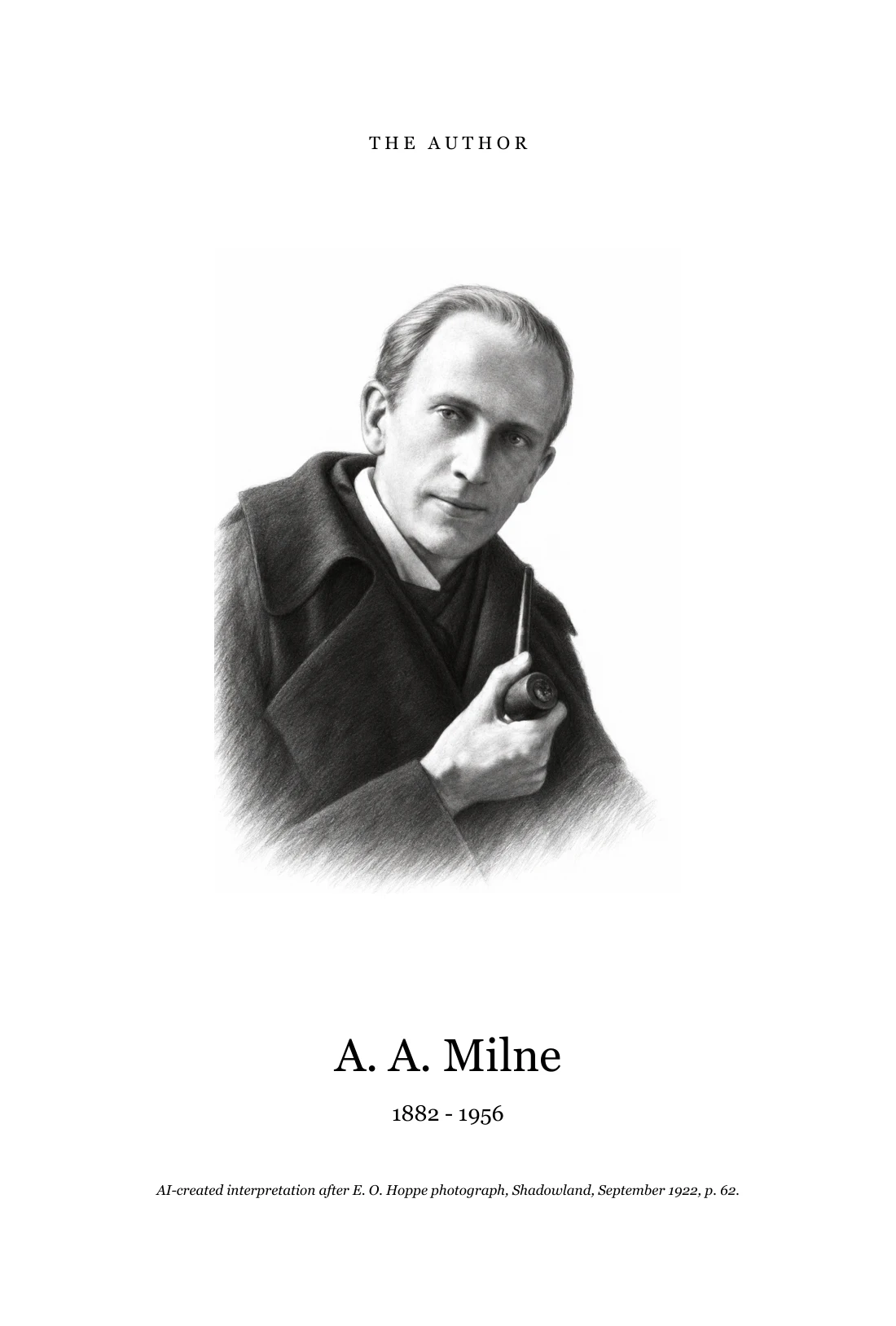
The stories themselves grew out of Christopher Robin’s games with his toys, which is part of why they feel so natural to children. Milne was a seasoned humorist who had worked on the magazine Punch, and he wrote with an ear for how adults would hear the jokes while reading aloud.
E. H. Shepard’s drawings did as much as Milne’s words to fix the characters in readers’ minds, and the two worked together on all four of Milne’s children’s books. Pooh’s first prose adventure, the story of the balloon and the bees, appeared in a London newspaper on Christmas Eve 1925, and the book followed in October 1926.
What are the Winnie-the-Pooh books like to read today?
Funnier than you remember, and gentler than almost anything written for children since. Each chapter is a self-contained adventure: Pooh stuck in Rabbit’s doorway, the hunt for the Heffalump, the expedition to the North Pole. Milne’s timing is superb, and much of the comedy comes from characters who are each sure they understand the world and are each slightly wrong.
They are ideal for reading aloud from about three or four upwards, a chapter at bedtime. Older children often enjoy them on their own a little later, and many adults find that the second book, with its quiet farewell at the end, lands differently once you are grown up. Pooh and Christopher Robin also turn up in Milne’s two books of children’s verse, but the two storybooks are where the whole cast of the Hundred Acre Wood lives.
- $11.99
Winnie-the-Pooh
1926. The first Pooh storybook. Pooh, Piglet, Eeyore, Owl, Rabbit, Kanga and Roo, with Christopher Robin to sort things out.
- $12.99
The House at Pooh Corner
1928. The second and last Pooh storybook, which introduces Tigger, invents Poohsticks and ends with a goodbye that has moved readers for nearly a century.


Where to go next
Many people are surprised to learn there are only two Pooh storybooks; we explain why in Did you know there are only two Winnie-the-Pooh storybooks?. Milne’s range was wide, and grown-up readers might enjoy his country-house mystery The Red House Mystery, introduced in Did you know the creator of Winnie-the-Pooh wrote a detective novel?. For more books to share at bedtime, try classic bedtime stories to read aloud.
But start where Pooh did, coming downstairs, bump, bump, bump, on the back of his head. Open Winnie-the-Pooh and say hello to the most famous bear in books, and spare a thought for Winnie of London Zoo.
Questions readers ask
Was Winnie-the-Pooh based on a real bear?
Partly. Pooh was Christopher Robin Milne’s teddy bear, but its name came from Winnie, a real Canadian black bear at London Zoo whom Christopher Robin loved to visit.
Where did the real Winnie the bear come from?
She was an orphaned cub bought in White River, Ontario, in 1914 by Lieutenant Harry Colebourn, a Canadian army veterinarian, who named her after his home city of Winnipeg.
Where does the “Pooh” in Winnie-the-Pooh come from?
A. A. Milne wrote that Pooh was the name Christopher Robin had given to a swan. The name was later passed on to the bear.
 The Red House Mystery188 pages · $13.99
 When We Were Very Young144 pages · $12.99