Thrushes raiding the kitchen garden at Kelmscott Manor: that is the scene on Strawberry Thief, the printed cotton William Morris designed in 1883 and one of his most popular patterns. Far fewer people know that, a few years later, the same man began writing stories about kings’ sons, sorceresses and haunted woods in lands that appear on no map, and that these books did a great deal to shape modern fantasy.
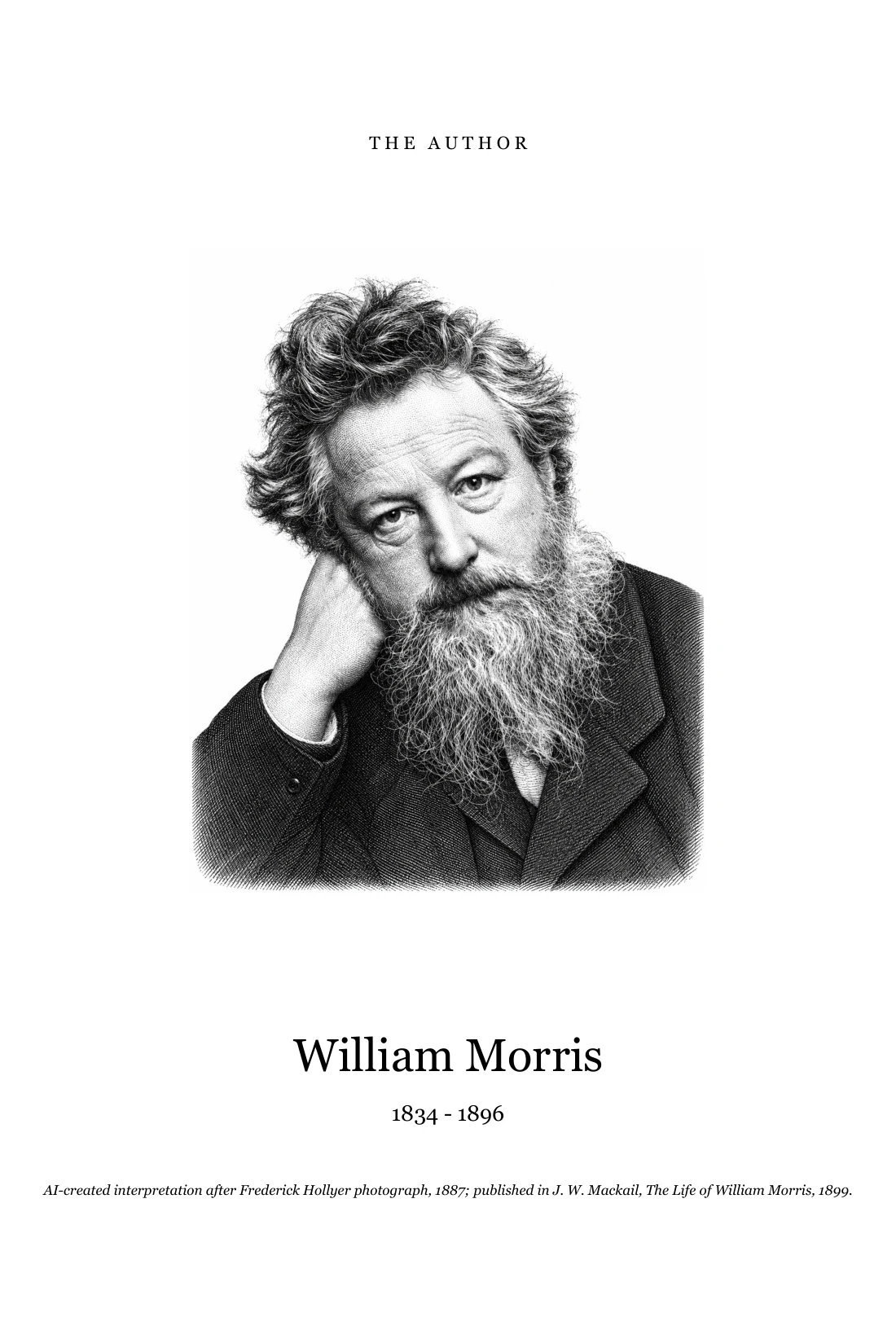
William Morris was a poet, designer, printer and socialist before he was a novelist. William Morris’s fantasy novels came late: between 1888 and his death in October 1896 he produced a run of prose romances, and the later ones broke new ground. Earlier fairy stories had usually sent a hero from our world into an enchanted one, as George MacDonald did in Phantastes in 1858. Morris dispensed with the doorway. His romances take place in invented countries with their own towns, roads and rulers, and the magic is simply part of the landscape.
Did William Morris invent the fantasy novel?
Not single-handedly, and no one invents a genre alone. But Morris is often described as perhaps the first modern writer to unite an imaginary world with the supernatural, and when publishers began building a fantasy list in the twentieth century, they went back to him. In 1969 the Ballantine Adult Fantasy series, edited by Lin Carter, reissued The Wood Beyond the World as one of its very first titles.
The influence on the two most famous fantasists of the next century is well documented. J. R. R. Tolkien wrote in a 1960 letter that the Dead Marshes and the approaches to Mordor’s Black Gate owed something to northern France after the Battle of the Somme but more to Morris’s Huns and Romans, and Morris’s Gothic tribes live in a forest called Mirkwood. C. S. Lewis wrote an admiring essay on Morris, and The Wood Beyond the World is often said to have left its mark on Narnia.
- 1861
Morris co-founds the decorative arts firm that will become Morris & Co.
- 1871
First of two journeys to Iceland, whose sagas he translates.
- 1888–89
The House of the Wolfings, a tale of Gothic tribes resisting Rome, part prose and part verse.
- 1891
Morris founds the Kelmscott Press; its first book is his own The Story of the Glittering Plain.
- 1894
The Wood Beyond the World, a romance set in a wholly invented land.
- 1896
The Well at the World’s End and the Kelmscott Chaucer. Morris dies on 3 October.
- 1897
The Water of the Wondrous Isles is published after his death.

William Morris’s fantasy novels, in the order to read them
- $12.99
The Wood Beyond the World
1894. Golden Walter, betrayed at home, follows a vision of a Lady, her Maid and a hideous dwarf into an enchanted wood. Short, strange and the ideal way in.
- $11.99
The Story of the Glittering Plain
1890–91. Hallblithe of the House of the Raven hunts for his kidnapped bride and is carried to a land where no one grows old. A brief, dreamlike quest.
- $18.99
The Water of the Wondrous Isles
1897. Birdalone, stolen as a child and raised by a witch, escapes in a magic boat and sails from one uncanny island to the next. A rarity for its day: a fantasy with a woman at its centre.
- $23.99
The Well at the World's End: A Tale
1896. Ralph, youngest son of a small kingdom, rides out in search of a well that grants long life. Morris’s longest and richest romance, and the one C. S. Lewis championed.
- $14.99
The House of the Wolfings
1888–89. The Goths of the Mark defend their homes against Rome, in prose broken by battle-songs. The book whose Mirkwood Tolkien read.


Start with The Wood Beyond the World. It is short, its plot moves, and it shows everything that makes Morris distinctive: the wandering hero, the beautiful and dangerous enchantress, the strong-willed heroine and the sense of a world that goes on past the edge of the story. If it holds you, go straight on to The Well at the World’s End, a long quest that Lewis defended as an image of truth rather than a mere escape.
What are William Morris’s romances like to read?
The first thing you will notice is the language. Morris wrote in a deliberately old-fashioned English, full of words like “deem”, “nought” and “whereas”, modelled on the medieval romances and Icelandic sagas he loved. It takes a chapter or two to settle into, and then it carries you like a ballad. The opening of The Well at the World’s End gives the flavour:
Long ago there was a little land, over which ruled a regulus or kinglet, who was called King Peter, though his kingdom was but little.
The Well at the World’s End (1896)
The second thing is how modern the heroines are. Morris’s women make their own escapes, strike their own bargains and more than once rescue the men. The Water of the Wondrous Isles goes further and gives the whole book to Birdalone.

Where Morris fits in the history of fantasy
Morris sits at a crossroads. Behind him are MacDonald’s Fairy Land and the medieval romances; ahead of him are Lord Dunsany’s invented pantheons, Tolkien’s Middle-earth and every map printed on the endpapers of a fantasy novel. We trace that line in fantasy novels before Tolkien, George MacDonald, who inspired Tolkien and Lewis and Lord Dunsany, the fantasist who shaped Tolkien and Lovecraft. For more books in the same vein, browse our fantasy shelf.
Then follow Golden Walter out of the harbour. The Wood Beyond the World is a slim book, written by a man who knew exactly how to make a pattern beautiful, and it may be the most important fantasy novel most readers have never opened.
Questions readers ask
What fantasy novels did William Morris write?
William Morris’s fantasy novels include The House of the Wolfings (1888–89), The Roots of the Mountains, The Story of the Glittering Plain (1890–91), The Wood Beyond the World (1894), The Well at the World’s End (1896), The Water of the Wondrous Isles (1897) and The Sundering Flood, the last two published after his death.
Was William Morris the first fantasy writer?
No single writer invented fantasy, but Morris is often credited as one of the first to set novel-length stories of magic in a wholly invented world, with no link to our own. That makes him a key ancestor of modern fantasy.
Did William Morris influence Tolkien?
Yes. Tolkien acknowledged in a letter that parts of The Lord of the Rings owed something to Morris, and Morris’s The House of the Wolfings features a forest called Mirkwood.
Which William Morris novel should I read first?
Start with The Wood Beyond the World (1894). It is short, fast-moving and shows all the features of his fantasy romances.
 News from Nowhere190 pages · $13.99