Tolkien’s verdict on E. R. Eddison came with a “but” attached. In a letter of 24 June 1957 he wrote that he had read Eddison’s books with great enjoyment for their sheer literary merit — and then went on to say that he disliked the characters, found Eddison’s view of the world unattractive, and thought his invented names slipshod and often inept. It is the review of one craftsman by another: generous about the art, sharp about everything else.
So yes, Tolkien admired The Worm Ouroboros, Eddison’s heroic fantasy of 1922. He also argued with it, and the argument says as much about the two writers as the praise. Tolkien knew Eddison in person — Eddison was an occasional guest of the Inklings, the Oxford circle of Tolkien and C. S. Lewis — and the two men’s ideas of what a fantasy should be were close enough to compare and far enough apart to clash.
What did Tolkien think of The Worm Ouroboros?
He admired the style. Eddison writes in a magnificent imitation of seventeenth-century English, full of long speeches, inventories of jewels and armour, and battle scenes that read like a lost Jacobean epic. He even works real early modern poems into the text, Shakespeare’s eighteenth sonnet among them. For Tolkien, a philologist who cared about the music of old English prose, that was a real achievement.
What he disliked was the moral world. Eddison’s heroes, the lords of Demonland, love glory, war and splendour for their own sake. Tolkien felt that Eddison had come to admire arrogance and cruelty, and that his so-called philosophy was not just wrong but silly. Eddison, for his part, thought Tolkien’s outlook soft. The hobbits and the Demons, one suspects, would not have got on.
And then there are the names. Eddison’s own author’s note, dated 9 January 1922, opens with a short guide to pronouncing them: Carcë, Krothering, Corund, Prezmyra, Brandoch Daha, Gorice. Tolkien, who invented languages first and then drew his names from them, thought Eddison’s nomenclature careless. Readers can judge for themselves; Lord Goldry Bluszco and King Gorice of Witchland are not easily forgotten.
It is neither allegory nor fable but a Story to be read for its own sake.
E. R. Eddison, The Worm Ouroboros (1922), author’s note
What is The Worm Ouroboros about?
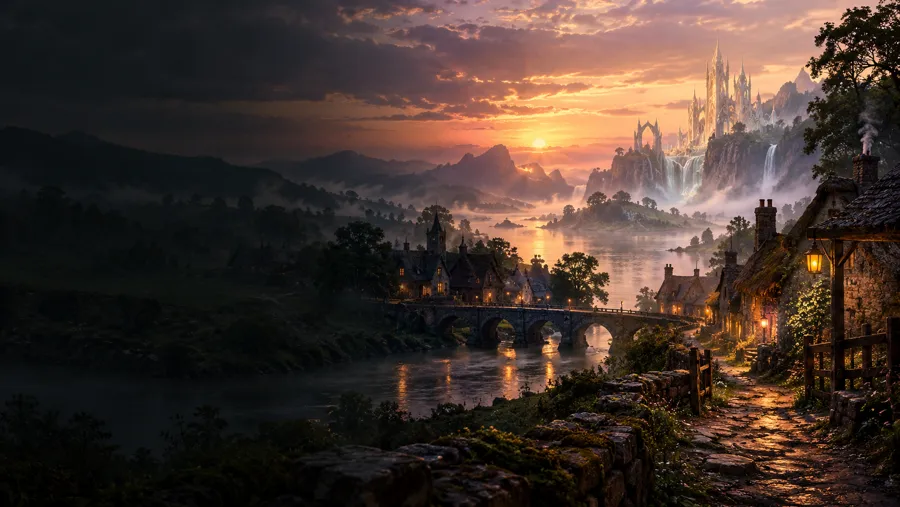
It begins in England. A man called Lessingham, at home in an old house in Wastdale in the Lake District, is carried off one night by a little black martlet in a chariot drawn by a winged steed to the planet Mercury. There, unseen, he watches the lords of Demonland celebrate the birthday of Lord Juss — and keeps mistaking each magnificent lord for Juss, to the martlet’s gentle amusement. Then an ambassador arrives from Witchland with an insulting demand, and the war that fills the rest of the book begins.
Lessingham quietly drops out of the story after the opening chapters. The Demons, despite the name, are not devils but a proud, horned warrior people; the Witches are their rivals, a nation rather than a coven, though there is sorcery enough in Witchland’s royal city of Carcë. The title names the serpent that swallows its own tail, and it is a clue to the shape of the story. We will leave you to discover how.
Think not, because he affecteth silks and jewels like a queen, and carrieth himself light and dainty as a silver birch tree on the mountain, that his hand is light or his courage doubtful in war.
E. R. Eddison, The Worm Ouroboros, Chapter I
The Worm Ouroboros: A Romance
1922. Demonland against Witchland in a world called Mercury, told in sumptuous Jacobean prose. Heroic, ornate and unlike anything else in fantasy.
The King of Elfland’s Daughter
1924. Lord Dunsany’s most beautiful novel, about a prince who marries the daughter of the King of Elfland. Gentler and stranger than Eddison.
The Wood Beyond the World
1894. William Morris’s short romance of a merchant’s son and an enchanted wood, one of the books that taught English writers how to invent a world.


Who was E. R. Eddison?
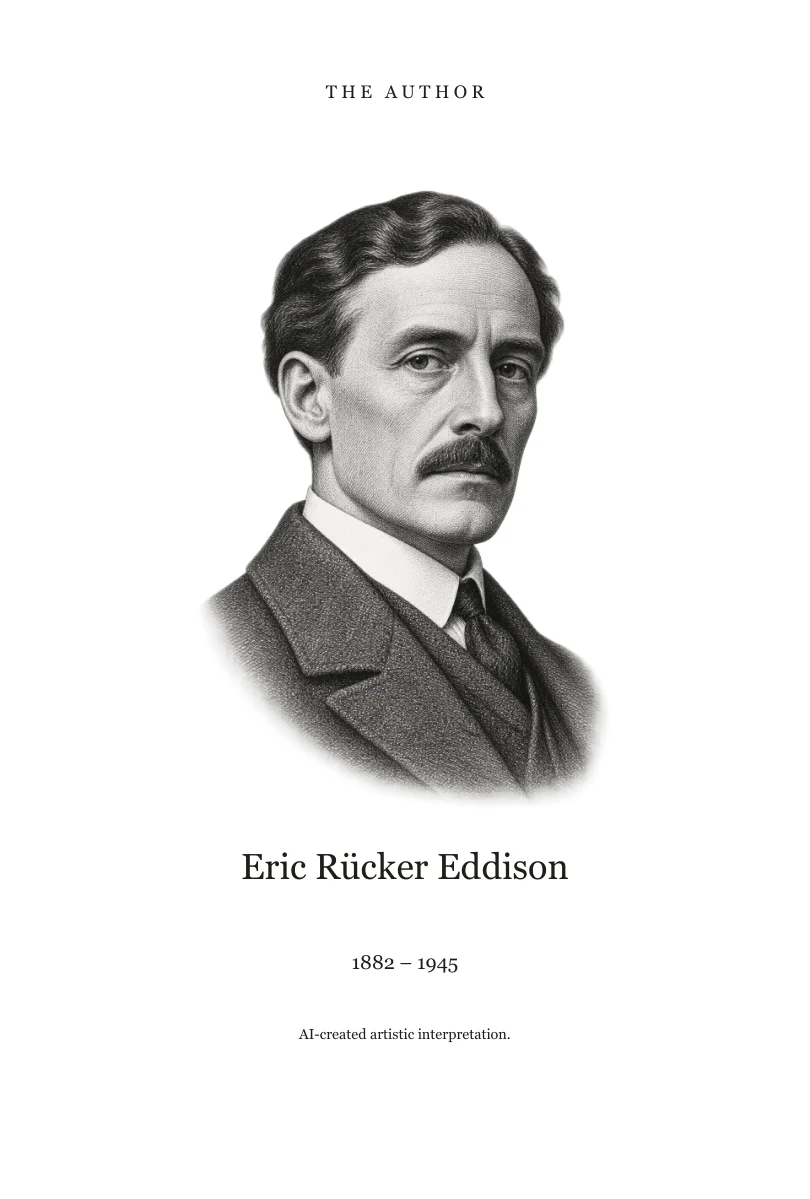
Eric Rücker Eddison was born near Leeds in 1882 and spent his working life as a senior civil servant at the Board of Trade, from 1906 until his retirement in 1938. He was honoured for his public service, made a CMG in 1924 and a CB in 1929, and wrote his fantasies alongside his official career. He also translated Egil’s Saga from the Old Norse in 1930, and the sagas’ blunt heroism runs all through his fiction. His later Zimiamvian trilogy was left unfinished at his death in 1945.
- 1882
Eric Rücker Eddison is born in Adel, near Leeds
- 1906
He joins the Board of Trade
- 1922
The Worm Ouroboros is published by Jonathan Cape
- 1930
His translation of Egil’s Saga appears
- 1935
Mistress of Mistresses begins the Zimiamvian trilogy
- 1945
Eddison dies in Marlborough
- 1957
Tolkien’s letter weighs up Eddison’s merits and faults
- 1967
A paperback edition finds a new audience after The Lord of the Rings
Is The Worm Ouroboros hard to read?
It asks for patience. The language is archaic, the speeches are long, and the book fills 478 pages. But it is not difficult in the way a dense modern novel is. Once your ear adjusts, the prose carries you, and the set pieces — a wrestling match for a kingdom, a climb up the ice-cliffs of Koshtra Pivrarcha, a sorcerer’s conjuring in an iron tower — are tremendous. Read the first two chapters slowly, and let the names wash over you until they start to stick.
For the wider tradition, see Fantasy novels before Tolkien, and Lord Dunsany, the fantasist who shaped Tolkien and Lovecraft for another of the writers on Tolkien’s shelf. Did you know George MacDonald inspired both Tolkien and C. S. Lewis? goes further back. Browse the rest of our fantasy shelf for more.
Start in Wastdale, on a golden summer evening, as Lessingham asks if he may sleep alone in the Lotus Room. By morning he is in Demonland, and you will be too.
Questions readers ask
Did Tolkien like The Worm Ouroboros?
Partly. In a 1957 letter Tolkien said he read Eddison with great enjoyment for the books’ literary merit, but he disliked the characters and their values and criticised Eddison’s invented names.
When was The Worm Ouroboros published?
It was published in 1922 by Jonathan Cape, with illustrations by Keith Henderson, fifteen years before Tolkien’s The Hobbit.
What does Ouroboros mean?
The ouroboros is the ancient symbol of a serpent or worm swallowing its own tail, representing endless cycles. Eddison’s title is a hint about the shape of his story.