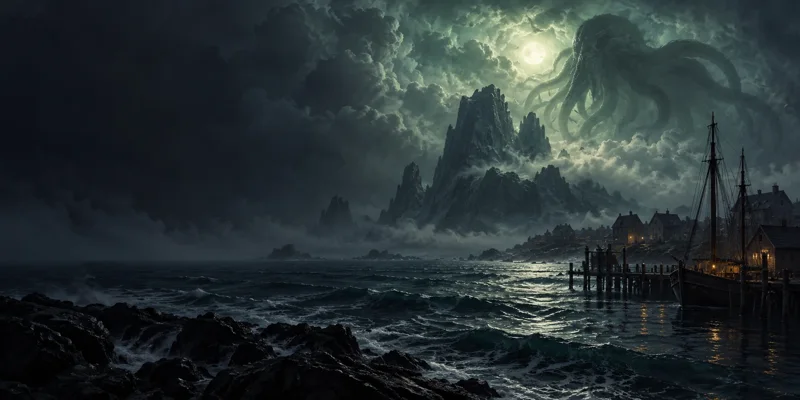
Some say that the Worlds and the Suns are but the echoes of the drumming of Skarl, and others say that they be dreams that arise in the mind of MANA because of the drumming of Skarl, as one may dream whose rest is troubled by sound of song, but none knoweth, for who hath heard the voice of MANA-YOOD-SUSHAI, or who hath seen his drummer?
Lord Dunsany, The Gods of Pegana (1905)
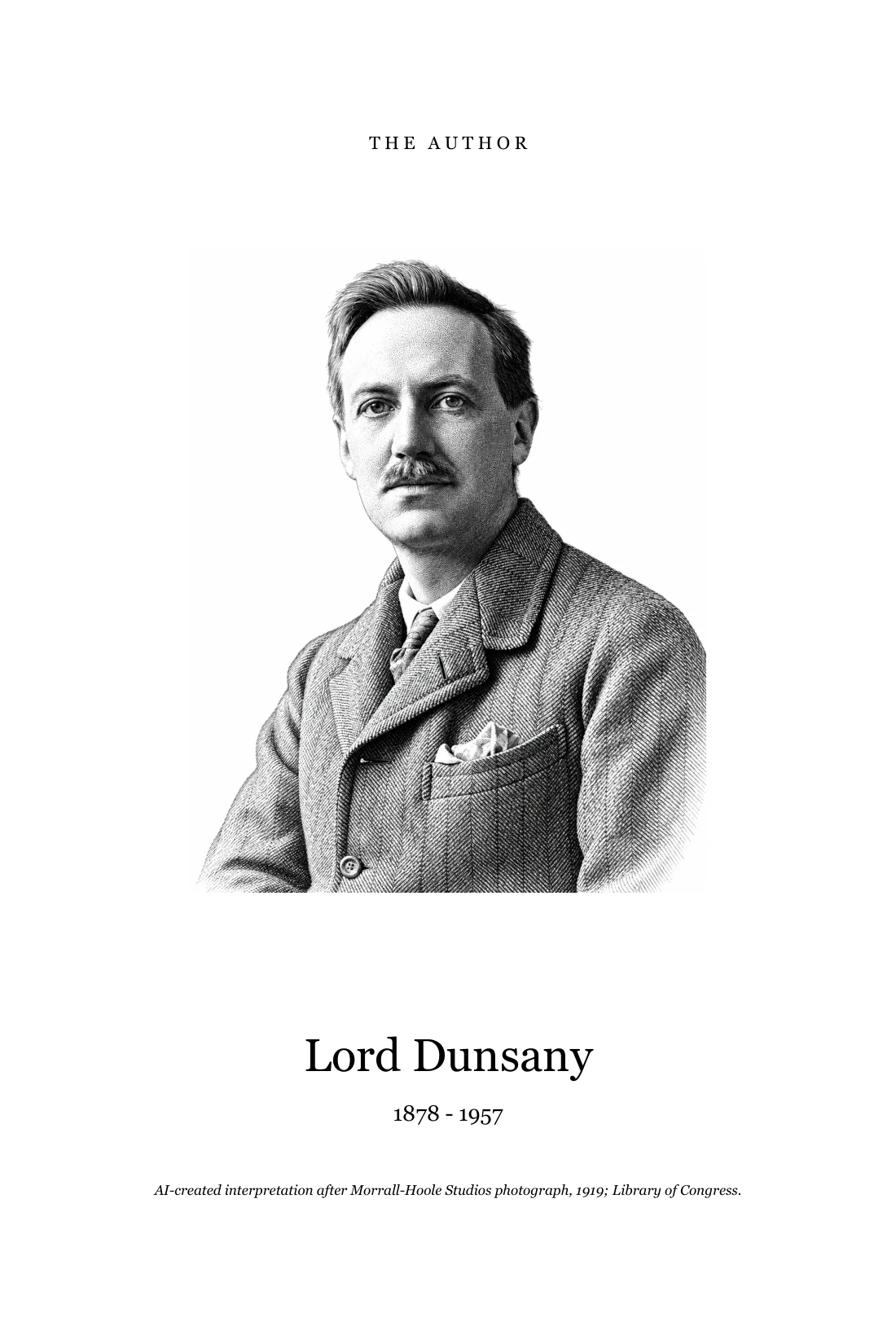
The Gods of Pegana appeared in 1905. It is a short book of myths about gods who never existed, written in the cadences of the King James Bible: a sleeping creator, Mana-Yood-Sushai, small gods who play with worlds, prophets who ask the wrong questions. It was a startling debut, and its author was a six-foot-four Irish peer, soldier and chess champion who would go on to publish more than ninety books.
Lord Dunsany is less read now than the writers he influenced. But if you want to know where a great deal of modern fantasy and weird fiction comes from, the Lord Dunsany books are the place to look, and the four collected here are the best of them.
Who was Lord Dunsany?
Edward Plunkett, 18th Baron Dunsany, was born in London in 1878, inherited one of the oldest titles in Ireland in 1899, and lived for much of his life at Dunsany Castle in County Meath. He served in the Boer War and the First World War, and was wounded by a bullet during the Easter Rising of 1916. He worked with W. B. Yeats and Lady Gregory at the Abbey Theatre, and at one point is said to have had five plays running in New York at the same time.
He was also a famous eccentric. He wrote with quill pens he cut himself, almost never revised, and is said to have composed while sitting on a crumpled old hat. A strong chess player, he once held the great Cuban player José Raúl Capablanca to a draw in a simultaneous exhibition and invented a chess variant of his own.
How did Lord Dunsany influence Lovecraft?
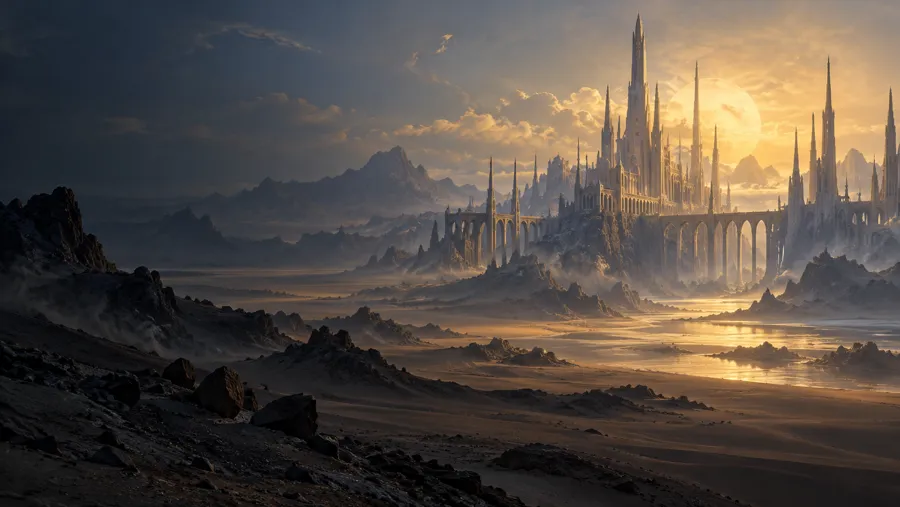
In 1919 a young H. P. Lovecraft discovered Dunsany’s stories and went to hear him speak in Boston. The effect on his writing was immediate. Stories such as “The White Ship” and “The Doom That Came to Sarnath”, written that year, and “The Cats of Ulthar” and “Celephaïs” in 1920, borrow Dunsany’s invented cities, his biblical rhythms and his gods who are indifferent to men. These became the core of what is now called Lovecraft’s Dream Cycle.
Lovecraft idolised Dunsany, though by the late 1920s he had decided the style did not come naturally to him and moved towards the cosmic horror he is famous for. Dunsany, sent one of Lovecraft’s stories in 1948, eleven years after Lovecraft’s death, replied that he could see his style had been borrowed and did not grudge it. We follow the thread in The authors who influenced H. P. Lovecraft and Weird fiction before Lovecraft.
And Tolkien?
The link with Tolkien is quieter, and worth stating carefully. According to the Tolkien scholar John D. Rateliff, when Tolkien was getting help with The Silmarillion in the 1960s, he gave his assistant Clyde Kilby a copy of Dunsany’s The Book of Wonder to read, and his letters and notes allude to two of its stories. One critic has suggested that Tolkien’s comic poem “The Mewlips” owes something to Dunsany’s “The Hoard of the Gibbelins”. Dunsany did not shape Middle-earth the way he shaped Lovecraft, but Tolkien plainly knew him, and so did nearly every fantasy writer of the century. See Fantasy novels before Tolkien for where he fits.

The Lord Dunsany books to read, in order
- $9.99
The Gods of Pegana
1905. His first book: the creation myths, sayings and prophets of an invented pantheon. Short, strange and solemn, best read slowly, a few pages at a time.
- $11.99
Time and the Gods
1906. More tales of the gods of Pegana and the cities of men who serve them, including the beautiful “The Coming of the Sea”. Richer and more varied than the first book.
- $9.99
The Book of Wonder
1912. Fourteen wry, jewelled tales of thieves, centaurs, dragons and doomed adventurers. The funniest Dunsany, and the easiest way into his short stories.
- $13.99
The King of Elfland’s Daughter
1924. A lord’s son rides into Elfland to bring back the Elf King’s daughter as his bride, and time runs differently on either side of the border. His finest novel.


Where should you start?
Start with The Book of Wonder. Its preface is an invitation that still works: “Come with me, ladies and gentlemen who are in any wise weary of London: come with me: and those that tire at all of the world we know: for we have new worlds here.” The stories are short, ironic and full of wonderful names, and you can read one in ten minutes.
Then go back to The Gods of Pegana and Time and the Gods for the mythology, and finish with The King of Elfland’s Daughter. In it the people of the valley of Erl tell their lord, “We would be ruled by a magic lord,” and he sends his son across the border of Elfland. Dunsany warns in his preface that much of the book takes place in “ordinary English woods and a common village and valley”, and the contrast between those fields and Elfland is its great subject.
Dunsany died in Dublin in 1957, long out of fashion, but his invented worlds are still among the most beautiful in the language. The door he left open is The Book of Wonder, and “The Bride of the Man-Horse” is the first step through it.
Questions readers ask
What is Lord Dunsany’s most famous book?
The King of Elfland’s Daughter (1924), a novel about a lord’s son who marries the daughter of the Elf King, is his best-known book, alongside his first, The Gods of Pegana (1905).
Did Lord Dunsany influence Tolkien?
Tolkien knew his work: he gave a copy of The Book of Wonder to Clyde Kilby in the 1960s, and his notes allude to two of its stories. Dunsany’s influence on H. P. Lovecraft was far more direct.
Where should I start with Lord Dunsany?
Start with The Book of Wonder (1912), a collection of short, witty fantasy tales, then try The Gods of Pegana and the novel The King of Elfland’s Daughter.