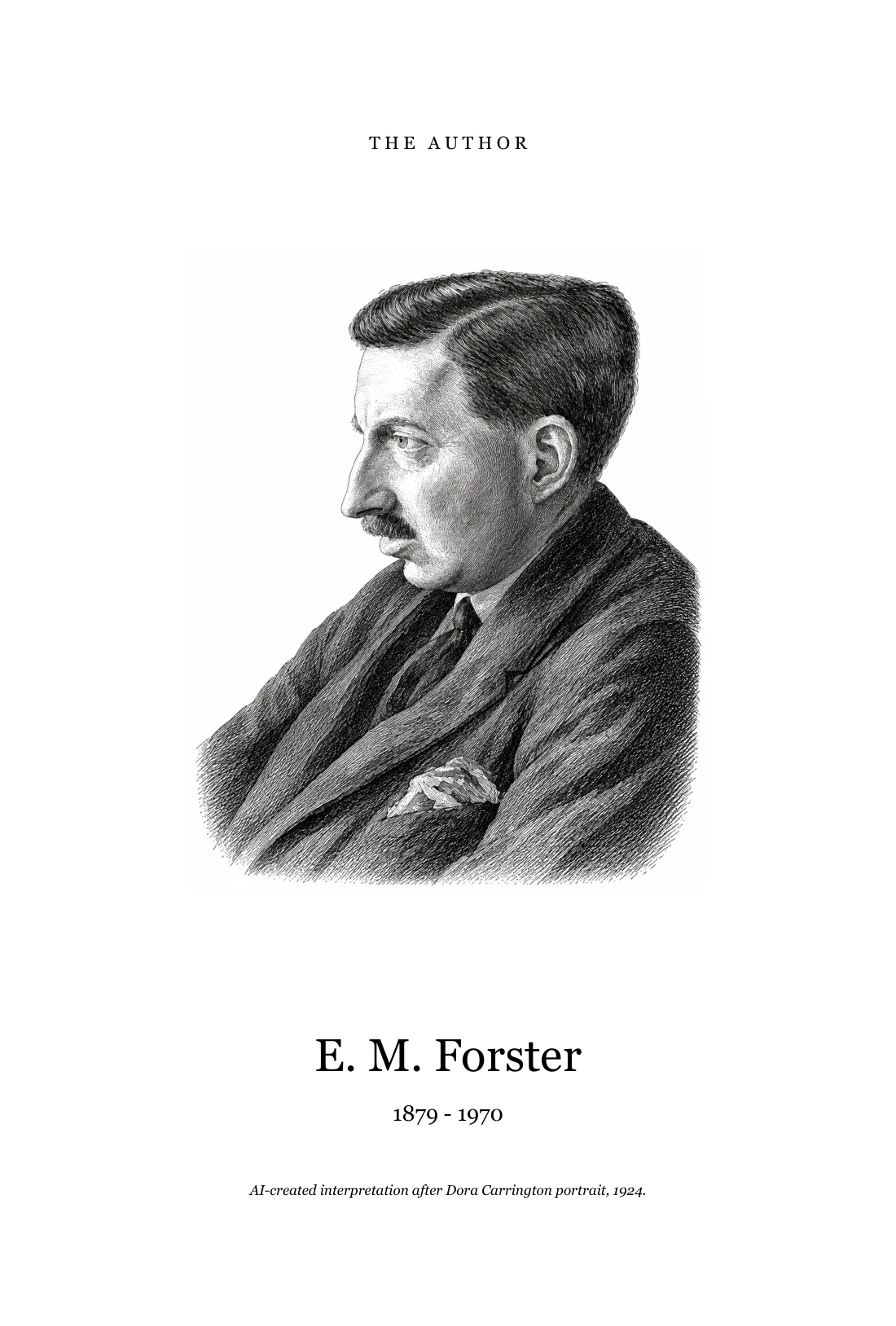
Start with A Room with a View. It is the lightest and sunniest of the E. M. Forster novels, the one most readers finish wanting more, and it introduces everything he cared about: the English abroad, the pull between good manners and honest feeling, and the comedy of people trying very hard not to say what they mean. Then read Howards End, then A Passage to India, and you will have read the three books on which his reputation rests.
That is the short answer. The longer one depends on how much of E. M. Forster you want, and on a curious fact about his career: almost all of it was written before the First World War.
- 1879
Edward Morgan Forster is born in London on 1 January.
- 1905
Where Angels Fear to Tread, his first novel, sends an English widow to a small Italian hill town.
- 1907
The Longest Journey, the novel Forster later called his favourite among his own books.
- 1908
A Room with a View, worked on since the early 1900s as the ‘Lucy novel’.
- 1910
Howards End is published, with its epigraph “Only connect”.
- 1913–14
He writes Maurice, a love story between two men, and puts it away unpublished.
- 1924
A Passage to India, the last novel published in his lifetime.
- 1970–71
Forster dies on 7 June 1970; Maurice is published the following year.
Which E. M. Forster novel should you read first?
A Room with a View opens with a complaint. Lucy Honeychurch and her cousin and chaperone, Charlotte Bartlett, have arrived at a Florentine pension and been given the wrong rooms. Within a page a stranger, old Mr Emerson, offers to swap, and the fuss that follows over whether a lady can accept such an offer tells you most of what the novel is about.
“The Signora had no business to do it,” said Miss Bartlett, “no business at all. She promised us south rooms with a view close together, instead of which here are north rooms, looking into a courtyard, and a long way apart. Oh, Lucy!”
E. M. Forster, A Room with a View (1908)
It is a comedy, and a romance, and it ends happily, which cannot be said of everything Forster wrote. It is also short. If you like it, you will like the rest of him; if Miss Bartlett’s fretting leaves you cold, Forster may not be your writer.
The E. M. Forster novels in our library, in reading order
- $14.99
A Room with a View
1908. Florence, a kiss among the violets and a fiancé who prefers paintings to people. Forster at his most hopeful, and the best first step.
- $17.99
Howards End
1910. Three families, the cultured Schlegels, the prosperous Wilcoxes and the struggling Basts, and a country house that each of them wants something from. Many readers think it his finest novel.
- $16.99
A Passage to India
1924. An Englishwoman, an Indian doctor and an expedition to the Marabar Caves that goes badly wrong. His largest and most unsettling book, and his last published novel.
- $11.99
The eternal moment, and other stories
1928. Six stories written before 1914, including the startling science fiction of “The Machine Stops”. A good way to see a stranger, more fantastical Forster.


Howards End and the house that inspired it
Forster spent ten years of his childhood, from 1883 to 1893, at a house called Rooks Nest near Stevenage in Hertfordshire. It became Howards End, the house at the heart of his 1910 novel, and the question of who will inherit it carries the whole book. He kept the furniture from Rooks Nest all his life.
Howards End is more ambitious than A Room with a View and a little more demanding. It is about money, class and the difficulty of understanding people unlike yourself, and its most famous passage is Margaret Schlegel’s private creed: “Only connect! That was the whole of her sermon. Only connect the prose and the passion, and both will be exalted, and human love will be seen at its height.” Read it second, once you are at home with Forster’s voice.

Why did Forster stop writing novels?
Nobody can say for certain, and Forster himself gave no single answer. What is clear is the shape of the career. By 1914 he had written all but one of his novels, and A Passage to India, begun after a visit to India in 1912–13 and finished after a second stay in the early 1920s, was the exception. After it he wrote criticism, including Aspects of the Novel (1927), essays, biography and broadcasts, and short stories, but no more novels for publication.
Maurice, the novel he had finished in 1914 and went on revising for decades, never went to a publisher. A love story between two men with a happy ending, it was not a book he felt able to publish while he lived, and it appeared only in 1971, the year after he died. It is not one of our editions, and nor are his first two novels, but all three are worth seeking out once you know the big three.
Short Forster: The Eternal Moment
If you would rather sample him than commit to a novel, The Eternal Moment, and Other Stories is the place. Forster’s own note at the front says the stories “were written at various dates previous to 1914”. The first of them, “The Machine Stops”, imagines people living alone in underground cells, talking to each other through screens and depending utterly on a vast machine. It is often counted among the first great dystopian stories, and you can follow that thread in Dystopian novels before 1984.
Forster belongs to the generation between the Victorians and the modernists, a world we explore in The Edwardian novel, and he was a friend of the writers known as Bloomsbury; see Who were the Bloomsbury Group? Long after he stopped publishing fiction he stood up for other people’s, appearing as a defence witness in the 1960 trial over D. H. Lawrence’s Lady Chatterley’s Lover.
The best first evening with Forster is still the one Lucy spends in Florence. A Room with a View opens with Miss Bartlett grumbling about the rooms, and it is very hard not to follow Lucy out into the city.
Questions readers ask
What order should I read E. M. Forster’s novels in?
Most readers do best starting with A Room with a View (1908), then Howards End (1910) and A Passage to India (1924). His other novels are Where Angels Fear to Tread (1905), The Longest Journey (1907) and the posthumous Maurice (1971).
How many novels did E. M. Forster write?
Six. Five were published in his lifetime, between 1905 and 1924, and Maurice, written in 1913–14, was published in 1971, the year after his death.
What is E. M. Forster’s best novel?
Critics usually name Howards End or A Passage to India, which won the James Tait Black Memorial Prize. A Room with a View is the most widely read and the easiest to love.
 Where Angels Fear to Tread124 pages · $11.99
 Aspects of the Novel124 pages · $11.99