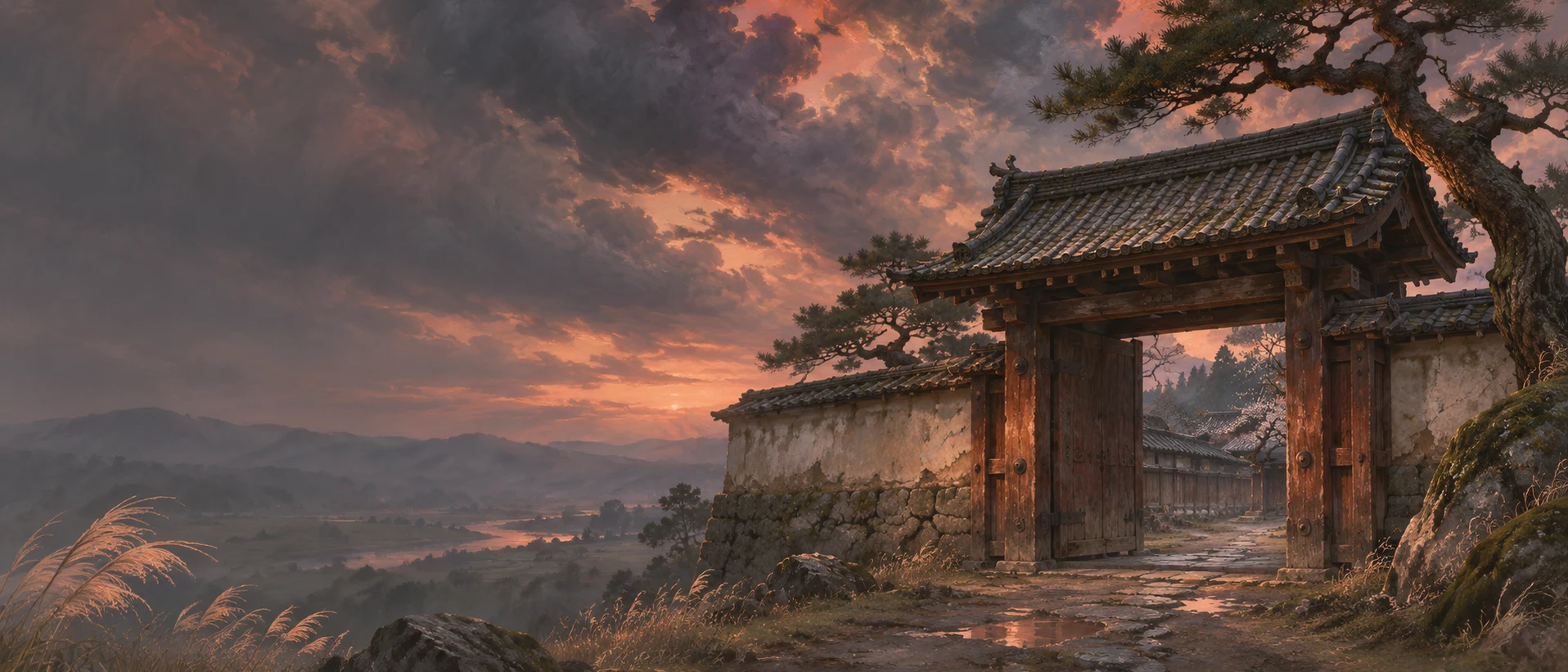
Nothing is left of the real Rashōmon. The great southern gate of old Kyoto, built at the end of the city’s central avenue when the capital was laid out in the late eighth century, had decayed by the twelfth century into a haunt of thieves, where people left corpses and unwanted babies. Today a stone pillar near a small playground marks where it stood, and not one of its foundation stones remains.
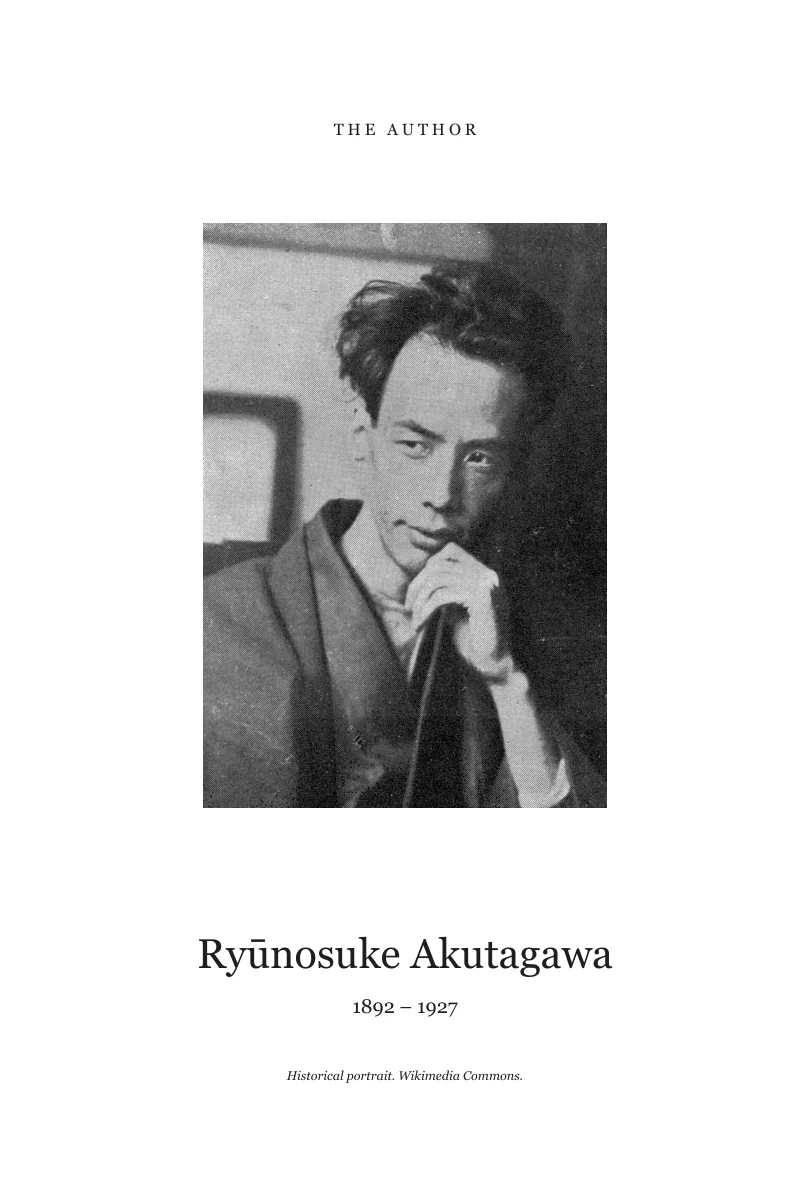
It survives instead in fiction. In 1915 Ryūnosuke Akutagawa, then a twenty-three-year-old student, published a short story set in the ruined gate. In 1950 Akira Kurosawa borrowed its name and its setting for Rashomon, one of the most influential films ever made. But the film’s plot, the murder told four ways, comes from a different story.
Is Kurosawa’s Rashomon based on Akutagawa’s Rashōmon?
Only in part. The film’s plot and characters come from Akutagawa’s “In a Grove” (1922), in which a series of witnesses, including the bandit Tajōmaru, the samurai’s wife and the dead samurai speaking through a medium, give conflicting accounts of a killing in a bamboo forest. From “Rashōmon” Kurosawa took his title, the ruined gate where his woodcutter, priest and commoner shelter from a downpour, and some of the frame story’s material: the theft of clothing and the argument about whether stealing to survive can be forgiven.
So if you want the story behind Kurosawa’s title, “Rashōmon” is it. It is also a remarkable piece of writing in its own right, and quite unlike the film in mood.
What happens in “Rashōmon”?
Kyoto has been struck by earthquake, whirlwind, fire and famine. A lowly servant, dismissed by his master a few days before, sits on the steps of the abandoned gate as the rain comes down, wondering whether to starve or turn thief. He climbs the ladder into the gate’s upper storey, where the unclaimed dead have been dumped, and finds a living person among them: an old woman pulling the hair from a corpse to make wigs.
It was evening. A solitary lackey sat under Rashōmon waiting for the rain to clear.
Ryūnosuke Akutagawa, “Rashōmon”, trans. Glenn W. Shaw, in *Tales Grotesque and Curious* (1930)
What follows is a short, brutal argument about necessity. The servant is disgusted; the old woman explains that the dead woman cheated people in life to survive, so surely she would not mind. Akutagawa follows the servant’s moral reasoning almost minute by minute, and the ending turns on how quickly it can change. The whole story runs to only a dozen or so pages.
Akutagawa based it on tales from the Konjaku Monogatarishū, a medieval Japanese collection of stories, and the reading of the gate’s name he used had been popularised by a medieval Noh play attributed to Kanze Nobumitsu. His friends were unimpressed when it first appeared in the magazine Teikoku Bungaku. Within a few years he was one of Japan’s best-known writers of short fiction, and he is now often called the father of the Japanese short story.
How the film uses the story
Kurosawa, who wrote the screenplay with Shinobu Hashimoto, opens and closes at the gate, in rain that never lets up. His three men are not Akutagawa’s servant and old woman, but they inherit their dilemma. The commoner who joins them steals from an abandoned baby’s bundle, and justifies himself much as the servant does in the story; the woodcutter’s response gives the film its final, more hopeful turn. In a sense Kurosawa takes the question “Rashōmon” asks, whether anyone can afford to be good, and lets his film answer it differently.
Toshiro Mifune plays the bandit, Machiko Kyō the wife and Masayuki Mori the samurai, with Takashi Shimura as the woodcutter. Rashomon opened in Tokyo on 25 August 1950 to moderate success, then won the Golden Lion at the 1951 Venice Film Festival, becoming the first Japanese film to make a real impact abroad. It went on to receive an honorary Academy Award as the best foreign-language film of the year, at the ceremony in March 1952, and gave its name to the “Rashomon effect”.
Reading Rashōmon in English
Glenn W. Shaw’s Tales Grotesque and Curious, published in Tokyo by the Hokuseido Press in 1930, collects eleven Akutagawa stories, “Rashōmon” among them. It does not include “In a Grove”, which reached English readers in Takashi Kojima’s translation of 1952. What you get instead are the stories that made Akutagawa’s name: “The Nose”, “The Spider’s Thread”, “Tobacco and the Devil” and the rest, sardonic and strange.
For more Japanese classics in English, see Kwaidan, the ghost stories collected by Lafcadio Hearn, The Book of Tea and Asian classics in English.
Watch the film for the rain, then read “Rashōmon” in Tales Grotesque and Curious. It takes ten minutes, and you will never see Kurosawa’s gate the same way again.
Questions readers ask
Is Rashomon based on a book?
Kurosawa’s 1950 film is based on two short stories by Ryūnosuke Akutagawa. Its plot comes from “In a Grove” (1922), and its title, setting and parts of its frame story come from “Rashōmon” (1915).
What is Akutagawa’s Rashōmon about?
A dismissed servant shelters from the rain in Kyoto’s ruined gate and debates whether to starve or become a thief. Inside he finds an old woman stealing hair from corpses, and their encounter settles his choice.
Does Tales Grotesque and Curious include In a Grove?
No. Glenn W. Shaw’s 1930 collection includes “Rashōmon” and ten other stories, but not “In a Grove”, which was translated into English by Takashi Kojima for a 1952 edition.
What awards did Rashomon win?
It won the Golden Lion at the 1951 Venice Film Festival and an honorary Academy Award as the outstanding foreign-language film, presented in March 1952.