
About 135,000 words of stories, 192 pages, untrimmed edges and not one illustration, not even on the cover. That was Argosy after 1896, when the publisher Frank Munsey dropped all its non-fiction and printed it on the cheapest wood-pulp paper he could get. It was the first pulp magazine, and the format lasted until the mid-1950s.
That is the short history of the pulp magazines: cheap printing, cheap paper and cheap, prolific authors, combined into affordable entertainment for working people. At their height in the 1920s, 1930s and 1940s, the best-selling pulps sold up to a million copies an issue. Their name, from the rough paper they were printed on, survives in the phrase “pulp fiction”, and their heroes are still everywhere.
- 1896
Munsey turns Argosy into an all-fiction magazine on pulp paper
- 1905
Munsey launches The All-Story
- 1912
All-Story serialises Edgar Rice Burroughs’s first Mars story and then Tarzan of the Apes
- 1918
A. Merritt’s “The Moon Pool” appears in All-Story Weekly
- 1919
Zorro makes his debut in All-Story
- 1920
Black Mask is founded; All-Story merges into Argosy
- 1923
The first issue of Weird Tales is dated March
- 1926
Hugo Gernsback launches Amazing Stories, the first magazine devoted to science fiction
- 1928
Lovecraft’s “The Call of Cthulhu” appears in Weird Tales
All-Story and the birth of Tarzan and John Carter
The most important magazine for readers of classics is Munsey’s All-Story. By 1911 Edgar Rice Burroughs, a Chicago pencil-sharpener wholesaler with plenty of spare time, had been reading the pulps and decided that if people were paid for writing such rot, he could write rot just as good. His first attempt was a story about a Confederate veteran transported to Mars. All-Story bought it and ran it from February to July 1912 as “Under the Moons of Mars”. Burroughs, afraid of being laughed at, signed it “Normal Bean”, to suggest he was perfectly sane. A typesetter assumed it was a mistake and printed “Norman Bean”.
I am a very old man; how old I do not know. Possibly I am a hundred, possibly more; but I cannot tell because I have never aged as other men
John Carter, *A Princess of Mars*
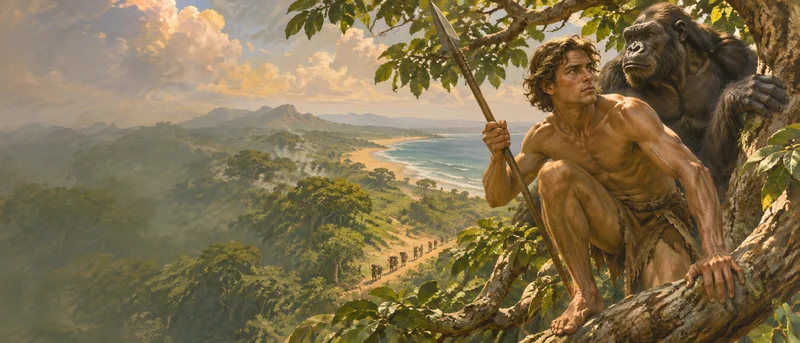
In October 1912 the same magazine printed the whole of Tarzan of the Apes in a single issue, and Tarzan became Burroughs’s most famous creation. Book publishers caught up later: A. C. McClurg published Tarzan as a book in 1914 and the Mars story, retitled A Princess of Mars, in 1917. Both reflect the racial attitudes of their era, Tarzan’s Africa above all, and modern readers will notice. But between them they founded two of the longest-running series in popular fiction. We follow them in the Barsoom books in order and the Tarzan books in order.

A. Merritt and the lost worlds
Abraham Merritt’s “The Moon Pool” appeared in All-Story Weekly in 1918, followed by a sequel, “Conquest of the Moon Pool”, in 1919. Reworked into a single novel, The Moon Pool is a lost-world fantasy in which a scientist and his companions follow a shining, deadly being called the Dweller down into a vast world beneath the earth. It was exactly the kind of story the pulps did best, and it had at least one devoted reader who would matter later.
Weird Tales and Cthulhu
By the 1920s, pulps had begun to specialise. There were detective pulps, western pulps, romance pulps and, from March 1923, Weird Tales, devoted to horror and the fantastic. Its most famous contributor was H. P. Lovecraft. He wrote “The Call of Cthulhu” in the summer of 1926, and the editor, Farnsworth Wright, turned it down; he accepted it only after Lovecraft’s friend Donald Wandrei falsely told him that Lovecraft was thinking of sending it elsewhere. It appeared in February 1928. The story is told in The Call of Cthulhu was rejected.
Lovecraft was a great admirer of Merritt. His biographer S. T. Joshi has suggested that the tilting “moon-door” in The Moon Pool resembles the huge door whose opening lets Cthulhu out of his sunken city of R’lyeh. The pulps were a small world, and their writers read one another closely. Weird Tales also published most of Robert E. Howard’s Conan the Barbarian stories.

Why did the pulps die?
Paper shortages in the Second World War hurt them, and afterwards they were squeezed from every side: by comic books, by paperback novels, by men’s adventure magazines and, probably, by television. In 1949 the big publisher Street & Smith closed most of its pulps to move upmarket, and by around 1955 the era was over.
Their descendants are everywhere. Hard-boiled detective fiction grew in Black Mask, founded in 1920 by H. L. Mencken and George Jean Nathan, and later home to Dashiell Hammett and Raymond Chandler. Science fiction as a publishing genre began with Amazing Stories. Superhero comics owe a debt to pulp heroes such as the Shadow and Doc Savage. And the four books below are still in print a century on.
Tarzan of the Apes
1912. The whole novel appeared in one issue of All-Story: a boy raised by apes, a lost inheritance and a jungle romance.
A Princess of Mars
1912. John Carter wakes on Mars, among four-armed green warriors and a captive princess. The start of Barsoom.
The Moon Pool
1918–19. Merritt’s lost-world fantasy of a living light and a hidden civilisation, the pulp novel Lovecraft loved.
The Call of Cthulhu
1928. Lovecraft’s best-known story, published in Weird Tales after one rejection, and the birth of a mythology.


For more, see Edgar Rice Burroughs and his pencil sharpeners, Princess of Mars and Norman Bean and the authors who influenced Lovecraft. The pulps’ Victorian ancestors are in what was the sensation novel?
Start where the pulps found their first superstar. Open A Princess of Mars by Edgar Rice Burroughs, and read its first line the way a reader in 1912 did, in a cheap magazine printed on paper that was never meant to last.
Questions readers ask
What were pulp magazines?
Cheap American fiction magazines printed on rough wood-pulp paper, published from 1896 until about 1955. They carried adventure, detective, western, horror, romance and science-fiction stories.
What was the first pulp magazine?
Frank Munsey’s Argosy, which in 1896 dropped its non-fiction and switched to cheap pulp paper, becoming the first pulp.
Which pulp magazine published Tarzan?
The All-Story, which printed Tarzan of the Apes complete in its October 1912 issue. Earlier that year it had serialised Burroughs’s first Mars novel as Under the Moons of Mars.
Where was The Call of Cthulhu first published?
In the pulp magazine Weird Tales, in February 1928, after its editor Farnsworth Wright had at first rejected it.

 The Return of Tarzan240 pages · $15.99
 The Gods of Mars228 pages · $14.99
 At the Earth's Core134 pages · $12.99
 The Warlord of Mars160 pages · $12.99