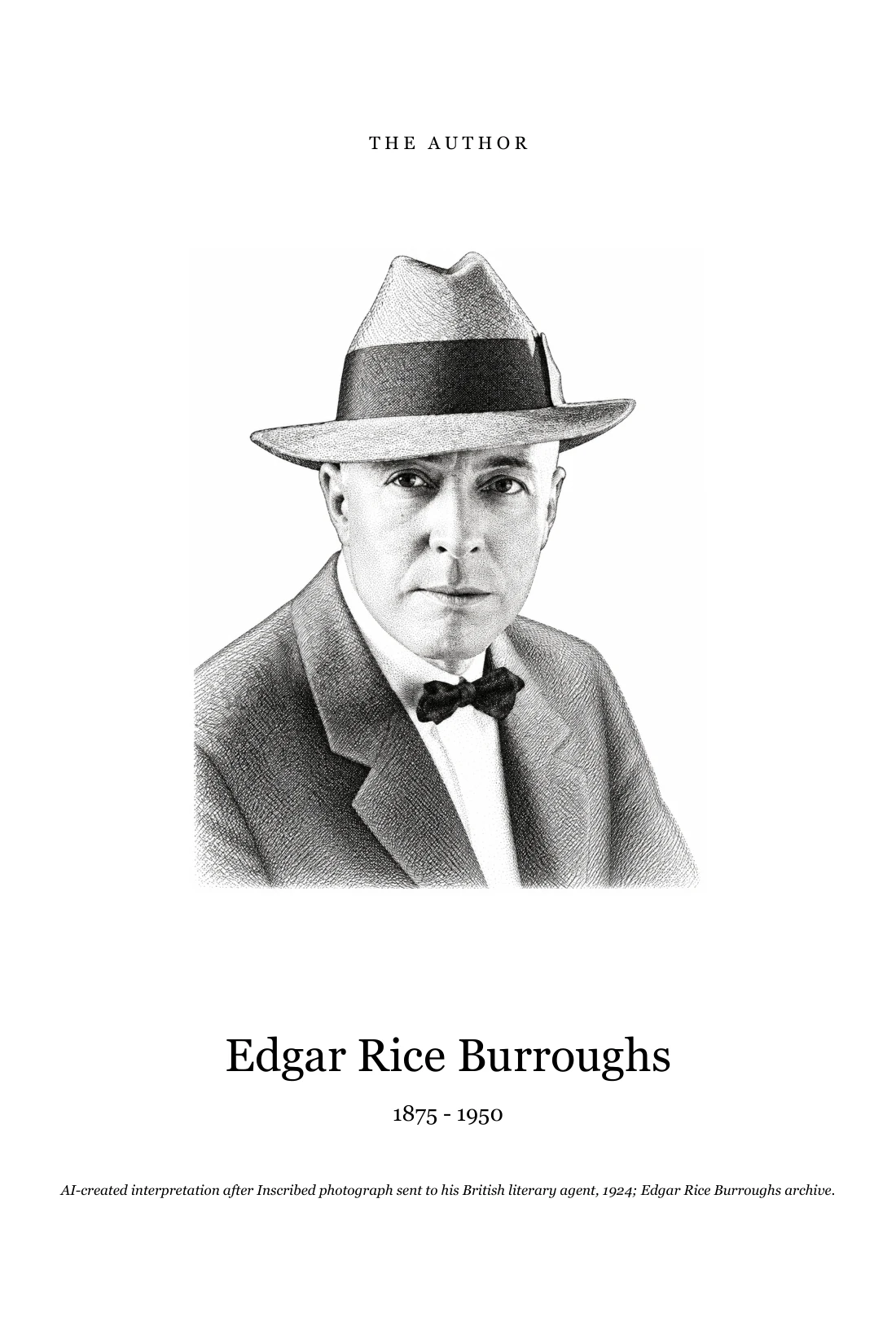
The joke was meant to say “I’m perfectly normal”. When Edgar Rice Burroughs sent his first novel to The All-Story magazine in 1911, he was in his mid-thirties, had drifted through a string of jobs, and had written a tale of a Civil War veteran transported to Mars. He signed it “Normal Bean”, a pun on “normal being”: a wink to readers that the man behind such a wild story was quite sane.
When the first instalment appeared in February 1912, the byline read “Norman Bean”. Somewhere between manuscript and print, an editor or typesetter had taken the pun for a slip and corrected it. A Princess of Mars, as the story was later called, began its life under a pseudonym that was itself a misprint.
How was A Princess of Mars first published?
Burroughs submitted the manuscript as Dejah Thoris, Martian Princess. The All-Story’s managing editor, Thomas Newell Metcalf, offered $400 for the magazine rights, and Burroughs accepted in November 1911. Metcalf proposed calling it In the Moons of Mars; it finally ran as Under the Moons of Mars, in six monthly parts from February to July 1912.
It was a success. Burroughs wrote fast, and that October the same magazine printed his second big idea, Tarzan of the Apes. By then he had no reason to hide. He published almost everything afterwards under his own name, and when the Mars story came out as a hardback from A. C. McClurg in October 1917, it bore his name and its new title.

What is A Princess of Mars about?
John Carter, a Virginian who fought for the Confederacy, goes prospecting in Arizona after the war. Fleeing Apaches, he takes refuge in a cave, loses consciousness and wakes on Mars, which its people call Barsoom. The lighter gravity makes him astonishingly strong, and he is soon a captive and then a comrade of the Tharks, fifteen-foot green warriors with tusks and an extra pair of limbs that serve as arms or legs, whose chieftain Tars Tarkas becomes his closest friend. Then the Tharks capture a red Martian princess, Dejah Thoris of Helium, and Carter has a cause.
The plot runs on duels, airships, rescues and reversals, and it barely pauses. What lifts it above most of its imitators is Barsoom itself: a dying world of dry sea-beds, ancient cities and an atmosphere kept breathable by a single great factory. Carl Sagan, Ray Bradbury and James Cameron are among those who have said it fired their imaginations.
The trick in the foreword
Burroughs was not quite finished with disguises. The novel opens with a foreword signed in his own name, in which he presents himself as John Carter’s young relative, who knew him as “Uncle Jack”. Carter, he says, was found dead in the snow in March 1886, and left a manuscript with strict instructions about when it could be read:
His further instructions related to this manuscript which I was to retain sealed and unread, just as I found it, for eleven years; nor was I to divulge its contents until twenty-one years after his death.
Edgar Rice Burroughs, foreword to A Princess of Mars
It is a neat piece of misdirection, the same device Swift and Defoe used, dressing a fantasy up as a true document. The foreword ends with Carter’s tomb, whose great door has a lock that opens only from the inside. Readers in 1912 did not need telling that the story would continue.

Was it worth the disguise?
Burroughs went on to write ten more Barsoom books, more than twenty Tarzan books and much else, and Carter’s adventures shaped a century of science fiction and fantasy, from pulp magazines to Disney’s John Carter, directed by Andrew Stanton in 2012 with Taylor Kitsch and Lynn Collins. Not bad for a story whose author feared it might get him laughed at.
A Princess of Mars
1912. A Confederate veteran wakes on Mars, wins the respect of towering green warriors and fights for a princess. The book that began the Barsoom series and made Burroughs’s name.
The Gods of Mars
The direct sequel, which picks up the cliffhanger and takes Carter into the Martian afterlife, where the religion of an entire planet turns out to be a lie.
The Warlord of Mars
The third book completes the arc begun in the first two, as Carter pursues Dejah Thoris to the frozen north of Barsoom.
Tarzan of the Apes
Burroughs’s other great creation, printed in The All-Story in October 1912, the same year as Carter’s debut, and under his own name.


Where to go next
We set out every Mars book in order in John Carter of Mars: the Barsoom books in order, and tell the story of the jobs Burroughs held before he wrote in Did you know Edgar Rice Burroughs was selling pencil sharpeners when he wrote his first story?. The magazines that made him are the subject of The pulp magazines that gave us Tarzan, John Carter and Cthulhu, and Norman Bean joins other disguised authors in famous pen names.
Then open A Princess of Mars at the foreword, meet Uncle Jack, and keep going. Within a few chapters you will be on Barsoom, and you will understand why its author need not have worried about seeming normal.
Questions readers ask
What pen name did Edgar Rice Burroughs use?
He signed his first story “Normal Bean”, a pun on “normal being”, but it was printed as “Norman Bean” when A Princess of Mars was serialised in The All-Story in 1912. He used his own name afterwards.
When was A Princess of Mars published?
It was serialised as Under the Moons of Mars in The All-Story from February to July 1912, and published as a book under the title A Princess of Mars by A. C. McClurg in October 1917.
Is John Carter based on A Princess of Mars?
Yes. Disney’s 2012 film John Carter, directed by Andrew Stanton and starring Taylor Kitsch, adapts A Princess of Mars, with elements from later Barsoom books.
 The Return of Tarzan240 pages · $15.99
 At the Earth's Core134 pages · $12.99
 The Chessmen of Mars234 pages · $14.99
 Tarzan and the Jewels of Opar184 pages · $13.99