
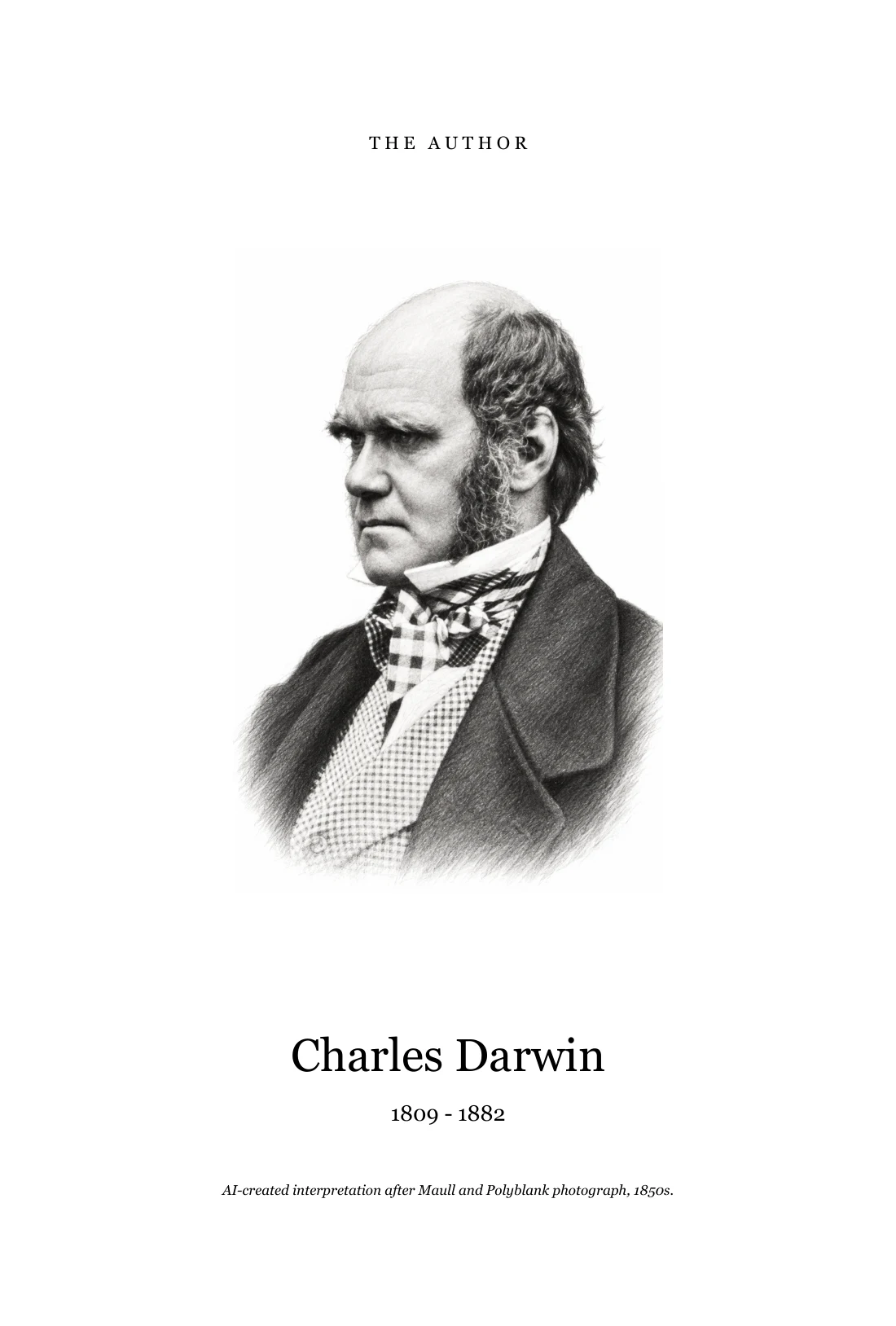
On Tuesday 22 November 1859, the publisher John Murray held his autumn sale, the occasion on which booksellers placed their orders for the season’s new titles. On the list was a long, closely argued book by a naturalist best known for his account of the voyage of the Beagle. By the end of the sale the edition was gone. Booksellers had asked for more copies than Murray could supply, and On the Origin of Species was not due to be published for another two days.
So the famous story is true, with a twist. On the Origin of Species did sell out on its first day, but the first day that counted was the trade sale, not publication day, and the buyers were booksellers rather than readers. Charles Darwin recorded in his journal that all copies were sold the first day, and that line helped turn a brisk trade order into a legend of crowds emptying the shelves.
How many copies of On the Origin of Species sold on the first day?
Every copy that was available. Not all 1,250 copies could be sold: twelve went to Darwin, forty-one to reviewers and five to Stationers’ Hall, and Darwin took at least twenty more to give away. Accounts of the orders taken at the sale differ slightly, but they agree that Murray finished it hundreds of copies short.
Nobody can say how many of those copies reached a reader that week. Once a book is in the shops its sales are invisible to the publisher, which is why the Darwin bibliographer R. B. Freeman called the idea that all 1,250 were bought by the public on publication day a mistake. What is certain is that Murray did not simply reprint. He asked Darwin to prepare a second edition at once, and it appeared on 7 January 1860 in a printing of 3,000 copies, the largest of any edition in Darwin’s lifetime.

A best-seller its author called an abstract
The irony is that Darwin thought of the book as a stopgap. He had begun gathering facts on the question in 1837 and sketched his conclusions in 1844, but the big work he was planning was years from finished. Then Alfred Russel Wallace, collecting in the Malay Archipelago, sent him a paper reaching almost exactly the same conclusions. Extracts from Darwin’s manuscripts were published beside Wallace’s paper by the Linnean Society, and Darwin hurried out what his own introduction calls an “Abstract”.
Not everyone in Murray’s circle expected it to sell. Whitwell Elwin, editor of the Quarterly Review, read the manuscript for the publisher in May 1859 and worried that a theory without its full evidence would do Darwin an injustice. He warmly endorsed Charles Lyell’s suggestion that Darwin publish his observations on pigeons first, with the theory in brief. Darwin kept his book as it was — though anyone who opens it will find that the pigeons made it in anyway.
I have, after deliberation, taken up domestic pigeons. I have kept every breed which I could purchase or obtain.
Charles Darwin, On the Origin of Species, Chapter I
The first chapter is about domestic breeding: tumblers and carriers, cabbages and cattle, the everyday evidence of change that any Victorian farmer or fancier could check. Darwin starts there deliberately, building from the familiar to the vast.
The word Darwin left out
Here is the sentence that ends the first edition, and its last word is the closest Darwin comes to the term most people associate with him.
from so simple a beginning endless forms most beautiful and most wonderful have been, and are being, evolved.
Charles Darwin, On the Origin of Species (1859)
The word “evolution” itself does not appear in the Origin until the sixth edition of 1872. That was also the edition in which the title was trimmed to The Origin of Species, dropping the “On”, though the subtitle about favoured races in the struggle for life stayed.
Six editions in thirteen years
Darwin went on revising the book through six editions in his lifetime, answering objections and adding material as he went, so “the Origin” is really a family of texts. The first edition is the book as it first met the world; the sixth is the version Darwin left as his final word.
- 1837
Back from the Beagle voyage, Darwin begins collecting facts on the origin of species
- 1844
He enlarges his notes into a sketch of his conclusions
- 1858
Wallace sends Darwin a paper with the same idea, and both are published by the Linnean Society
- 22 Nov 1859
Booksellers take every available copy at John Murray’s autumn sale
- 24 Nov 1859
On the Origin of Species is published
- 7 Jan 1860
A second edition of 3,000 copies appears
- Feb 1872
The sixth edition shortens the title and uses the word “evolution” for the first time
Is On the Origin of Species hard to read?
Less than its reputation suggests. Darwin writes in long sentences, but plainly, and he is unusually honest about the weak points in his own case: a whole chapter is given to difficulties on his theory. Read a chapter at a time, it feels less like a textbook than a long conversation with a careful, slightly anxious friend who wants you to check his working.
For more on books that caused a stir the moment they appeared, see Did you know Uncle Tom’s Cabin was the best-selling novel of the 19th century?, or Books that predicted the future for ideas that arrived early.
Start, as Darwin did, with the pigeons. By the time On the Origin of Species reaches its tangled bank, you will see why booksellers could not get enough of it.
Questions readers ask
Did On the Origin of Species sell out on the first day?
Yes, in a sense. Booksellers ordered more than the roughly 1,170 copies available at John Murray’s trade sale on 22 November 1859, two days before publication. Whether all of them reached readers on publication day is not known.
When was On the Origin of Species published?
It was published on Thursday 24 November 1859 by John Murray in London.
How many copies of the first edition of On the Origin of Species were printed?
Murray printed 1,250 copies. A second edition of 3,000 copies followed on 7 January 1860.
Does Darwin use the word evolution in On the Origin of Species?
Not in the first edition, which ends with the word “evolved”. The word “evolution” first appears in the sixth edition of 1872.