
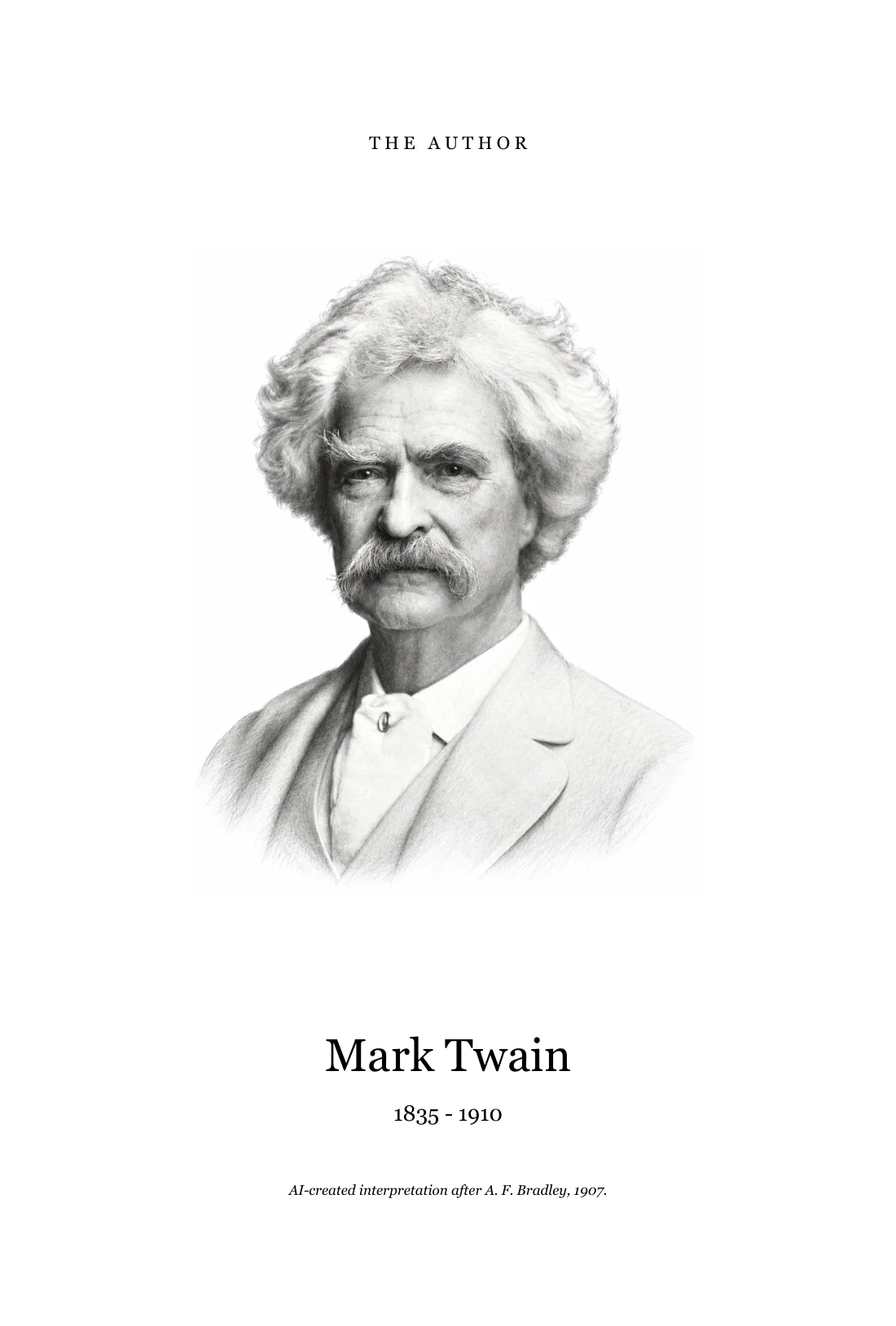
The meaning of Mark Twain’s pen name is a measurement. On a Mississippi steamboat, a crewman called the leadsman dropped a weighted line over the side to sound the depth and sang out the reading to the pilot. “Mark twain” meant the line was wet to the second mark: two fathoms, or twelve feet. For a riverboat, that was safe water.
Samuel Langhorne Clemens knew the call because he spent the late 1850s learning and then working as a steamboat pilot. He first signed himself “Mark Twain” in 1863, as a newspaper reporter in Nevada, and he never really gave it up. Almost everything we love him for, from Tom Sawyer to Huckleberry Finn, traces back to that river.
What does “mark twain” mean?
“Twain” is an old word for two, the same one that survives in “never the twain shall meet”. The sounding line was marked at intervals with strips of leather or cloth, and the leadsman called each depth as it passed: “quarter less twain”, “mark twain”, “mark three”. Twelve feet was enough clearance for a loaded steamboat, so the cry meant the pilot could breathe easily.

From cub pilot to licensed pilot
Clemens grew up in Hannibal, Missouri, a river town on the west bank of the Mississippi, and like every boy there he wanted to work on the boats. In 1857 he persuaded the pilot Horace Bixby to take him on as a “cub”, an apprentice, and by 1859 he had his licence. It was a well-paid, highly respected job, and he later said he loved it more than any work he ever did.
When I was a boy, there was but one permanent ambition among my comrades in our village on the west bank of the Mississippi River. That was, to be a steamboatman.
Mark Twain, Life on the Mississippi (1883)
The river also brought him his greatest grief. In 1858 his younger brother Henry, who had found work on a steamboat with Sam’s help, was fatally injured when the boat’s boilers exploded. Then in 1861 the Civil War closed the river to commercial traffic, and his piloting career was over after barely four years.
Why did Samuel Clemens choose the name Mark Twain?
Twain gave his own explanation in Life on the Mississippi. He said an old pilot, Captain Isaiah Sellers, had used “Mark Twain” to sign river notes for a New Orleans newspaper, and that he took the name when Sellers died. It is a good story, but historians have never found any of Sellers’s pieces signed that way, and Sellers was still alive when Clemens first used the name.
A rival tale comes from his Nevada days, when he is said to have run up drinks on credit in Virginia City saloons by calling for two at a time and telling the barman to “mark twain” on the slate. That version is no better documented. What is certain is that the phrase came from the river, and that he picked a name that sounded like a real person and carried a whiff of danger and adventure. He went west to Nevada and California after the war, a period he turned into Roughing It, and the name went with him.

The Mark Twain books the river made
Not all of his books are about the Mississippi, but the river years run through his best work: the voices, the small towns, the con men and the sense of freedom on the water.
Life on the Mississippi
1883. Part memoir of his years learning the river, part travel book about his return two decades later. The best account of how Clemens became Twain.
The Adventures of Tom Sawyer
1876. Boyhood in a Mississippi river town much like Hannibal, with whitewashed fences, pirates, a treasure hunt and a murder in a graveyard.
Adventures of Huckleberry Finn
1884. Huck and Jim, an enslaved man escaping to freedom, float down the river on a raft. Many consider it the great American novel.
The Prince and the Pauper
1881. Two identical boys, a prince and a beggar, swap places in Tudor London. Twain at his most playful.
A Connecticut Yankee in King Arthur’s Court
1889. A practical Connecticut factory man wakes up in Camelot and sets about modernising it. Comedy that turns surprisingly dark.


A word on Huckleberry Finn: it is written in the voice of a boy raised in a slave-holding town, and it uses the racial language of that time and place freely. Twain meant the book as a savage satire of that society, and it is still taught and still argued over. It is worth reading with that history in mind.
A name that outgrew the man
By the end of his life Mark Twain was perhaps the most famous American in the world, and the name had become a kind of character Clemens played in public, complete with white suit and cigar. Few pen names have stuck so completely; we gather others in famous pen names. Twain’s comic gift earns him a place in the funniest classic novels, and Huckleberry Finn sits at the heart of essential American classics.
If you want to hear the river in his voice, start with Life on the Mississippi. The early chapters, about a cocky young cub discovering how much he has to learn, are some of the warmest and funniest pages Mark Twain ever wrote.
Questions readers ask
What does the pen name Mark Twain mean?
It was a call used by leadsmen on Mississippi steamboats when they measured the depth of the water. “Mark twain” meant two fathoms, or twelve feet, which was safe water for a riverboat.
Was Mark Twain really a riverboat pilot?
Yes. Samuel Clemens trained as a cub pilot from 1857 and was a licensed Mississippi pilot from 1859 until the Civil War stopped river traffic in 1861.
When did Samuel Clemens start using the name Mark Twain?
He first used it in 1863, while working as a reporter for a newspaper in Virginia City, Nevada.
Which Mark Twain book is about the Mississippi River?
Life on the Mississippi is his memoir of the river and his piloting years. The Adventures of Tom Sawyer and Adventures of Huckleberry Finn are also set along it.
 The Innocents Abroad526 pages · $23.99
 Roughing It442 pages · $20.99
 Sketches New and Old286 pages · $16.99
 The Tragedy of Pudd'nhead Wilson154 pages · $12.99