
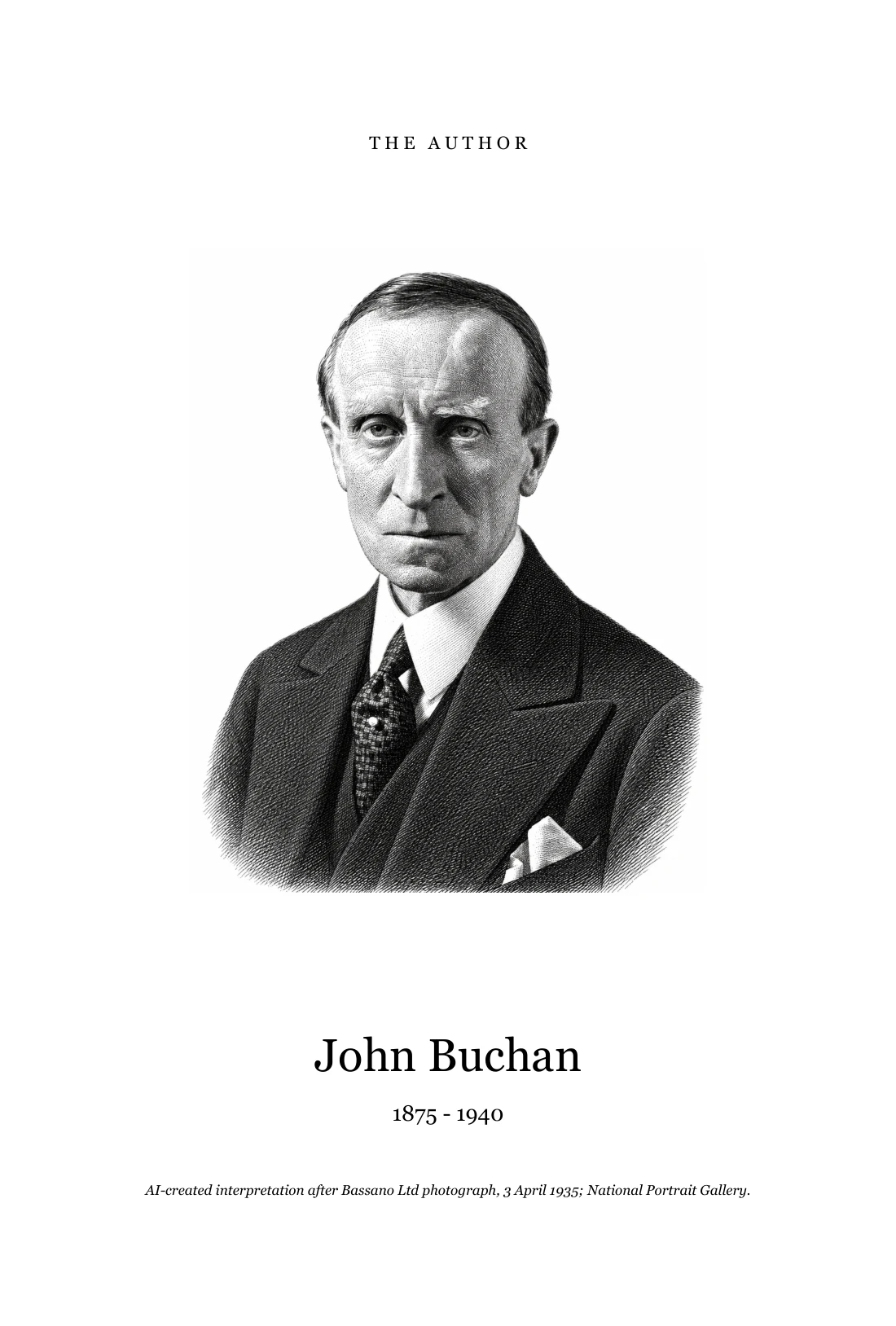
John Buchan’s 1935 would seem far-fetched in one of his own novels. On 1 June he was created Baron Tweedsmuir of Elsfield. That November he was sworn in as Governor General of Canada, in the parliament buildings at Quebec City. In between, Hitchcock’s film of his most famous novel made Richard Hannay a star of the screen. Buchan held the office until his death in February 1940.
If you have come here wondering which John Buchan books to read, the answer is simple: begin with The Thirty-Nine Steps, which he called a “shocker”, and if it grips you, follow Hannay into Greenmantle and Mr. Standfast. But the life behind the books is remarkable enough to be worth a few minutes first.
- 1875
John Buchan is born in Perth, Scotland, on 26 August.
- 1895
He publishes his first novel while still a student.
- 1901–03
Serves on Lord Milner’s staff in South Africa at the end of the Boer War.
- 1907
Leaves the Bar to join the publishers Thomas Nelson and Sons.
- 1915
The Thirty-Nine Steps introduces Richard Hannay.
- 1917
Becomes Director of Information during the First World War.
- 1927
Elected MP for the Combined Scottish Universities.
- 1935
Created Baron Tweedsmuir and sworn in as Governor General of Canada.
- 1940
Dies in Montreal on 11 February after a stroke, still in office.
How did a novelist become Governor General of Canada?
By a long road. Buchan was a minister’s son from Scotland who studied at Glasgow and Oxford, practised as a barrister, and worked in turn as a colonial administrator, a publisher, a war correspondent, a wartime propagandist and a Member of Parliament. He wrote all the while: well over a hundred books, including histories and biographies as well as fiction.
Canada’s prime minister of the day, R. B. Bennett, put his name forward, and the opposition leader, William Lyon Mackenzie King, had long admired him. King had suggested he might serve as plain Mr Buchan, but George V insisted on a peer, hence Lord Tweedsmuir. His first year in office was eventful: George V died, Edward VIII abdicated, and Buchan reportedly remarked that within a year he had represented three kings.
He took the job seriously. He travelled the country as far as the Arctic, argued that a Canadian’s first loyalty was to Canada, and in 1936, with the Canadian Authors Association, launched what became the Governor General’s Literary Awards, still the country’s best-known prizes for books. He also kept writing. His memoir Memory Hold-the-Door was written at Rideau Hall, and his last novel, Sick Heart River, sends his hero Edward Leithen into the Canadian north. It appeared posthumously in 1941.

The John Buchan books to read first
The Power-House
Serialised 1913, in book form 1916. A young barrister discovers that a cultured London collector runs a criminal network. Written before Hannay existed, and the first outing for the barrister Edward Leithen.
The Thirty-Nine Steps
1915. A bored mining engineer, a murdered stranger in his flat and a chase across the Galloway hills. Short, fast and the template for every man-on-the-run story since.
Greenmantle
1916. Hannay is sent east through wartime Germany to Constantinople to stop a rising. The most exotic of the three, and Buchan at full gallop.
Mr. Standfast
1919. Undercover among pacifists from the Cotswolds to Glasgow and Skye, then on to the Alps and the Western Front. The most personal of the Hannay books, steeped in The Pilgrim’s Progress.
Huntingtower
1922. A retired Glasgow grocer on a walking holiday stumbles into a plot to seize a Russian princess. Buchan at his warmest and funniest.


Start with the shocker
Buchan dedicated The Thirty-Nine Steps to his friend Thomas Arthur Nelson, explaining that he had written it during an illness, having run out of the cheap thrillers he liked to read. His definition of the genre has never been bettered: “the romance where the incidents defy the probabilities, and march just inside the borders of the possible.”
At about a hundred pages in our edition, it can be read in an evening, and it set a pattern that Graham Greene later said adventure writers had followed ever since. For the full sequence of Hannay’s adventures, see Richard Hannay in order, and for how Hitchcock reshaped the plot, The Thirty-Nine Steps: book vs. Hitchcock.
If you want to see where it began, read The Power-House first. It is even shorter, and its villain, Andrew Lumley, delivers the speech that sums up Buchan’s whole view of the world.
You think that a wall as solid as the earth separates civilisation from barbarism. I tell you the division is a thread, a sheet of glass.
John Buchan, The Power-House (1916)

Reading Buchan today
Buchan wrote as an imperialist of his time, and his books carry its prejudices: some of his characters speak about Jews, Africans and others in ways that will jar. Critics still argue about how far those views were his own, and his granddaughter has pointed out that the narrator of The Thirty-Nine Steps dismisses the worst of them. It is fair to know before you start.
What lasts is the pace, the landscapes and the sense that ordinary life is thin ice over something dangerous. There is more of that in Classic war novels, and on screen in Hitchcock films based on classic books. But the original shocker comes first. The Thirty-Nine Steps begins on a dull May afternoon in London with Hannay bored stiff, and it is not many pages before he is running for his life.
Questions readers ask
Was John Buchan Governor General of Canada?
Yes. John Buchan, created Lord Tweedsmuir in 1935, served as Governor General of Canada from November 1935 until his death in February 1940.
What is John Buchan’s most famous book?
The Thirty-Nine Steps (1915), the first Richard Hannay novel, filmed by Alfred Hitchcock in 1935.
What order should I read John Buchan’s books in?
Begin with The Thirty-Nine Steps, then Greenmantle and Mr. Standfast, which follow Hannay through the First World War. The Power-House and Huntingtower start his other two series.
 Midwinter214 pages · $14.99
 The Courts of the Morning338 pages · $17.99
 The Three Hostages258 pages · $15.99
 Castle Gay326 pages · $17.99