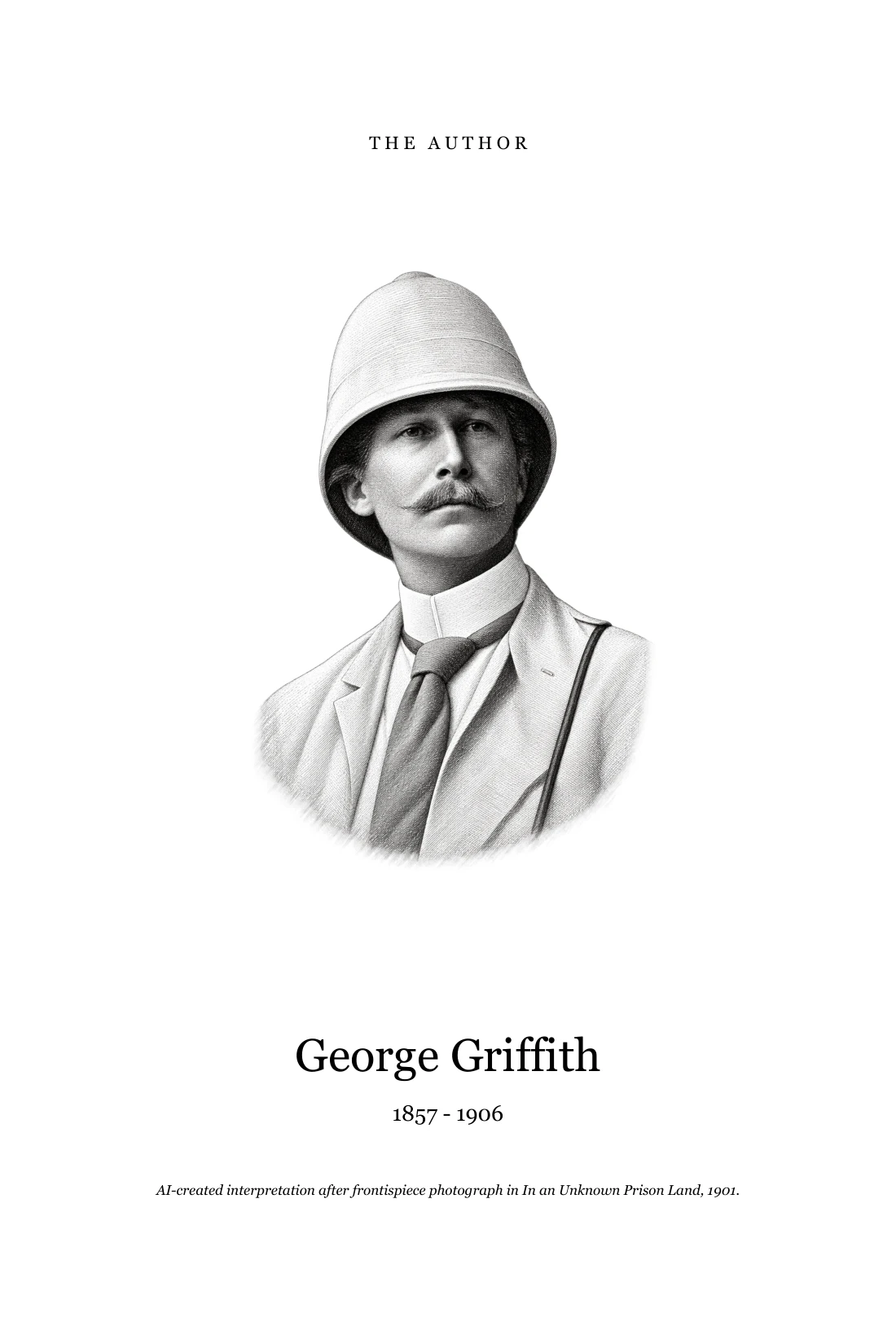

“How I Broke the Record Round the World.” That was the headline Pearson’s Weekly gave George Griffith in the summer of 1894, when it serialised his account of a journey around the globe in sixty-five days, from 12 March to 16 May. Pearson had sent him to beat the seventy-six days of Elizabeth Bisland, whose journey the magazine had serialised, and Griffith, who had travelled widely as a young man, was the obvious choice.
On paper he beat Bisland easily, and her rival Nellie Bly’s seventy-two days too, though round-the-world records were loosely kept and other travellers made rival claims. But the stunt says everything about Griffith’s place in the 1890s. He was Pearson’s star, a writer of breathless future wars and sky battles, and for a few years the best-selling science fiction author in the country. His last great success, A Honeymoon in Space (1901), is the easiest way to meet him now.
Who was George Griffith?
He was born George Chetwynd Griffith-Jones in Plymouth in 1857, the son of a clergyman, and was largely taught at home from his father’s library, which was full of Walter Scott and Jules Verne. After his father’s death he had little more than a year of proper schooling before money ran out. At fifteen he went to sea as an apprentice, deserted his ship in Melbourne, and worked his way around Australia and beyond before coming home at nineteen.
For ten years he taught school, published poems under the name Lara, and moved to London to try journalism. A failed radical newspaper and a lost libel case left him penniless, and in 1890 he took a job on the new Pearson’s Weekly, at first writing addresses on envelopes for its competitions. He talked his way into a column, and in 1893 volunteered to write the magazine a future-war serial.
The Angel of the Revolution and the airship wars
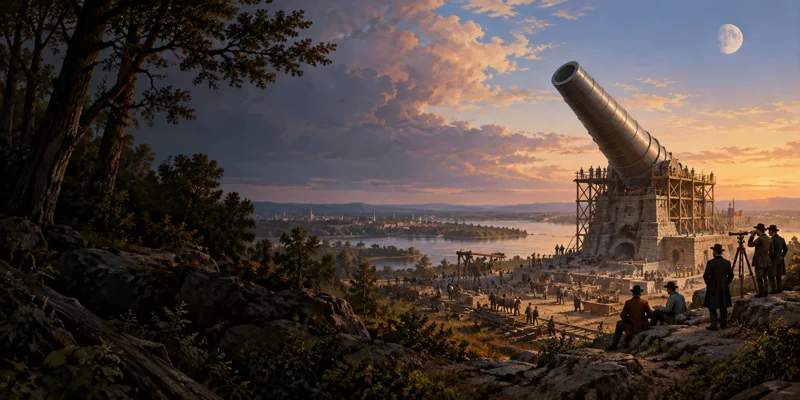
The Angel of the Revolution ran through most of 1893 and made him famous. A secret brotherhood of revolutionaries builds a fleet of armed airships, wins a world war against the great powers and imposes peace from the sky. Its sequel, Olga Romanoff (1894), ends the peace with a new villain and a comet. Writing years before the first aeroplane flight, Griffith grasped how completely air power would change war, which is why historians of the genre still take him seriously.
He was also wildly productive, turning out serials, short stories under pseudonyms and travel reports. He changed his name legally to George Griffith by deed poll in 1894. But by the end of the decade a younger writer at the same magazines, H. G. Wells, had overtaken him with readers and with Pearson alike.
What is A Honeymoon in Space about?
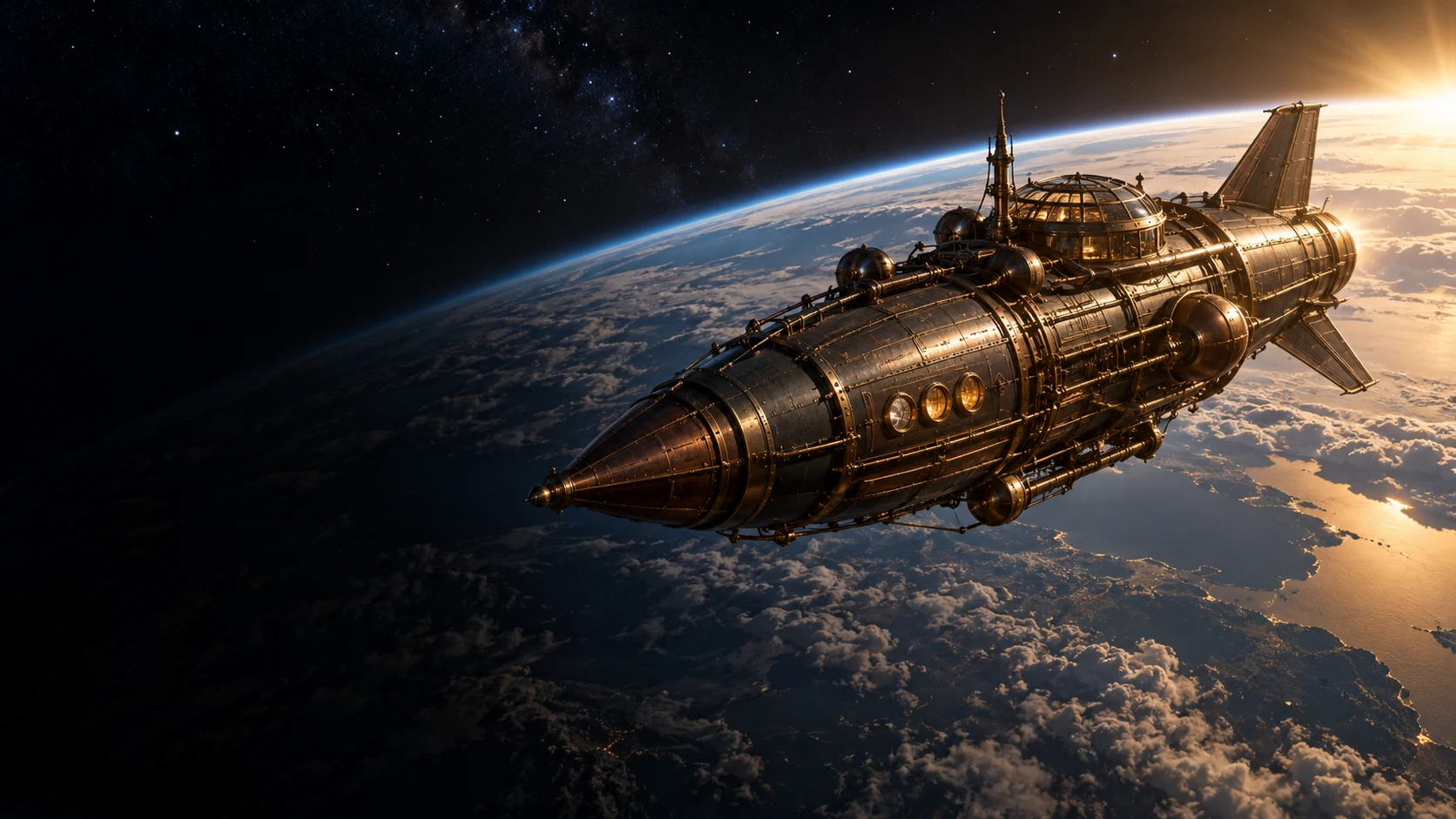
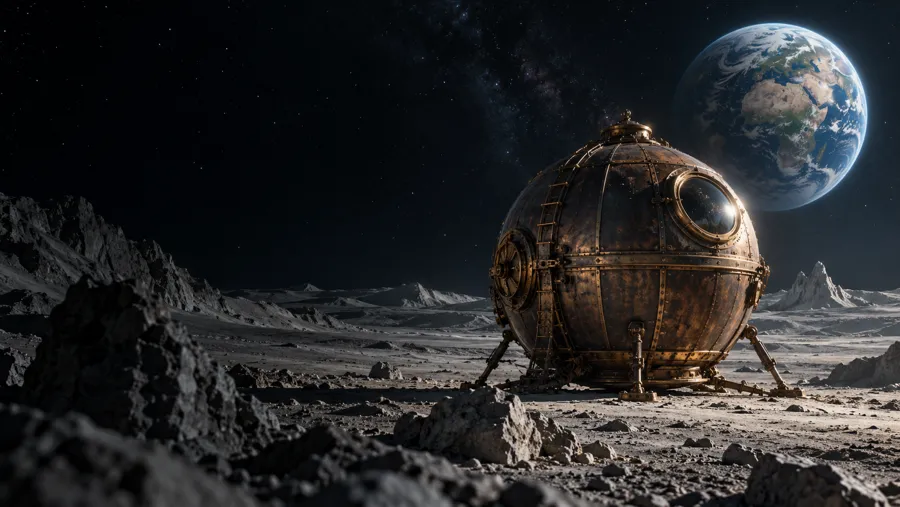
An English earl, Lord Redgrave, has built a spaceship, the Astronef, powered by a mysterious anti-gravity “R. Force” discovered by the late father of the American woman he loves. He snatches her from an ocean liner, marries her above Washington, and takes her on a honeymoon to the Moon, Mars, Venus, the moons of Jupiter and Saturn.
the wedding breakfast held in the deck-chamber of the Astronef poised in mid-air, five hundred feet above the dome of the Capitol
George Griffith, A Honeymoon in Space (1901)
Each world shows them a different kind of society, from the ruins of a dead lunar civilisation to angelic Venusians who communicate by music. The episodes first appeared in Pearson’s Magazine in 1900 as “Stories of Other Worlds”. It is a planetary tour rather than a plot, and it carries the assumptions of its age openly: the Martians speak English, and the honeymooners are quick to use their guns. Read it as a postcard from 1900 and it is great fun.
A Honeymoon in Space
1901. A runaway earl, an American heiress and an anti-gravity ship on a tour of the solar system. Breezy, romantic, and a window on what 1900 thought space might hold.
From the Earth to the Moon
1865. Jules Verne’s Gun Club fires a shell at the Moon, with passengers. The book Griffith grew up on, and the ancestor of every space voyage that followed.
The First Men in the Moon
1901. H. G. Wells’s two-man expedition to the Moon, published the same year as Griffith’s honeymoon. Compare the two and you see why Wells won.


Why was George Griffith forgotten?
Partly because his books were topical rather than timeless, and partly because his prose is plainly cruder than Wells’s. His anti-American streak kept him out of the American market almost entirely. Some of his novels also carry the racial and imperial prejudices of their time, at times in ugly form, and few of his later books have been reprinted.
His last years were hard. His health and his sales declined together, and he moved his family to Port Erin on the Isle of Man, where living was cheaper. He died there on 4 June 1906, aged forty-eight.
For his place in the story, see The science fiction firsts: classics that invented the genre and Did you know The Skylark of Space helped launch the space opera?, and for the 1889 race that started the craze, Nellie Bly raced Phileas Fogg.
The Astronef is ready for boarding. Open A Honeymoon in Space, watch an earl steal a bride from an Atlantic liner, and enjoy the most Victorian space flight ever written.
Questions readers ask
Who was George Griffith?
A British writer (1857–1906) who was one of the most popular science fiction authors of the 1890s, best known for The Angel of the Revolution (1893), Olga Romanoff (1894) and A Honeymoon in Space (1901).
What is A Honeymoon in Space about?
An English earl and his American bride honeymoon aboard an anti-gravity spaceship, the Astronef, visiting the Moon, Mars, Venus and the moons of Jupiter and Saturn. It first appeared as a magazine serial in 1900.
Was George Griffith more popular than H. G. Wells?
For a few years in the mid-1890s he was the leading science fiction writer at Pearson’s and with the public, but Wells overtook him by the end of the decade.