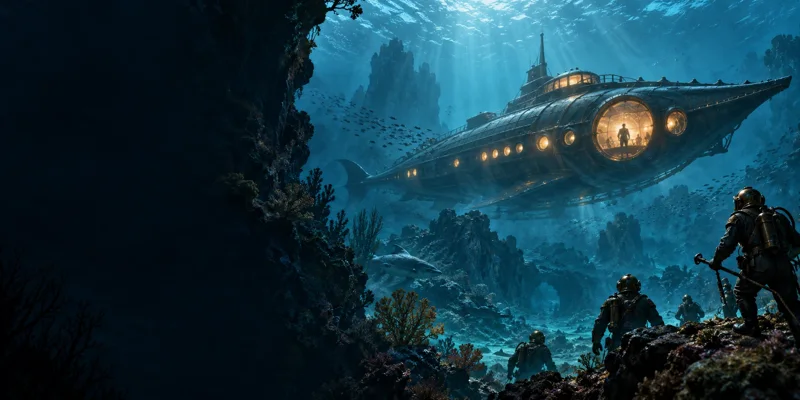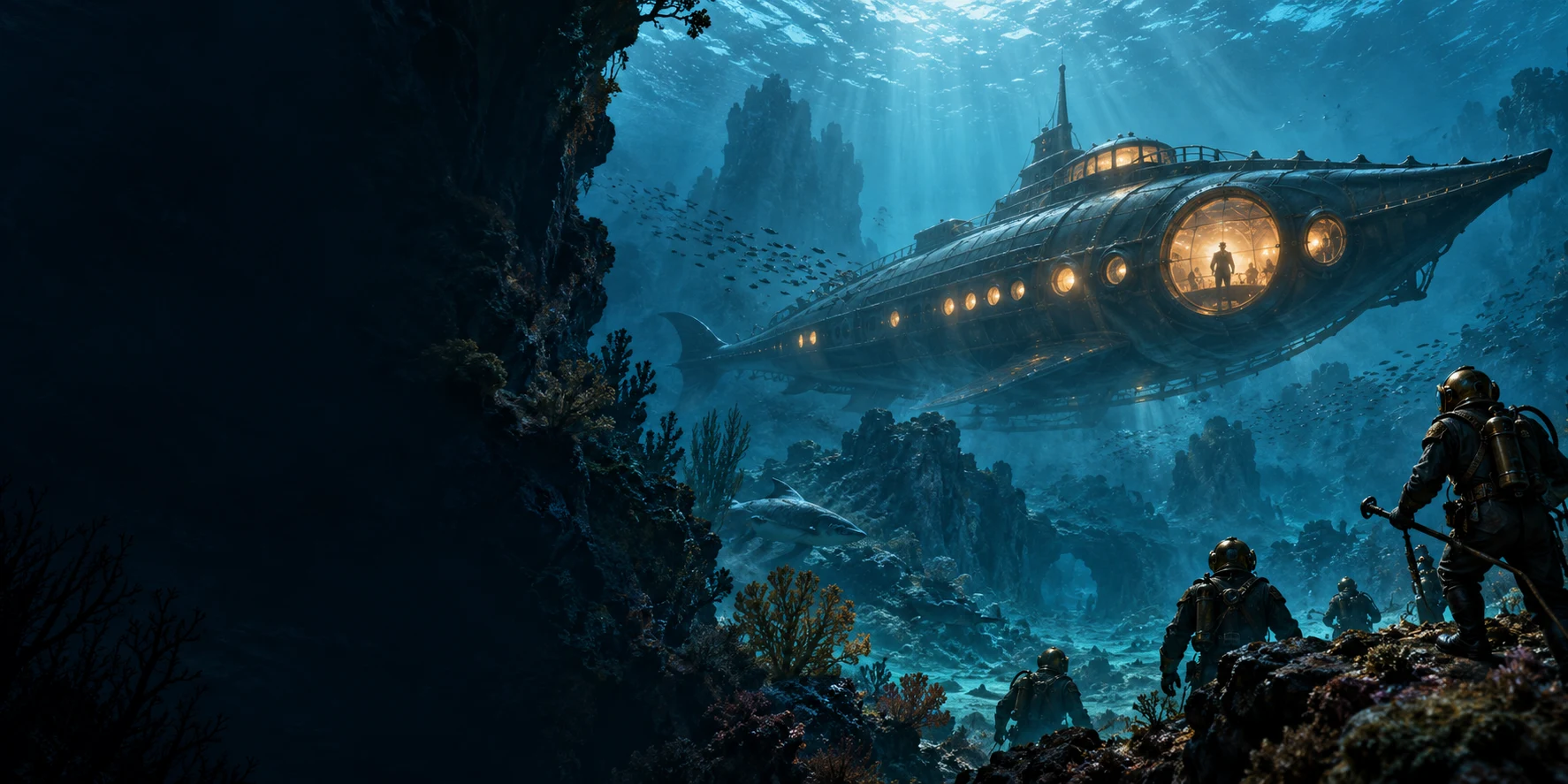
When Jules Verne first imagined the captain of the Nautilus, he gave him a clear past: a Polish patriot whose family had been killed by Russian forces during the uprising of 1863, now taking his revenge from beneath the sea. His publisher, Pierre-Jules Hetzel, was horrified. Russia was a valuable market. After a long fight the two men settled on a compromise, and Nemo’s past was left a mystery, which is a large part of why he is so haunting.
That tug of war between a restless imagination and a careful publisher produced one of the great series in fiction. Jules Verne wrote fifty-four Voyages extraordinaires in his lifetime, and eight more appeared after his death, several heavily rewritten by his son Michel. If you are wondering which Jules Verne books to read first, these six are the ones that made his name.
The best Jules Verne books to start with
- $17.99
Twenty Thousand Leagues Under the Sea
1869–70. Professor Aronnax, his servant Conseil and the harpooner Ned Land are taken aboard the Nautilus by the enigmatic Captain Nemo. Undersea forests, Atlantis, the South Pole. Verne’s masterpiece.
- $15.99
Journey to the Centre of the Earth
1864. A Hamburg professor deciphers a runic message and drags his reluctant nephew down an Icelandic volcano towards the centre of the earth. The most dreamlike of the Voyages.
- $13.99
Around the World in Eighty Days
1872. Phileas Fogg bets half his fortune that he can circle the globe in eighty days. Brisk, funny and full of railway timetables, with an ending that still delights.
- $24.99
The Mysterious Island
1874–75. Five Northern prisoners of war escape the siege of Richmond in a stolen balloon and land on an unknown Pacific island, where they rebuild civilisation from scratch. Connected to two earlier Verne novels in ways best discovered as you go.
- $17.99
From the Earth to the Moon
1865. After the Civil War, the bored artillery experts of the Baltimore Gun Club decide to fire a projectile at the Moon. Satire as much as science, and it ends on a cliffhanger.
- $17.99
Five Weeks in a Balloon
1863. Three Englishmen cross Africa by balloon. Verne’s first novel for Hetzel, and the template for everything that followed.



Where should a beginner start with Jules Verne?
Start with Around the World in Eighty Days if you want pace, or Journey to the Centre of the Earth if you want strangeness. Both are short, both move fast, and both show Verne’s great trick: making an impossible journey feel like a matter of planning, equipment and nerve. Then read Twenty Thousand Leagues Under the Sea, which is longer and slower but richer, and has Verne’s most memorable character at its heart.
The Mysterious Island is the one to save for last. It is long, but it is also one of the great castaway stories, and it rewards readers who already know the earlier books.
“Descend into the crater of Yocul of Sneffels, which the shade of Scartaris caresses, before the kalends of July, audacious traveler, and you will reach the centre of the earth. I did it.”
Arne Saknussemm’s deciphered message, Journey to the Centre of the Earth (1864)
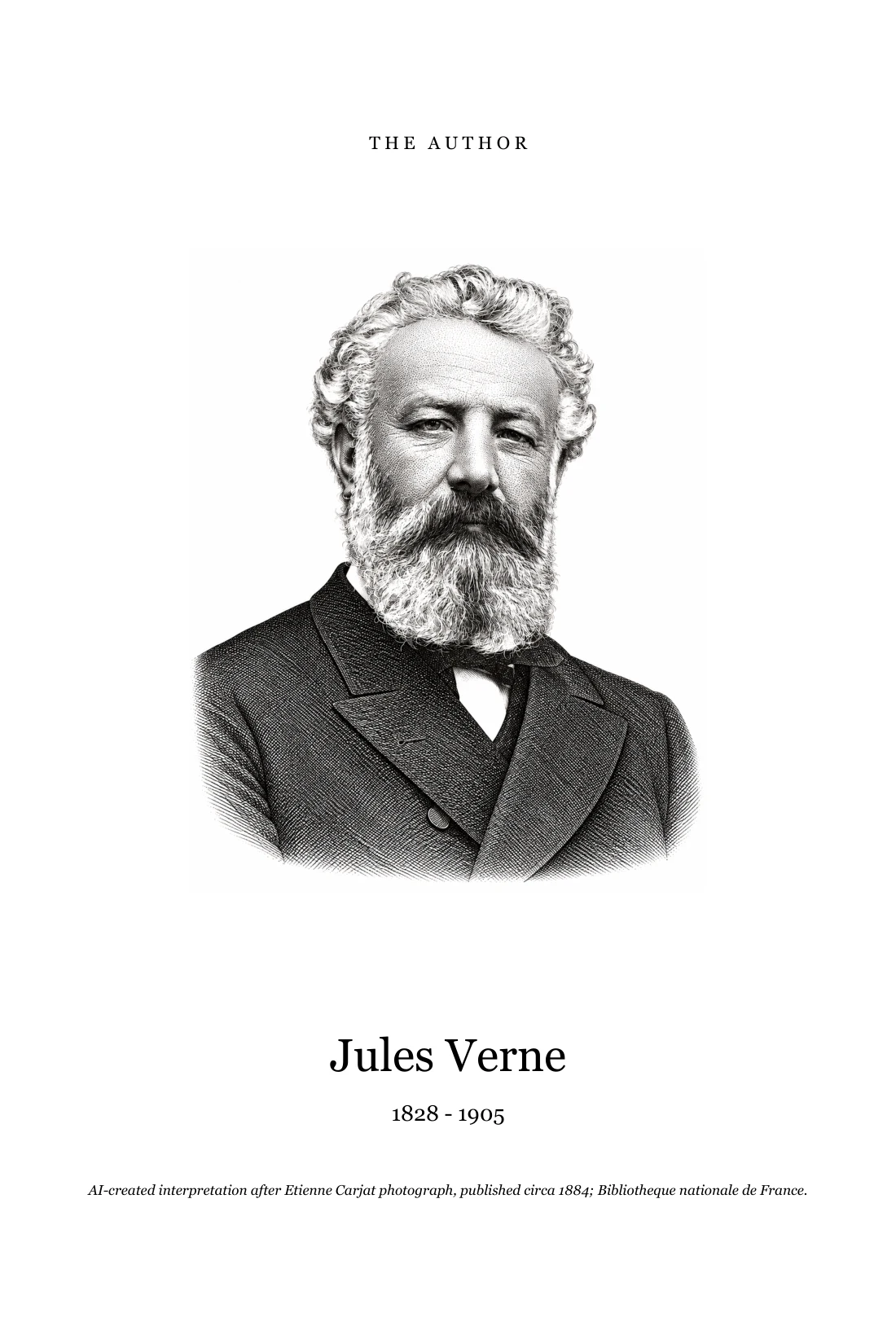
A short life of Jules Verne
- 1828
Born on 8 February in Nantes, a port city on the Loire.
- 1848
Moves to Paris to study law, and begins writing plays instead.
- 1863
Five Weeks in a Balloon is published by Hetzel, the start of a partnership that lasts for the rest of Hetzel’s life.
- 1864
Journey to the Centre of the Earth is published.
- 1866
Hetzel announces the series title Voyages extraordinaires.
- 1869–70
Twenty Thousand Leagues Under the Seas is serialised in Hetzel’s magazine.
- 1872
Around the World in Eighty Days appears in the newspaper Le Temps.
- 1886
Hetzel dies, and Verne’s later books turn noticeably darker.
- 1905
Dies on 24 March at his home in Amiens.

Why translations matter with Verne
English-speaking readers long thought of Verne as a writer for boys, and the translations are partly to blame. The first English version of Twenty Thousand Leagues, published in 1872 by the Reverend Lewis Page Mercier, cut nearly a quarter of the text and introduced hundreds of errors. Some later critics who mocked Verne’s science were, it turned out, mocking Mercier’s mistakes. In France, meanwhile, Verne was admired by the Surrealists and treated as a serious novelist.
Older translations still circulate widely, and many are perfectly readable. If you fall for Verne, seek out a modern, complete translation of your favourite book to see what you missed.
Where to go after the big six
Verne’s catalogue is huge, and the next tier is full of good books: the Siberian adventure Michael Strogoff, the airship tale Robur the Conqueror and its darker sequel The Master of the World, and the Scottish mining novel The Underground City. For the real race that Fogg inspired, read Did you know Nellie Bly raced Phileas Fogg?; for the meaning of that famous title, Twenty thousand leagues is a distance, not a depth; and for Verne’s place in the genre, science fiction firsts.
But for your first voyage, take the one Fogg took. Open Around the World in Eighty Days and watch a man who claims that “the unforeseen does not exist” discover how wrong he is.
Questions readers ask
What is the best Jules Verne book to read first?
Around the World in Eighty Days or Journey to the Centre of the Earth. Both are short and fast-moving, and they lead naturally on to Twenty Thousand Leagues Under the Sea.
How many books did Jules Verne write?
Fifty-four novels in the Voyages extraordinaires appeared in his lifetime, and eight more were published after his death in 1905, some heavily revised by his son Michel. He also wrote plays, short stories and non-fiction.
What are the Voyages extraordinaires?
The name Verne’s publisher Pierre-Jules Hetzel gave to the long series of adventure novels Verne wrote for him, starting with Five Weeks in a Balloon in 1863. Their aim was to combine adventure with the geography and science of the day.
Do I need to read Jules Verne’s books in order?
No. Nearly all of them stand alone. The exceptions are From the Earth to the Moon, which continues in Around the Moon, and The Mysterious Island, which connects to two earlier novels.
 The Master of the World128 pages · $11.99
 Robur the Conqueror158 pages · $12.99
 The Survivors of the Chancellor: Diary of J.R. Kazallon, Passenger170 pages · $13.99
 Michael Strogoff; Or, The Courier of the Czar278 pages · $16.99