
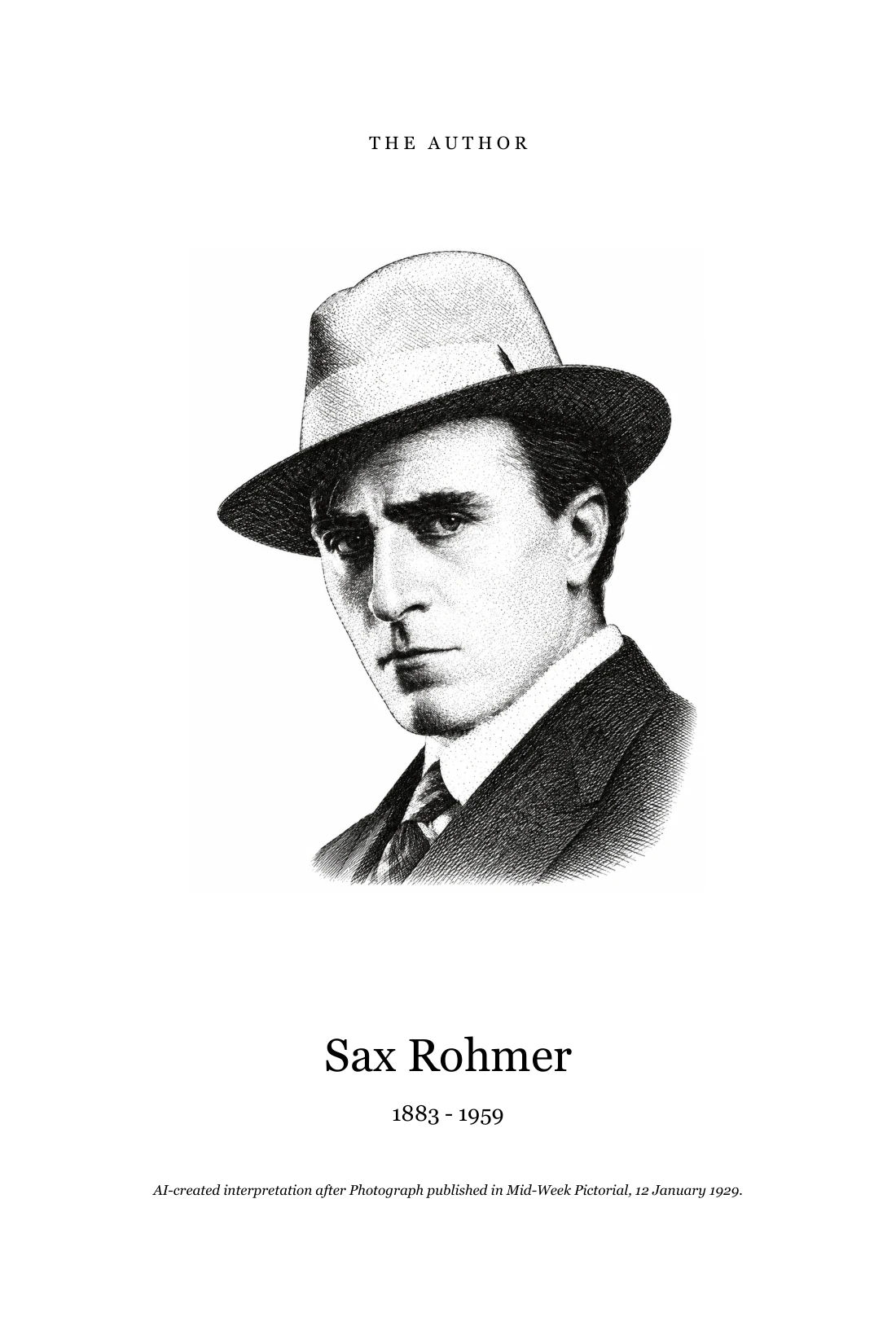
By his own account, Sax Rohmer once asked a Ouija board what would make his fortune, and it spelled out a word for a Chinese man. Whatever the truth of that story, the fortune followed. His first Fu Manchu stories began appearing in magazines in 1912, were gathered into a novel the next year, and turned a former writer of music-hall sketches into, it is said, one of the best-paid novelists of the years between the wars.
The books are still read, still in print and still argued over. This post answers the practical question, which Fu Manchu books to read and in what order, and the harder one: what to make of them now.
The first Fu Manchu books in order
Rohmer wrote three early books about Fu Manchu, then left him alone for fourteen years before reviving him in 1931 for a long second run. The first three were written while Rohmer lived at 51 Herne Hill in south London, where English Heritage has put up a blue plaque. Each had a different title in Britain and America.
- $14.99
The Insidious Dr. Fu Manchu
1913; published in Britain as The Mystery of Dr. Fu-Manchu. Nayland Smith arrives from Burma at Dr Petrie’s door, and the two begin chasing a mastermind through London’s docklands and far beyond.
- $14.99
The Return of Dr. Fu-Manchu
1916; British title The Devil Doctor. More episodes of poison, traps and narrow escapes, and more of Kâramanèh, the enslaved girl who keeps saving Petrie’s life.
- $13.99
The Hand of Fu-Manchu
1917; British title The Si-Fan Mysteries. The secret society behind Fu Manchu comes into view, and the first cycle reaches its climax.


All three are narrated by Petrie, a London doctor, and all three are episodic, because each began as a run of linked magazine stories. They are built like the Sherlock Holmes stories Rohmer admired, with Nayland Smith as the restless investigator and Petrie as the loyal chronicler. The difference is that the enemy is not a single criminal but, in the books’ own terms, a race.

What is the “Yellow Peril”?
The phrase was used in the decades around 1900 for a fear, common in Europe, America and Australia, that East Asian peoples would overwhelm the West by migration, conquest or conspiracy. Rohmer’s books arrived after the Boxer Rebellion and amid sensational British press stories about opium dens and the small Chinese community of Limehouse in the East End. As English Heritage puts it, the books deliberately played on those fears. Rohmer did not invent the stereotype, but he gave it a face. Nayland Smith describes that face in the first book, and the passage ends with the phrase that defined the series.
“Imagine that awful being, and you have a mental picture of Dr. Fu-Manchu, the yellow peril incarnate in one man.”
Nayland Smith to Dr Petrie, The Insidious Dr. Fu-Manchu (1913)
Historians have pointed out how far this picture was from the reality. The real Chinese community of Limehouse was small, and the historian Virginia Berridge has argued that it was among the more law-abiding of London’s immigrant groups. The Chinese government and Chinese American communities objected to the stories and, later, to the films.
Fu Manchu on screen
The films carried the stereotype much further than the books could. Warner Oland played Fu Manchu for Paramount from 1929, Boris Karloff in The Mask of Fu Manchu (1932), and Christopher Lee in five films between 1965 and 1969. The Mask of Fu Manchu drew a formal complaint from the Chinese Embassy in Washington. In 1940, with China at war with Japan, the US State Department is reported to have asked Republic Pictures to make no more Fu Manchu films.

Should you read Fu Manchu today?
That is your call, and there are good reasons on both sides. As thrillers, the early books are fast, inventive and atmospheric, full of fog, poisoned flowers and sudden violence, and Fu Manchu became the template for a century of evil masterminds and for a whole run of imitation “Yellow Peril” thrillers. As documents, they show how racist ideas were sold as entertainment to a mass readership, and how easily a sinister foreigner could be made to stand in for a whole people.
If you do read them, read them as history as well as adventure. Notice whom the books treat as human and whom they treat as a threat; notice how often Nayland Smith’s “knowledge” of China is simply assertion. And read some of the people Rohmer caricatured: the Chinese novelist Lao She, who taught in London from 1924 to 1929, drew on those years for Mr Ma and Son, a satire in which a Chinese father and son run into English prejudice at every turn.
For more on the period’s villains and detectives, see the golden age of detective fiction, our guide to books like Sherlock Holmes and the story of Philo Vance, who once shared a screen with Fu Manchu. To meet Sax Rohmer at the beginning, with all the questions the books raise, start with The Insidious Dr. Fu Manchu.
Questions readers ask
What order should I read the Fu Manchu books in?
Start with the first three, in order: The Insidious Dr. Fu-Manchu (1913), The Return of Dr. Fu-Manchu (1916) and The Hand of Fu-Manchu (1917). Rohmer continued the series from 1931, beginning with The Daughter of Fu Manchu.
Are the Fu Manchu books racist?
Yes. They are built on the “Yellow Peril” stereotype of Chinese people as a sinister threat to the West, and they were criticised for it by Chinese officials and communities at the time. Many readers now approach them as historical documents as well as thrillers.
Who created Fu Manchu?
Sax Rohmer, the pen name of the English writer Arthur Henry Ward (1883–1959). Fu Manchu first appeared in a magazine story in 1912.
Did Fu Manchu have a moustache in the books?
No. Rohmer describes him as having a close-shaven skull, and the long drooping “Fu Manchu moustache” comes from the film versions.
 She Who Sleeps228 pages · $14.99
 Moon of Madness158 pages · $12.99
 The Day the World Ended226 pages · $14.99