
Publishers Weekly’s list of the year’s best-selling novels for 1929 reads like a syllabus: Erich Maria Remarque’s All Quiet on the Western Front, Sinclair Lewis’s Dodsworth, Anne Douglas Sedgwick’s Dark Hester, and then, at number four, The Bishop Murder Case by S. S. Van Dine. The year before, The Greene Murder Case had held the same position. For a few years, few detectives in America sold like Philo Vance.
Today he is a name mystery fans half-recognise and few have read. That is a pity, because the early books are ingenious, and their hero is like no one else in the genre: a wealthy New York connoisseur of Chinese ceramics and Renaissance art who regards murder as an interesting problem in psychology and the police as well-meaning bores.
The Philo Vance books in order
Every title follows the same pattern, The — Murder Case, and in eleven of the twelve the missing word has exactly six letters.
- The Benson Murder Case (1926)
- The Canary Murder Case (1927)
- The Greene Murder Case (1928)
- The Bishop Murder Case (1929)
- The Scarab Murder Case (1930)
- The Kennel Murder Case (1933)
- The Dragon Murder Case (1933)
- The Casino Murder Case (1934)
- The Garden Murder Case (1935)
- The Kidnap Murder Case (1936)
- The Gracie Allen Murder Case (1938)
- The Winter Murder Case (1939), published after Wright’s death
Read them in that order if you read them all, but most readers stop after the first four, which is where the series is strongest. The first three were planned together as a trilogy before Wright sold them to the Scribner’s editor Maxwell Perkins.

Who was S. S. Van Dine?
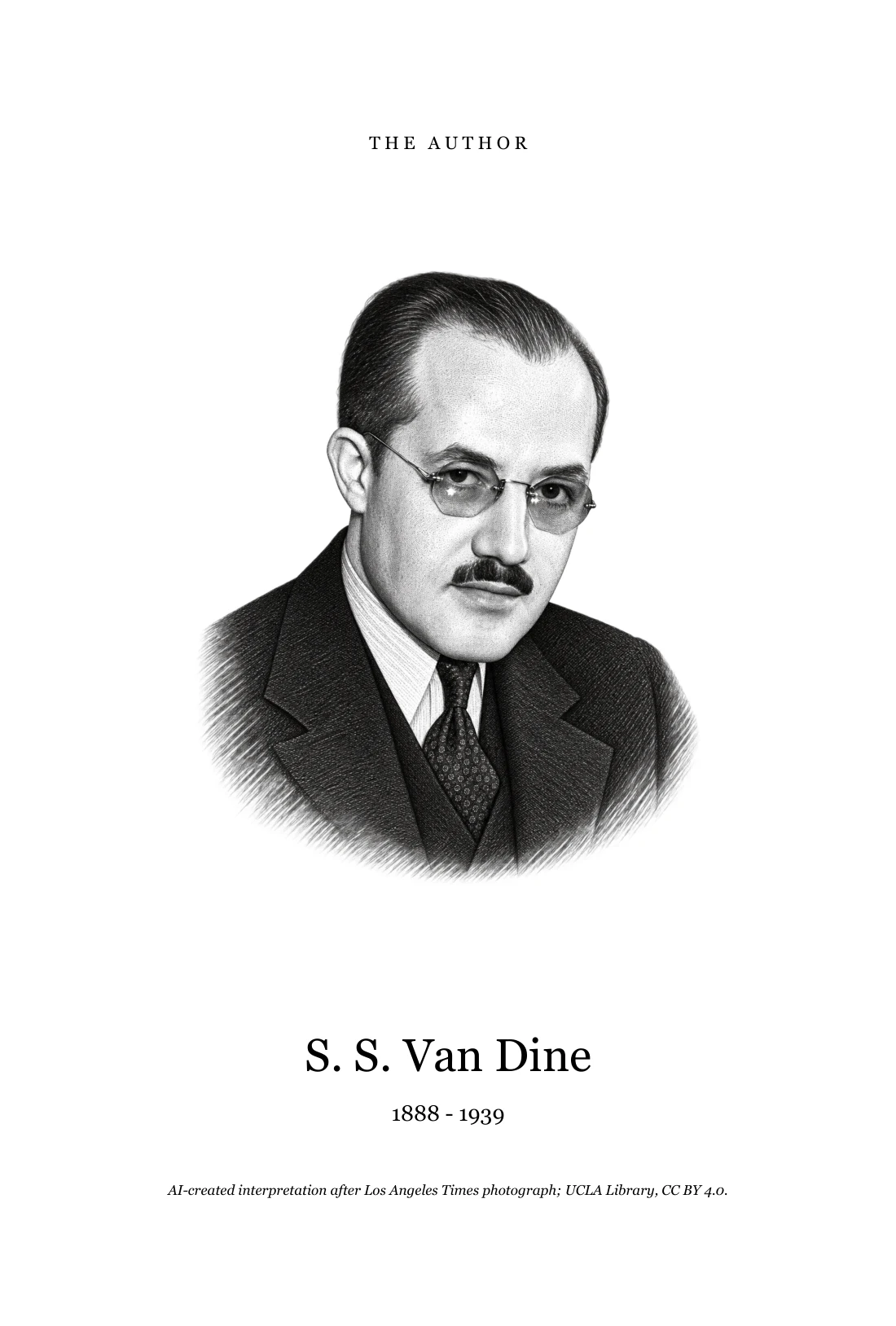
Behind the pen name was Willard Huntington Wright, a combative art critic and editor who had championed modern painting and once edited The Smart Set. By the early 1920s his career had collapsed, and he was seriously ill. He blamed overwork; his biographer John Loughery has argued that the real cause was a secret drug habit. Confined to bed for a long convalescence, Wright read crime fiction by the hundred, decided he could do better, and set about proving it.
He chose the pseudonym partly to hide his embarrassment at writing for the mass market, and in the books Van Dine is also a character: Vance’s old friend and legal adviser, who records every case and almost never speaks. The device lets Wright play an elaborate joke from the very first page, where Van Dine assures us that Philo Vance is not his friend’s real name and that the man himself has now “gone to Italy to live”.
The Benson Murder Case
1926. A Wall Street broker and man-about-town is found shot dead in a chair in his living room, and Vance offers to name the killer from the psychology of the crime alone. Loosely modelled on the unsolved 1920 murder of the bridge expert Joseph Bowne Elwell.
The Bishop murder case
1929. Murders patterned on “Who Killed Cock Robin?” and other nursery rhymes, around a household of physicists and mathematicians with a private archery range. Often credited as the first nursery-rhyme mystery.


What is Philo Vance like?
Insufferable, by design. Vance drops his g’s, quotes Latin, sprinkles his talk with “don’t y’ know” and adjusts his monocle when he is thinking. He despises the kind of detection that crawls about on carpets. His method, as he explains to his exasperated friend District Attorney Markham, is to read the character of the crime and work back to the only person who could have committed it.
“Won’t you ever learn that crimes can’t be solved by deductions based merely on material clues and circumst’ntial evidence?”
Philo Vance to District Attorney Markham, The Benson Murder Case (1926)
Around him Wright built a dependable cast: Markham, Sergeant Ernest Heath of the Homicide Bureau, the brisk, unsentimental medical examiner Dr Doremus, and Currie, Vance’s English butler. Most of the books open with a list of characters, like a play, and they play fair with the reader, which Wright regarded as a matter of principle.

Why did Philo Vance fall out of fashion?
Partly because the books got worse. After The Bishop Murder Case the plots thin and the mannerisms thicken. Partly because American crime fiction changed direction: by the early 1930s the hard-boiled school of Dashiell Hammett was setting the pace, and Hammett, reviewing The Benson Murder Case in 1927, had been notably unimpressed. The comic poet Ogden Nash is credited with the most famous verdict, a two-line verse suggesting that what Vance really needed was a kick in the pants.
Hollywood kept him going for a while. William Powell played Vance in The Canary Murder Case (1929) and three more films, Basil Rathbone took the role in The Bishop Murder Case (1929), and The Kennel Murder Case (1933) is still admired by film historians. Ellery Queen is widely believed to have been modelled on Vance, and the Golden Age taste for elaborate, rule-bound puzzles owes him a debt. Our guide to the Golden Age of detective fiction has the bigger picture, and Golden Age detective novels to start with picks his best rivals.
If you want to meet S. S. Van Dine at his most confident, begin with The Benson Murder Case. Vance knows who did it remarkably early, and the pleasure lies in watching him let everyone else get it wrong.
Questions readers ask
What order should I read the Philo Vance books in?
Publication order, beginning with The Benson Murder Case (1926), then The Canary, Greene and Bishop Murder Cases. Those first four are widely considered the best of the twelve.
How many Philo Vance books are there?
Twelve novels by S. S. Van Dine, from The Benson Murder Case (1926) to The Winter Murder Case, published in 1939 after the author’s death.
Who wrote the Philo Vance mysteries?
S. S. Van Dine, the pen name of the American art critic and editor Willard Huntington Wright (1888–1939), who at first tried to keep his authorship secret.
Is The Bishop Murder Case the first nursery-rhyme mystery?
It is often described as the first. Published in 1929, it builds a series of murders around “Who Killed Cock Robin?” and other Mother Goose rhymes, years before Agatha Christie used the idea.
 The Canary Murder Case266 pages · $15.99
 The Scarab Murder Case264 pages · $15.99