
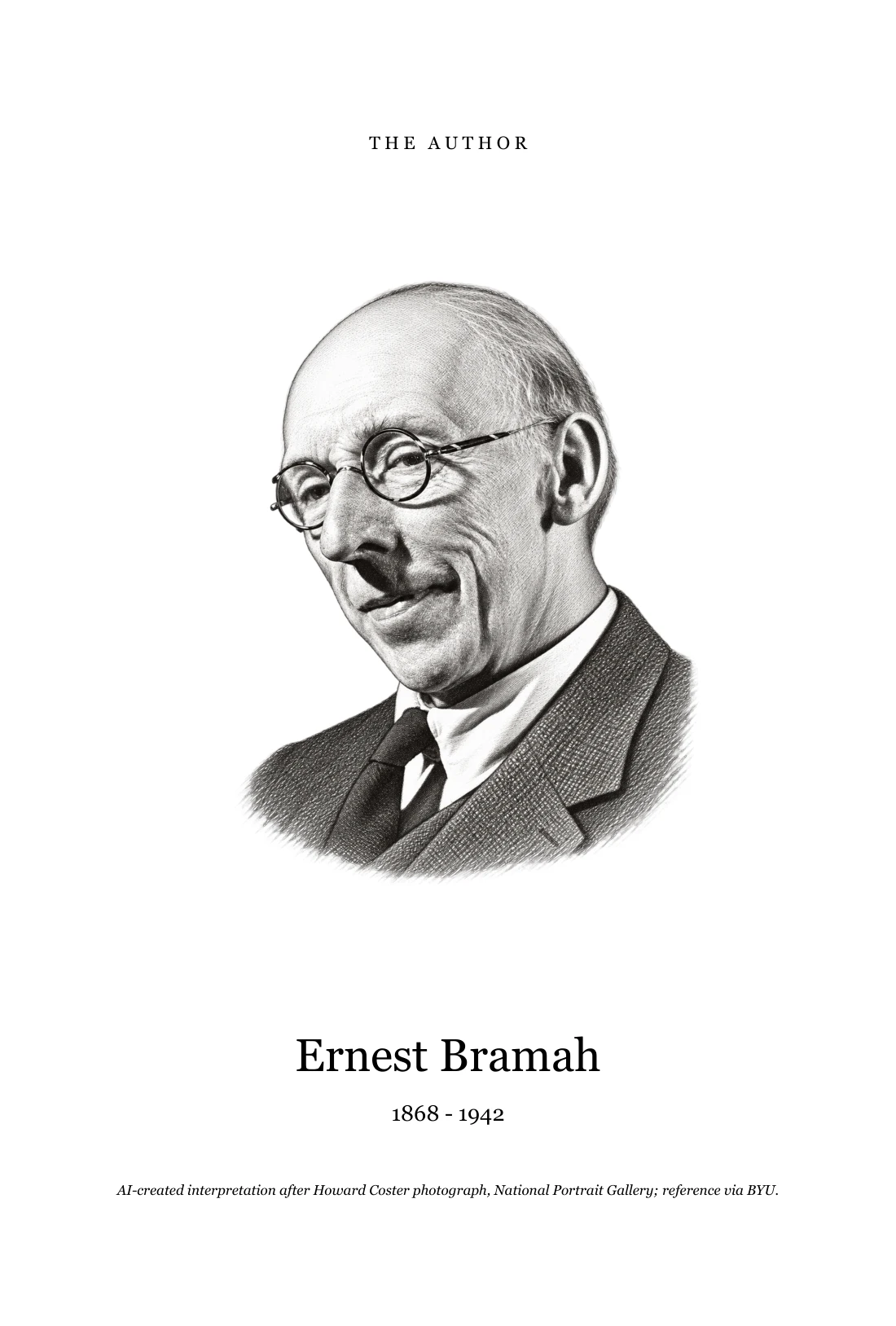
Search for the origin of “May you live in interesting times” and sooner or later you meet Ernest Bramah. The phrase is not Chinese, and it is not his either: it appears nowhere in his Kai Lung stories, and the likeliest source is a speech by the British politician Joseph Chamberlain. But the mistake is understandable. Nobody else in English wrote quite so many elaborate, courteous, faintly menacing sayings that sound as if they ought to be ancient.
Bramah is remembered for two quite different series. The Kai Lung books are comic tales within tales, narrated by a wandering storyteller in an imaginary China; the Max Carrados stories are detective fiction about a man who lost his sight as an adult. Of all the Ernest Bramah books, the best first choices are The Wallet of Kai Lung for laughter and Max Carrados for a puzzle.
Who was Ernest Bramah?
A very private man, which is why so little is known about him. He left Manchester Grammar School at sixteen, tried farming with his father’s money and lost a great deal of it, then wrote a rueful book about the experience that almost nobody bought. He went to London to write, worked as secretary to Jerome K. Jerome and on the staff of Jerome’s magazine To-Day, and edited other journals before his own books began to sell.
Even his pen name keeps something back. His birth certificate records his middle name as Brammah, his mother’s maiden name; Bramah is the same name with one letter dropped.
Who is Kai Lung?
Kai Lung is a professional storyteller who travels with his wallet of tales, unrolling his mat in market places and telling stories for small coins. He talks constantly, in a style of exquisite, roundabout politeness in which every insult is wrapped in a compliment and every compliment conceals a barb. The Wallet of Kai Lung is said to have been turned down by eight publishers before Grant Richards took it in 1900. In the later Kai Lung’s Golden Hours (1922), introduced by Hilaire Belloc, he tells stories to delay his own execution, like a Chinese Scheherazade.
after secretly observing the unstudied grace of her movements, the most celebrated picture-maker of the province burned the implements of his craft, and began life anew as a trainer of performing elephants.
Ernest Bramah, Kai Lung’s Golden Hours (1922)
Readers should know that Bramah’s China is a literary invention, closer to a fantasy kingdom than to any real place. In a 1923 letter to his publisher he said he had never been there. The comedy lies in the language rather than in mockery of real people, but it is still a Western writer playing with an exotic costume, and some readers will find that harder to enjoy than others.
Who is Max Carrados?
Max Carrados first appeared in 1914. He lost his sight after a twig flicked his eye on a bridle path, inherited a fortune from an American cousin on condition that he change his name, and now lives in comfort, advising collectors on ancient coins and solving crimes with his remaining senses. His partner is an old schoolfriend, Mr Carlyle, a struck-off solicitor turned private inquiry agent, who keeps underestimating him.
“Blindness invites confidence,” replied Carrados. “We are out of the running—human rivalry ceases to exist.”
Ernest Bramah, Max Carrados (1914)
The stories are clever and often tense, and Bramah takes care to make Carrados plausible. In the preface to the second collection he set his hero beside real blind achievers, from the Cambridge mathematician Nicholas Saunderson to the magistrate John Fielding and Helen Keller. George Orwell, by most accounts, ranked the Carrados books with Conan Doyle and R. Austin Freeman among the few detective stories since Poe worth reading twice.

Ernest Bramah books to start with
The Wallet of Kai Lung
1900. Kai Lung’s first collection, in which he talks his way out of trouble with tales of magicians, mandarins and misfortune. Read a story at a time.
Kai Lung's Golden Hours
1922. Imprisoned and facing death, Kai Lung tells a story each day to win more time, and falls in love with a girl who smuggles him advice. The most charming of the series.
Max Carrados
1914. Eight cases for the blind detective, from a forged Greek coin to a deadly game played in the dark. Golden Age detection before the Golden Age.
The eyes of Max Carrados
1923. Nine more Carrados cases, introduced by Bramah’s preface on the remarkable blind men and women of history.
The Mirror of Kong Ho
1905. Letters home from Kong Ho, a Chinese gentleman in London who finds the barbarians and their motor cars and pianos endlessly baffling. The satire faces west.


Where to go next
Max Carrados is one of many detectives who came after Holmes, and you can meet the others in Books like Sherlock Holmes. He gets a series guide of his own in Max Carrados: the blind detective of the Golden Age, and the storyteller in Who is Kai Lung?.
Kai Lung will unroll his mat whenever you are ready. Find a quiet half hour, open The Wallet of Kai Lung, and allow a man of extreme politeness to keep you from whatever you were meant to be doing.
Questions readers ask
What are Ernest Bramah’s best books?
The Wallet of Kai Lung (1900) and Kai Lung’s Golden Hours (1922) for comic storytelling, and Max Carrados (1914) for detective fiction. His satire The Mirror of Kong Ho (1905) is less known but sharp.
Did Ernest Bramah invent “May you live in interesting times”?
No. The saying is often linked to him, but it does not appear in the Kai Lung books. Researchers trace it most plausibly to a speech by Joseph Chamberlain in the 1890s.
Who was the blind detective Max Carrados?
Ernest Bramah’s detective, who lost his sight in a riding accident and solved crimes using his other senses. He first appeared in 1914 in the collection Max Carrados.