
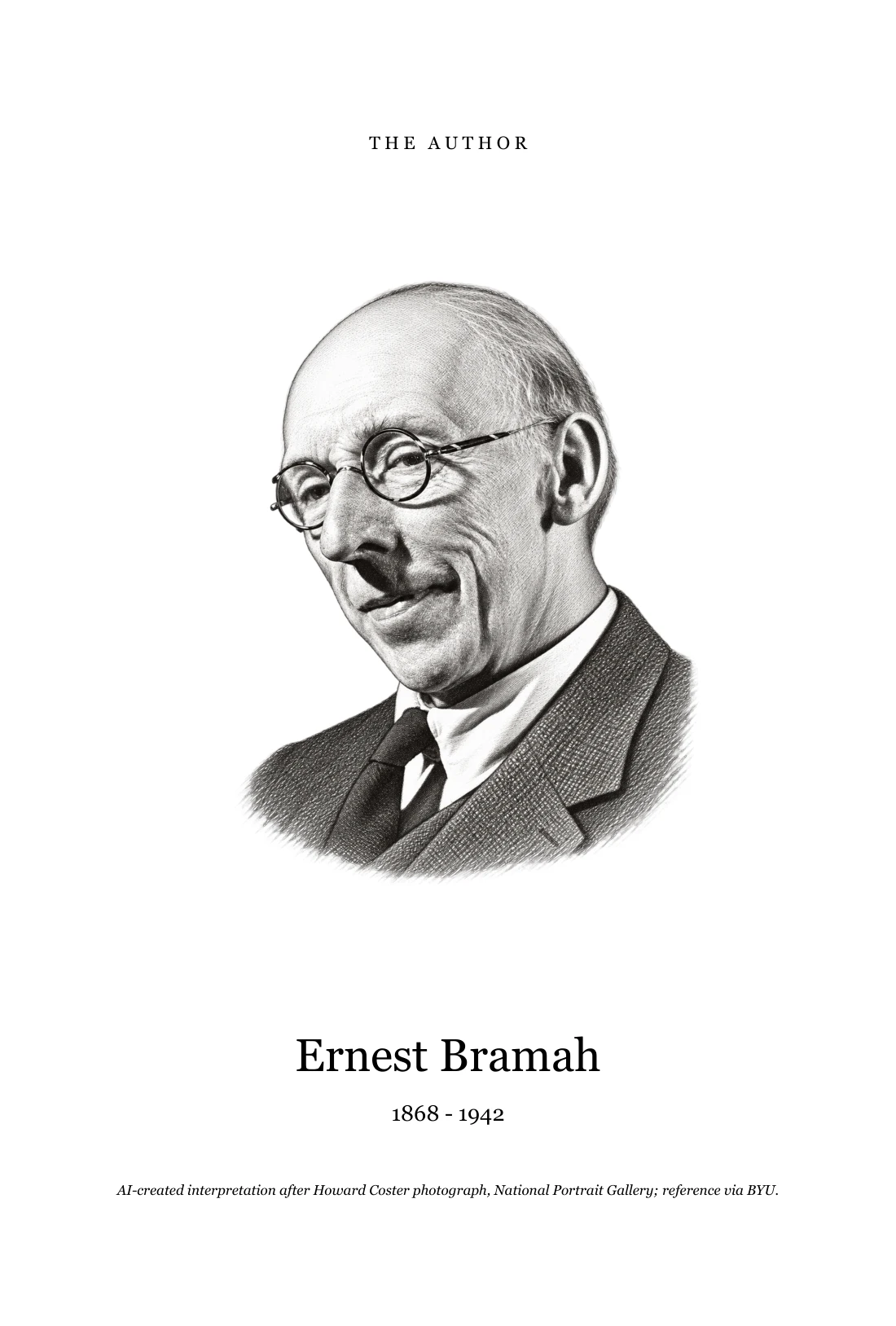
Kai Lung is a wandering storyteller who earns his rice by unrolling his mat in the market-places of an imaginary China and telling tales to anyone who will stop and listen. He was invented in 1900 by Ernest Bramah, the pen name of Ernest Brammah Smith, a former farmer and magazine editor from near Manchester who guarded his private life so closely that little is known about him even now.
Bramah wrote about Kai Lung on and off for forty years. If you want to know where to start, it is The Wallet of Kai Lung (1900) or Kai Lung’s Golden Hours (1922). They are independent of one another, but Golden Hours is the more satisfying book, because it is the first with a single story holding all the others together.
How many Kai Lung books are there?
Seven, though only five appeared in Bramah’s lifetime:
- The Wallet of Kai Lung (1900)
- Kai Lung’s Golden Hours (1922)
- Kai Lung Unrolls His Mat (1928)
- The Moon of Much Gladness (1932), published in America as The Return of Kai Lung
- Kai Lung Beneath the Mulberry Tree (1940)
- Kai Lung: Six (1974) and Kai Lung Raises His Voice (2010), gathering stories that had not been collected
- $14.99
The Wallet of Kai Lung
1900. Kai Lung meets a brigand in a camphor-laurel forest and, robbed of his last coins, sets about talking his way free with a story. Loose and episodic, and full of Bramah’s most quotable maxims.
- $14.99
Kai Lung's Golden Hours
1922. Arrested on trumped-up charges, Kai Lung tells tale after tale to postpone his sentence, helped by a quick-witted young woman called Hwa-mei. The masterpiece, with a preface by Hilaire Belloc.



Who is Kai Lung?
He is a professional, and proud of it. Kai Lung describes himself, with the ritual modesty that governs every sentence in these books, as an outcast of degraded habits whose entire stock-in-trade is a few unendurable and badly told stories. He is in fact shrewd, brave in a quiet way and devoted to the art of narrative. Danger finds him often, and his only weapon is to keep talking.
The joke, and the pleasure, is in the language. Everyone in Kai Lung’s China speaks with outrageous, flowery courtesy, insulting one another in compliments and threatening one another in proverbs. Within a few pages of the first book he produces one of Bramah’s most famous lines.
It is a mark of insincerity of purpose to spend one’s time in looking for the sacred Emperor in the low-class tea-shops.
Ernest Bramah, The Wallet of Kai Lung (1900)
That line had a life of its own. Ford Madox Ford liked to quote a “Chinese proverb” about seeking the Sacred Emperor in a low tea house, and at least one scholar has argued that Ford’s proverb was really Bramah’s invention.
Kai Lung’s Golden Hours: stories against the executioner
Golden Hours is built like The Thousand and One Nights. The Mandarin Shan Tien has come to the town of Yu-ping, his secretary Ming-shu is a schemer, and Kai Lung finds himself before the court accused of crimes he did not commit. Each day he is due to be sentenced; each day he begins a story the Mandarin cannot resist hearing to the end. Meanwhile Hwa-mei, “of the house of K’ang”, works to save him from outside.
The tales within the tale are fables of scholars, merchants, dragons and unlucky lovers, and they all bear, slyly, on Kai Lung’s own predicament. It is the funniest of the books and the most beautifully made, which is exactly what Belloc said when he introduced it.

Is Kai Lung’s China a real place?
No. It is a China of Bramah’s imagination, assembled from translated folk tales and Western ideas of Chinese manners, and it should be read as fantasy rather than as a portrait of a real culture. The humour is aimed above all at pomposity, bureaucracy and the absurdities of politeness, which are hardly Chinese inventions. Still, it is a pastiche of another people’s voice written by an Englishman in 1900, and some modern readers will find the premise uncomfortable. It is best met with that in mind.
Who loved Kai Lung?
Kai Lung has always had devoted admirers among other writers. Dorothy L. Sayers quotes him in several Lord Peter Wimsey novels, from Strong Poison to Busman’s Honeymoon, and Belloc was far from the only reader to prize his craftsmanship. For Sayers’s detective, see Lord Peter Wimsey’s first cases, in order.
Bramah also wrote a rather different Chinese book, The Mirror of Kong Ho (1905), in which a Chinese gentleman writes home from London about the baffling habits of the English. It turns the joke around, and pairs well with Kai Lung.
The same author also created one of the strangest detectives of the age, a man who solves crimes without sight; see Max Carrados, and Bramah’s full career in Ernest Bramah: from Kai Lung to Max Carrados.
Take your place in the Mandarin’s court for the first postponed sentence. Kai Lung’s Golden Hours is best read a story or two at a time, the way Kai Lung himself would want it: slowly, with a cup of tea, and with no hurry to reach the end.
Questions readers ask
Who is Kai Lung?
Kai Lung is a travelling storyteller in an imaginary China, created by Ernest Bramah in The Wallet of Kai Lung (1900). He survives brigands, magistrates and threatened executions by telling stories.
What order should I read the Kai Lung books in?
Publication order works: The Wallet of Kai Lung (1900), Kai Lung’s Golden Hours (1922), Kai Lung Unrolls His Mat (1928), The Moon of Much Gladness (1932) and Kai Lung Beneath the Mulberry Tree (1940). Many readers start with Golden Hours, the best of them.
How many Kai Lung books are there?
Seven: five published in Ernest Bramah’s lifetime and two later collections, Kai Lung: Six (1974) and Kai Lung Raises His Voice (2010).
What was Ernest Bramah’s real name?
Ernest Bramah was the pen name of Ernest Brammah Smith (1868–1942), who also created the blind detective Max Carrados.
 Max Carrados214 pages · $14.99
 The eyes of Max Carrados280 pages · $16.99