Two premieres, two hundred years apart. On 29 January 1728, John Gay’s The Beggar’s Opera opened at the theatre in Lincoln’s Inn Fields in London, and a highwayman called Captain Macheath became the most fashionable criminal in England. On 31 August 1928, at the Theater am Schiffbauerdamm in Berlin, Bertolt Brecht and Kurt Weill opened The Threepenny Opera, their reworking of Gay’s play, with a new song about the same man. In German he was Mackie Messer. In English he became Mack the Knife.
The song, then, really does come from a remake. Brecht kept Gay’s plot and most of his characters, wrote a new libretto and gave Weill the job of writing new music, and the street-singer’s ballad that introduces Macheath went on to become a jazz and pop standard.
What is The Beggar’s Opera about?
It is a comedy about crime as a business. Jonathan Peachum is a receiver of stolen goods who also earns rewards for turning thieves in, keeping a ledger of which of his clients are worth more to him alive than hanged. When he learns that his daughter Polly has secretly married Macheath, his best customer, he and his wife decide the marriage might pay after all, if Macheath can be hanged and his money claimed.
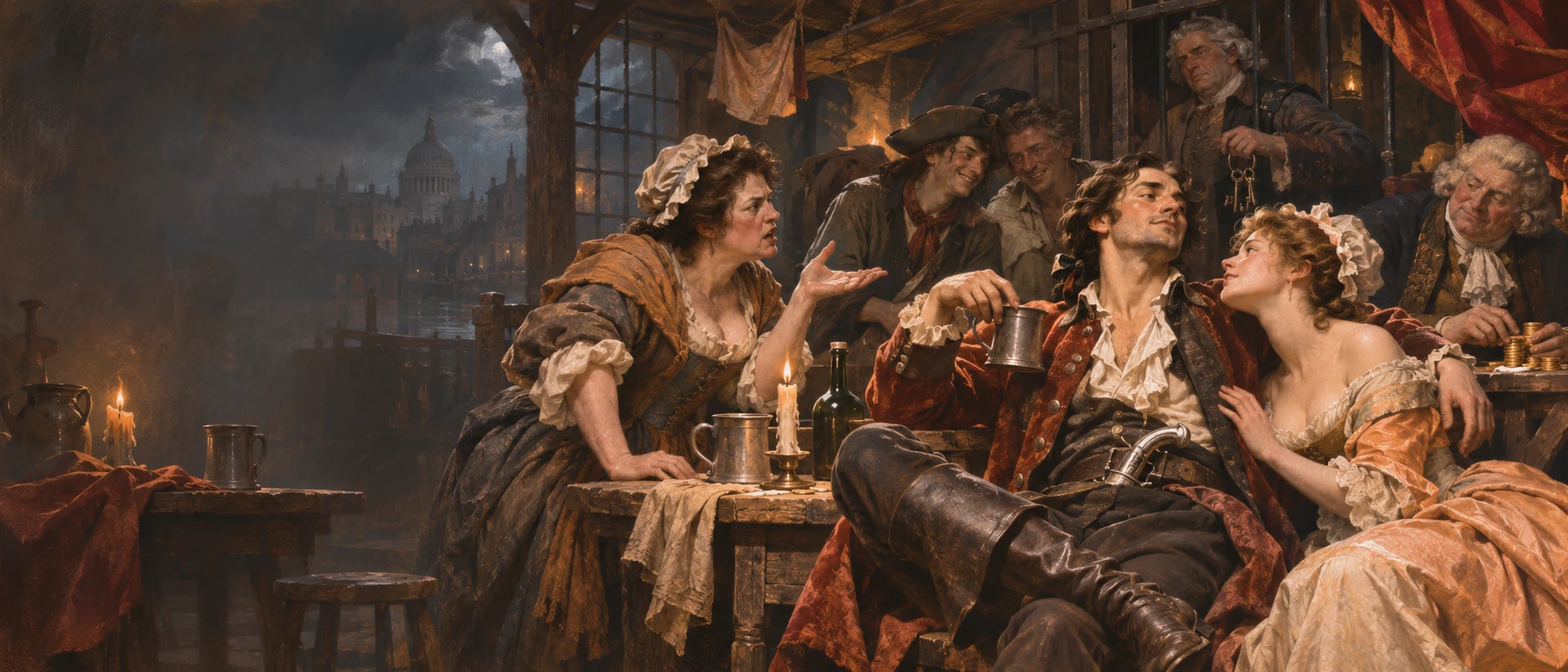
Macheath is betrayed in a tavern by two women who have done a deal with Peachum, and thrown into Newgate. There the jailer’s daughter, Lucy Lockit, turns out to be another woman he has promised to marry, and Polly arrives to claim him as her husband. The two rivals give the play some of its best scenes.
Gay’s great joke is that everyone in his underworld sounds exactly like a lady or gentleman of fashion, and that the fashionable world behaves exactly like his thieves. Peachum sets out the theme in the very first song.
The Priest calls the Lawyer a Cheat, / The Lawyer be-knaves the Divine: / And the Statesman, because he’s so great, / Thinks his Trade as honest as mine.
John Gay, The Beggar’s Opera, Air I

Why was The Beggar’s Opera such a hit?
Because it mocked everything its audience was talking about. London was in the grip of a craze for Italian opera, sung in a language most listeners did not understand, and Gay replaced its arias with sixty-odd short songs set to tunes everyone already knew: ballads, folk melodies and a few borrowed opera airs. Audiences could hum along. The play also mocked Sir Robert Walpole, the prime minister, whose nickname “Bob Booty” turns up among Peachum’s list of thieves.
It ran for sixty-two consecutive performances, then the second-longest run in theatre history, and has been revived ever since. The Craftsman reported the wits’ verdict: that it had made Rich, the theatre manager John Rich, very gay, and would probably make Gay very rich. Pictures of Lavinia Fenton, the first Polly, were in such demand that she became a celebrity overnight.
How did The Beggar’s Opera become The Threepenny Opera?
Through a translation. In the winter of 1927 to 1928, Brecht’s collaborator Elisabeth Hauptmann was sent a copy of Gay’s play from England and began translating it into German. When the impresario Ernst Josef Aufricht went looking for a play to open his new company at the Schiffbauerdamm in 1928, Brecht offered him the Gay adaptation and brought in Weill to compose. The title was settled only a week before opening night. Until then it had been announced simply as The Beggar’s Opera.
Weill kept just one of the old tunes, the melody of Peachum’s opening song. Everything else was new, shaped by jazz and the dance music of Weimar Berlin. Brecht made the story harder and angrier, a socialist satire on capitalism. His Mackie is a far more brutal figure than Gay’s gallant highwayman.
The famous ballad was a last-minute addition. Harald Paulsen, the actor playing Macheath, demanded a number that would introduce his character properly. Brecht and Weill wrote one, but gave it to a street singer, in the old tradition of the Moritat, the murder ballad sung by strolling minstrels. At the premiere the barrel organ meant to accompany it failed, and the band had to improvise. In 1955 Louis Armstrong recorded it in Marc Blitzstein’s English translation, and in 1959 Bobby Darin took it to number one on both sides of the Atlantic.
How the two endings match
Both plays mock their own happy endings. In Brecht a messenger on horseback arrives from the Queen with a pardon, and a title, moments before the hanging. In Gay, Macheath is about to be hanged when the Player objects that an opera must end happily, and the Beggar, the play’s supposed author, cheerfully agrees to a reprieve. Then he explains what his play would have meant had it kept its proper ending.
Through the whole Piece you may observe such a Similitude of Manners in high and low Life, that it is difficult to determine whether (in the fashionable Vices) the fine Gentlemen imitate the Gentlemen of the Road, or the Gentlemen of the Road the fine Gentlemen.
John Gay, The Beggar’s Opera, Act III
The Beggar’s Opera
1728. Highwaymen, fences, a corrupt jailer and two rival wives, set to the popular tunes of Gay’s London. Short, quick and still very funny about money, marriage and the law.
Gulliver's Travels
1726. Swift’s own great satire, published two years before the play he suggested to Gay, and aimed at many of the same targets.


More stories that found their way to the opera house are in classic stories that became operas and classic books that became musicals. For more comedies that still play, see the funniest classic plays, and for Swift’s side of the friendship, Gulliver’s Travels as political satire.
Then go back to the beginning of the story, before the knife and the jazz. Open The Beggar’s Opera, find Peachum at his account book, and listen for the first appearance of Macheath.
Questions readers ask
Is “Mack the Knife” from The Beggar’s Opera?
Not directly. The song was written by Kurt Weill and Bertolt Brecht for The Threepenny Opera (1928), their adaptation of John Gay’s The Beggar’s Opera (1728). Its subject, Macheath, is Gay’s highwayman.
What is The Beggar’s Opera about?
It is a satirical ballad opera about the highwayman Macheath, his secret marriage to Polly Peachum, his betrayal by her father, a fence and thief-taker, and his rivalry between Polly and the jailer’s daughter Lucy Lockit.
When was The Beggar’s Opera first performed?
It premiered on 29 January 1728 at the Lincoln’s Inn Fields theatre in London and ran for sixty-two consecutive performances.
Who wrote the music for The Beggar’s Opera?
John Gay set his lyrics to popular ballads and existing tunes. Johann Christoph Pepusch is usually credited with arranging them and writing the overture.