
“If a Soldier is a wedge,” the narrator of Flatland explains, “a Woman is a needle.” He means it as a warning. Women in his two-dimensional world are straight lines, nearly invisible from the end, and therefore lethal to bump into. So the law requires every house to have a separate door for them, and forbids any woman to walk in public without continually sounding her Peace-cry, under penalty of death.
That is the joke at the heart of Flatland: A Romance of Many Dimensions, first published in London in 1884 under the name “A Square”. It is remembered as a clever primer on geometry, and it is one. But for half its length it is a satire on Victorian class and the place of women, written by a clergyman and headmaster who spent his career arguing that education should be open to more people than the Victorians allowed.
What is Flatland about?
The narrator is a Square, a respectable professional gentleman in a world with length and breadth but no height. The first part of the book is his guide to Flatland society, and it is precise. Soldiers and the lowest workmen are Isosceles Triangles, sharp and cheap. The middle class are Equilateral Triangles. Professional men and gentlemen, like the narrator, are Squares and Pentagons. Above them come the nobility, gaining sides with every rank, and at the top the Circles, who are the priests.
Advancement is biological. By a law of nature, a male child has one more side than his father, so the son of a Square is a Pentagon. Families climb a step each generation, unless they belong to the lower orders, for whom the rule rarely works. Shapes born irregular are hidden in hospitals, straightened by doctors or, in the worst cases, put to death for the safety of the State.
The second half turns from society to space. The Square dreams of Lineland, a world of one dimension whose king cannot imagine a second. Then a Sphere arrives on the last day of the 1999th year, passes through his plane as a circle that grows and shrinks, and lifts him into the third dimension. The geometry is lovely. The point is that each world is as sure of its limits as the one below it.

How is Flatland a satire?
Every detail of the social chapters is Victorian England turned into diagrams. A class system that calls itself natural law. Priests who are also the ruling class. A revolution in which the lower orders paint themselves in colours to pass for their betters, crushed by the Circles. Above all, a society that keeps women out of learning and then cites their ignorance as proof that they could never learn.
The narrator reports all this with complacent approval, which is the trick. Abbott never steps forward to condemn it. He lets the Square explain, for example, that men speak two languages: with women they talk of love, duty and pity, conceptions which, he says, “have no existence, and the fiction of which has no object except to control feminine exuberances”. Readers are meant to wince, and many did.
Was Edwin Abbott a woman-hater?
Some early readers thought so. The book needed a second edition within the year, and Abbott used its preface to answer two objections, one geometrical and one moral: that the author hated women. Writing as the Square’s editor, he says the old prisoner has softened his views on women and the Isosceles classes, and adds a sentence that gives the game away:
But, writing as a Historian, he has identified himself (perhaps too closely) with the views generally adopted by Flatland, and (as he has been informed) even by Spaceland, Historians; in whose pages (until very recent times) the destinies of Women and of the masses of mankind have seldom been deemed worthy of mention and never of careful consideration.
Edwin A. Abbott, preface to the second edition of Flatland (1884)
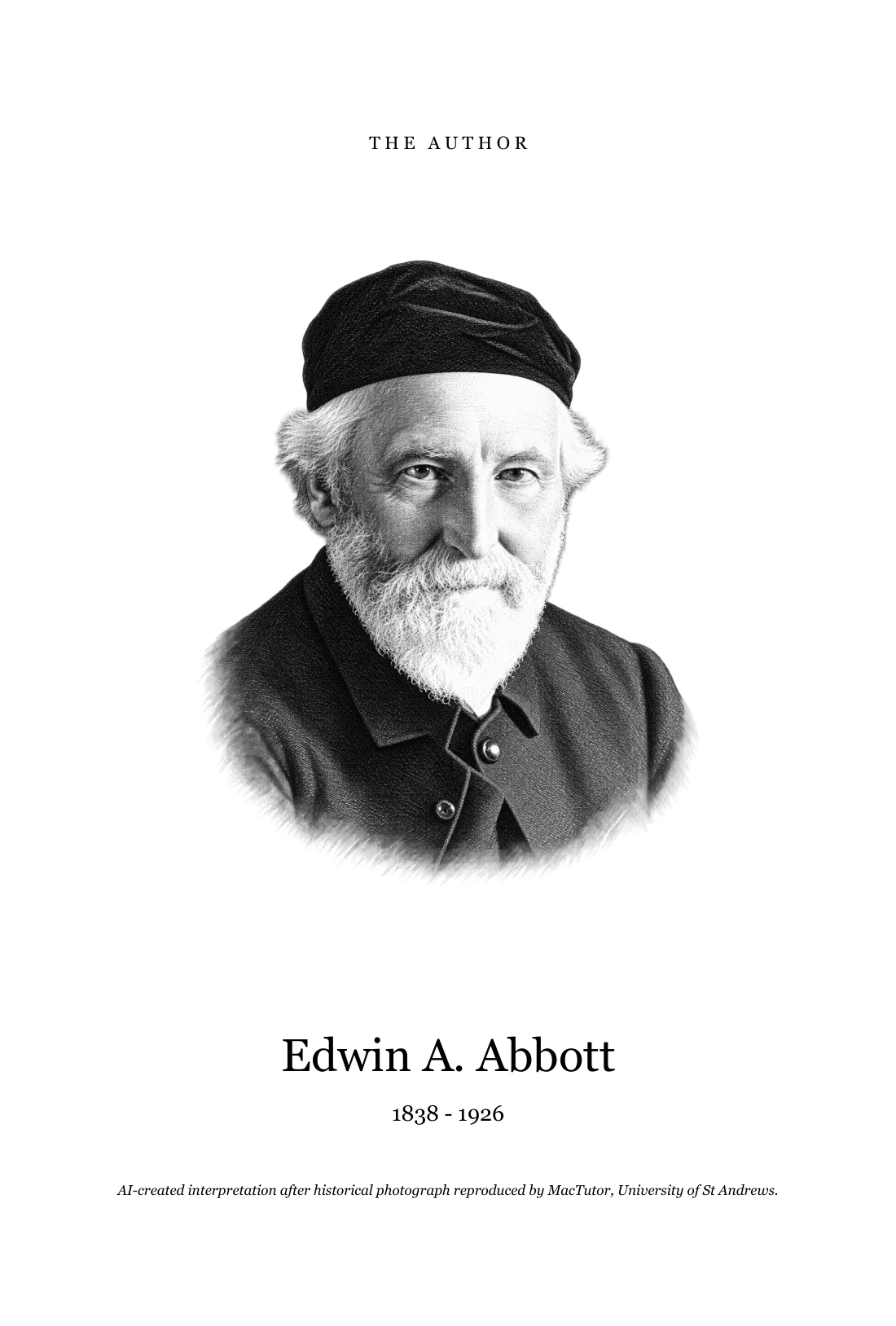
Edwin A. Abbott was headmaster of the City of London School from 1865 to 1889, and a scholar who wrote on Shakespeare, Francis Bacon and religion. He favoured wider access to education, including for women, and Flatland reads best as his argument for it, put into the mouth of a narrator who cannot see the case against himself.
Why do people still read Flatland?
Because the geometry turned out to matter. After Einstein’s general relativity made the fourth dimension a scientific subject, a 1920 letter to Nature pointed back to Abbott’s little book, and it has been on mathematical reading lists ever since. There have been several animated films, including two in 2007.
The satire has aged differently. Some of it lands with full force, some of it reads as uncomfortable on its own terms, and readers still argue about how far Abbott escapes the views he mocks. That argument is part of the pleasure. It is short enough to finish in a single evening, and the shift from social comedy to cosmic vision in the second half still surprises.
Flatland: A Romance of Many Dimensions
1884. A Square’s memoir of his flat homeland and his journey into Space. Half social satire, half thought experiment, and the second edition’s preface is part of the fun.
Gulliver's Travels
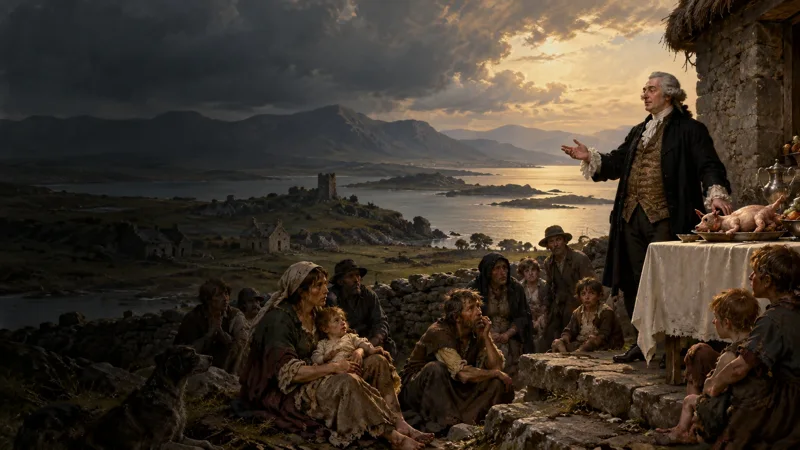
Jonathan Swift’s voyages to lands of tiny and giant people, which skewer English politics as they go. The ancestor of every satire disguised as a travel book, Flatland included.
A Modest Proposal
Swift’s deadpan proposal for solving Irish poverty. Read it to see where Flatland’s straight-faced cruelty comes from.


Where to go next
Swift is the obvious next step: see Did you know Gulliver’s Travels was a political satire? and our round-up of the sharpest satires in classic literature. For the mathematical side, Flatland earns a spot among the science fiction firsts, and it sits happily on our short reads shelf.
Start with Flatland, read the preface last, and notice how often you find yourself nodding along with the Square before you remember what you are agreeing to.
Questions readers ask
What is the point of Flatland?
Flatland works on two levels. Its second half uses a two-dimensional world to help readers imagine higher dimensions; its first half satirises Victorian class, religion and the treatment of women through Flatland’s rigid social geometry.
Who wrote Flatland and when?
Edwin A. Abbott, an English clergyman and headmaster of the City of London School, published it in 1884 under the pseudonym “A Square”. A revised second edition appeared the same year.
Is Flatland sexist?
Its narrator is, deliberately. Abbott, who supported wider education, used the narrator’s views to mock Victorian attitudes, and said so in his second-edition preface, though readers still debate how far the satire succeeds.