

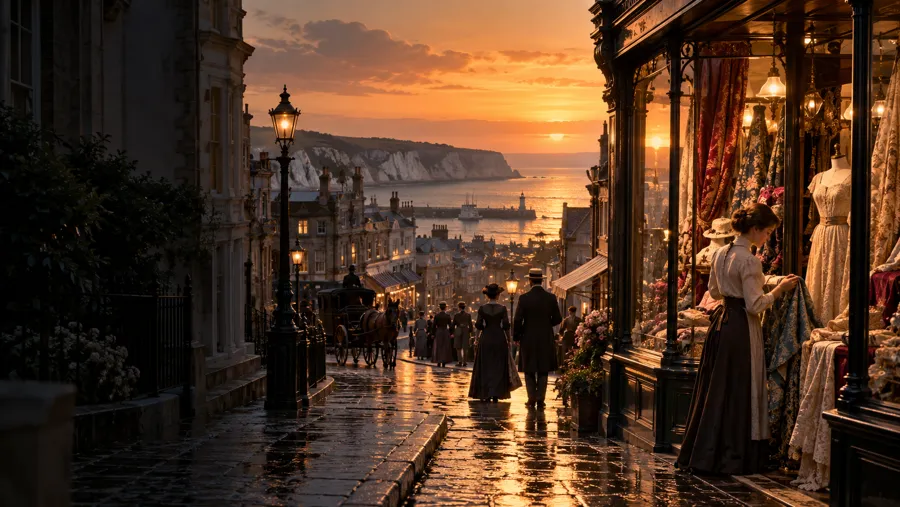
Thirteen-hour days behind a drapery counter and nights in a dormitory with the other apprentices: that was life for the teenage Herbert George Wells at Hyde’s Drapery Emporium in Southsea, from 1880 to 1883. Wells later remembered those years as the most miserable of his life so far. He escaped into science, teaching and journalism. Then, once he was famous, he went back to the drapery counter again and again, and wrote comedy about it.
Those novels are the other H. G. Wells. Readers who know him only for The Time Machine and The War of the Worlds are often surprised to find that his most affectionate books have no aliens in them at all. They are about ordinary, half-educated young men in collars too tight for them, and the comedy comes from their longing to live a larger life.
H. G. Wells’s comic novels, in order
- $13.99
The Wheels of Chance: A Bicycling Idyll
1896. Hoopdriver, a draper’s assistant from Putney, takes his holiday on a bicycle, wobbles down the south coast and rescues a young woman running away from home. A comedy of the cycling craze.
- $17.99
Kipps
1905. A Folkestone draper’s apprentice inherits a fortune and tries, agonisingly, to become a gentleman. Wells’s funniest study of the English class system.
- $16.99
Ann Veronica
1909. A twenty-one-year-old walks out of her father’s house to live her own life in London. Less a comedy than a scandal in its day, with wit to spare.
- $14.99
The History of Mr. Polly
1910. A failing shopkeeper with chronic indigestion and a gift for mangling long words decides his life has been a mistake, and does something about it. The best of the four.



The Wheels of Chance: Wells on a bicycle
The Wheels of Chance (1896) was written at the height of the cycling craze, when cheap, safe bicycles were sweeping Britain. Mr Hoopdriver is a poorly paid draper’s assistant from Putney who spends his holiday pedalling along the south coast. When he falls in with Jessie Milton, a young woman who has run away from her stepmother, he becomes a knight errant on two wheels. It is light, sunny and short, and it is where Wells first worked out his favourite comic hero.
Kipps: the money problem
Arthur Kipps is an orphan apprenticed to a draper in Folkestone, just as Wells had been apprenticed in Southsea. Then a grandfather he never knew leaves him a fortune, and Kipps finds that being rich is far harder work than serving behind a counter. He must learn manners nobody ever taught him, and he is never at ease in the society his money buys. Kipps (1905) is funny and sharp about snobbery, but its sympathy is all with its hero.
It has had a long afterlife. Michael Redgrave played Kipps on film in 1941, and in 1963 the story became the musical Half a Sixpence, starring Tommy Steele, who repeated the role in the 1967 film.
The History of Mr Polly: the escape
Alfred Polly is thirty-seven, married without quite meaning to be, and running a gentlemen’s outfitter in a dreary little town in Kent that is losing money fast. He reads adventure stories, loves words he only half understands and invents gloriously muddled phrases for them: “Sesquippledan verboojuice”. The novel opens with him on a stile, in a bad way:
He was sitting on a stile between two threadbare looking fields, and suffering acutely from indigestion.
The History of Mr. Polly (1910)
What Polly does next, at the age of thirty-seven, is the most liberating thing in all of Wells. It is best discovered on the page; all we will say is that it involves a fire, a long walk and an inn by a river. Wells said that Polly was modelled not on himself but on his elder brother Frank, and the book is full of a brother’s exasperated love. John Mills played Polly on film in 1949.
Ann Veronica: the odd one out
Ann Veronica (1909) is the novel in this group that is not really a comedy, though it is often witty. Its heroine leaves her father’s suburban house to make her own way in London, joins the suffragettes and goes to prison after a raid on Parliament. Macmillan refused to publish it, and The Spectator attacked it in a review headed “A Poisonous Book”. The scandal was sharpened by gossip: Ann Veronica was inspired by Amber Reeves, a young woman with whom Wells was having an affair. Read it now and it seems a bold, likeable book about a woman claiming the same right to escape as Hoopdriver and Polly.
Where to start with H. G. Wells’s comic novels
Start with The History of Mr Polly. It is the warmest and the most complete, and its final chapters are as close to an idyll as Wells ever came. If you enjoy it, go back to Kipps, then take The Wheels of Chance on holiday. Wells’s more ambitious social novels, Tono-Bungay and Love and Mr Lewisham, carry the same voice into darker territory.
For the other side of Wells, start with Did you know H. G. Wells predicted the atomic bomb?. And if comic Englishmen on the loose are your weakness, Jerome K. Jerome and P. G. Wodehouse are the natural next stops.
But first, sit down on that stile with Mr Polly. He is about to make the best decision of his life.
Questions readers ask
Did H. G. Wells write comic novels?
Yes. H. G. Wells’s comic novels, written alongside his science fiction, are about ordinary lower-middle-class life; the best known are The Wheels of Chance (1896), Kipps (1905) and The History of Mr Polly (1910).
What is H. G. Wells’s funniest book?
The History of Mr Polly is usually considered his funniest and warmest novel, with Kipps a close second.
Was H. G. Wells a draper’s apprentice?
Yes. He was apprenticed at Hyde’s Drapery Emporium in Southsea from 1880 to 1883, and drew on the experience in The Wheels of Chance, Kipps and The History of Mr Polly.
Why was Ann Veronica controversial?
Its young heroine defies her father, leaves home and falls for a man separated from his wife, which shocked many readers in 1909. The Spectator attacked it, and its scandal grew when it became known that Wells had been having an affair with Amber Reeves, who inspired the character.
 The Time Machine118 pages · $11.99
 The War of the Worlds156 pages · $12.99
 The Invisible Man138 pages · $12.99
 The Island of Doctor Moreau126 pages · $11.99