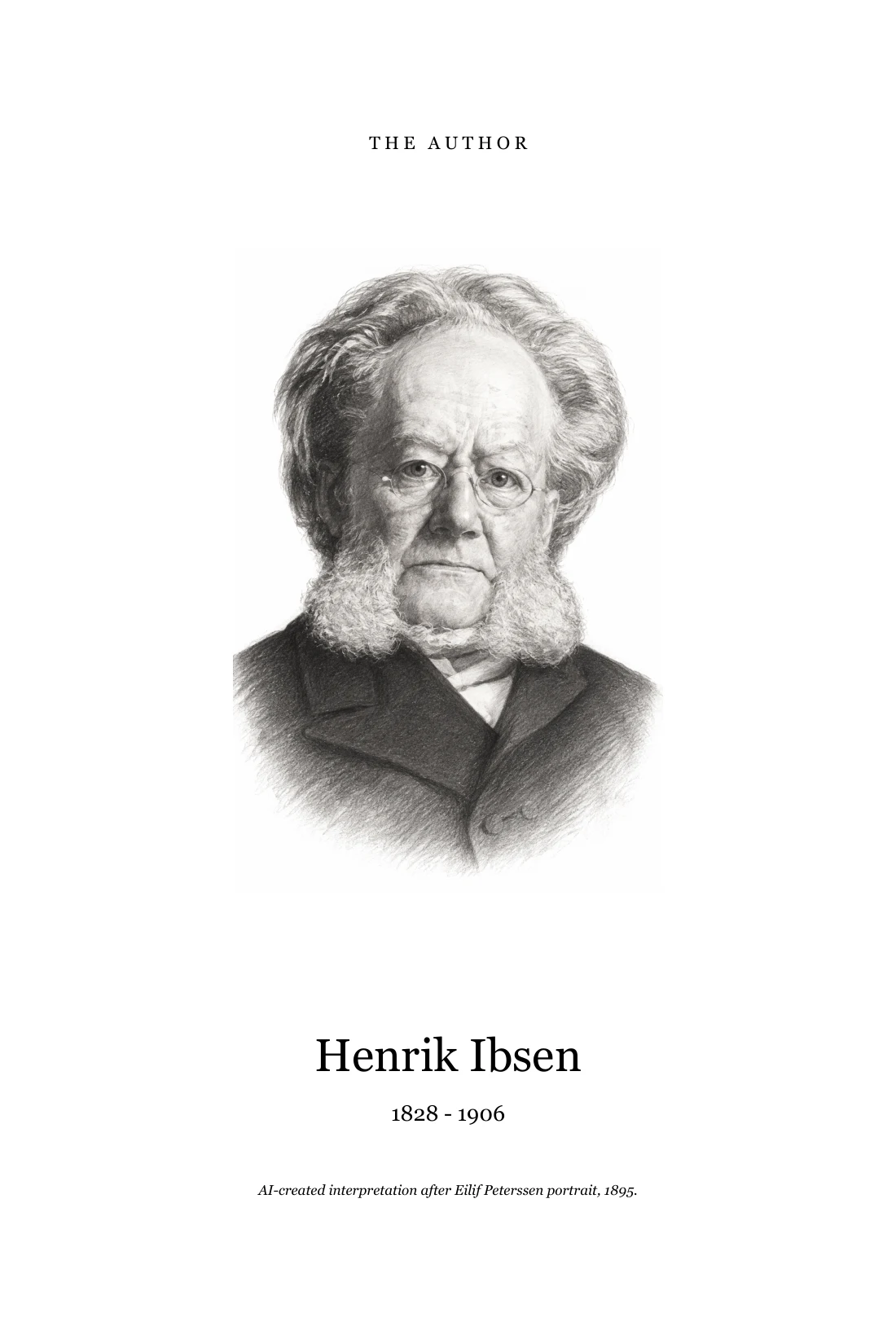
Eight thousand copies. That was the first printing of A Doll’s House when it was published in Copenhagen on 4 December 1879, and it sold out within a month. A play, bought and argued over like a novel: within weeks it was on the stage of the Royal Danish Theatre, and Nora Helmer’s exit soon carried the name of Henrik Ibsen far beyond Scandinavia.
If you are wondering which Ibsen plays to start with, begin there. A Doll’s House is the clearest of the great prose plays and the easiest to picture on the page. Then read Ghosts and An Enemy of the People, which followed it in quick succession, and finish with Hedda Gabler, in the order he wrote them. Together they are the core of his reputation as “the father of modern drama”.
Which Ibsen plays should you read first?
Ibsen’s career divides roughly in two. In the 1860s he made his name with long verse dramas, Brand and Peer Gynt, which are magnificent but sprawling. After Peer Gynt he gave up verse and began writing plays in plain prose about middle-class people in Norwegian towns, and those are the ones that changed the theatre. They are short, tightly plotted and built around a secret that comes out. These four are the place to begin.
- $11.99
A Doll's House
1879. Nora Helmer, cheerful and apparently featherbrained, has been hiding a forged signature for years to save her husband’s life. When the secret surfaces, she sees her marriage clearly for the first time. Start here.
- $10.99
Ghosts
1881. A widow, a pastor and a son home from Paris, in a house where the past will not stay buried. The darkest of the four and the one that caused the loudest scandal.
- $12.99
An Enemy of the People
1882. A spa doctor discovers that the town’s new baths are contaminated and assumes everyone will thank him for saying so. A brisk, angry, often funny play about what a community does to an inconvenient truth.
- $12.99
Hedda Gabler
1890. A general’s daughter, newly married to a dull academic and trapped in a house she never wanted, takes an interest in a rival’s manuscript. One of the great roles in the theatre, and a portrait of boredom turned dangerous.


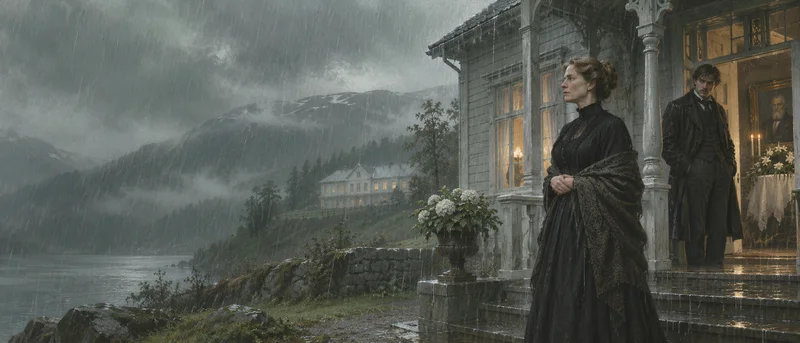
A Doll’s House: the door that slammed across Europe
The play’s final scene is a reckoning. Nora sits her husband down for what she realises is their first serious conversation in eight years of marriage, and tells him what their home has been.
I have been your doll-wife, just as at home I was papa’s doll-child; and here the children have been my dolls.
Henrik Ibsen, A Doll’s House (1879), translated by R. Farquharson Sharp
Then she leaves, and the street door shuts behind her. Audiences were appalled, and not only audiences. In Germany the actress Hedwig Raabe refused to play the part as written, declaring she would never leave her children. With no copyright to protect him, Ibsen chose to write an alternative ending himself rather than let a lesser writer do it, and called the result a “barbaric outrage” on his own play. The original ending is the one that survives.
Ghosts: the play theatres would not touch
Ibsen worked on Ghosts at Sorrento in the summer of 1881 and published it that December. Mrs Alving has spent years protecting her son Oswald from the truth about his late father, and now that Oswald is home, the past starts walking through the house. Its subject, venereal disease passed from a dissolute father to his son, was barely mentionable in 1881.
Ibsen knew what was coming. Nine days after publication he wrote to one of his German translators, Ludwig Passarge, that the play had “occasioned a terrible uproar in the Scandinavian press”, and that he considered it “utterly impossible that any German theatre will accept the play at present”. Its first production was given in Danish, in 1882, in Chicago. In London the Independent Theatre managed a private performance in March 1891 and the critics erupted; as late as 1906 the censor still would not allow a public one.
But I almost think we are all of us ghosts, Pastor Manders. It is not only what we have inherited from our father and mother that “walks” in us. It is all sorts of dead ideas, and lifeless old beliefs, and so forth.
Henrik Ibsen, Ghosts (1881), translated by William Archer
An Enemy of the People: Ibsen answers back
The fury over Ghosts went straight into his next play. Dr Thomas Stockmann, medical officer of a small town’s new spa, finds that the water is poisoning the visitors. He expects gratitude. Instead the mayor, who happens to be his brother, the liberal newspaper and finally the townspeople themselves turn on him, because the truth will cost money. The character of the mayor is said to have been modelled partly on Ibsen’s own uncle.
It is the most accessible of the four, a play of public meetings and slammed doors, and it ends on a line Stockmann delivers as a discovery: “the strongest man in the world is he who stands most alone.” Arthur Miller adapted it for Broadway in 1950.
Hedda Gabler: the play that keeps actors busy
By 1890 Ibsen had moved from public scandal to private catastrophe. Hedda, the general’s daughter, has married George Tesman, a decent and tedious scholar, and returned from a long honeymoon already sick of him. When a former admirer, Eilert Løvborg, reappears with a brilliant new manuscript, she sees a chance to shape someone’s fate. The play premiered in Munich on 31 January 1891, and actors have been fighting over the part ever since. We will not tell you how it ends.
Ibsen is still, by some counts, the most performed playwright in the world after Shakespeare, but plays are not always easy to read. Our guide How to read a play on the page helps, and his greatest English champion, George Bernard Shaw, gets his own post in Did you know George Bernard Shaw was the first person to win a Nobel Prize and an Oscar? Nora’s descendants, from Eliza Doolittle onwards, are traced in Did you know My Fair Lady is based on Pygmalion? and feminist classics.
Then start with Nora. A Doll’s House takes about three hours to read, and you will be listening for that door long before it closes.
Questions readers ask
What is the best Ibsen play to start with?
A Doll’s House (1879). It is short, clear and gripping, and it introduces everything Ibsen does best: a respectable home, a buried secret and a character who finally sees her life as it is.
What order should I read Ibsen’s plays in?
For his best-known prose plays, try A Doll’s House (1879), Ghosts (1881), An Enemy of the People (1882) and Hedda Gabler (1890). Ghosts and An Enemy of the People are especially rewarding together, because the second was partly Ibsen’s reply to the outcry over the first.
Why was Ghosts so controversial?
It dealt openly with venereal disease inherited by a son from his father, and with the hypocrisy that kept it hidden. Ibsen expected no German theatre to accept it, its first production took place in Chicago in 1882, and in England the censor blocked public performances for years.
Why is Ibsen called the father of modern drama?
Because his prose plays of the 1870s to 1890s brought ordinary middle-class lives, social problems and natural, realistic dialogue to the stage, and dramatists from Shaw onwards followed his lead.
 The Master Builder116 pages · $11.99
 The Lady from the Sea114 pages · $11.99