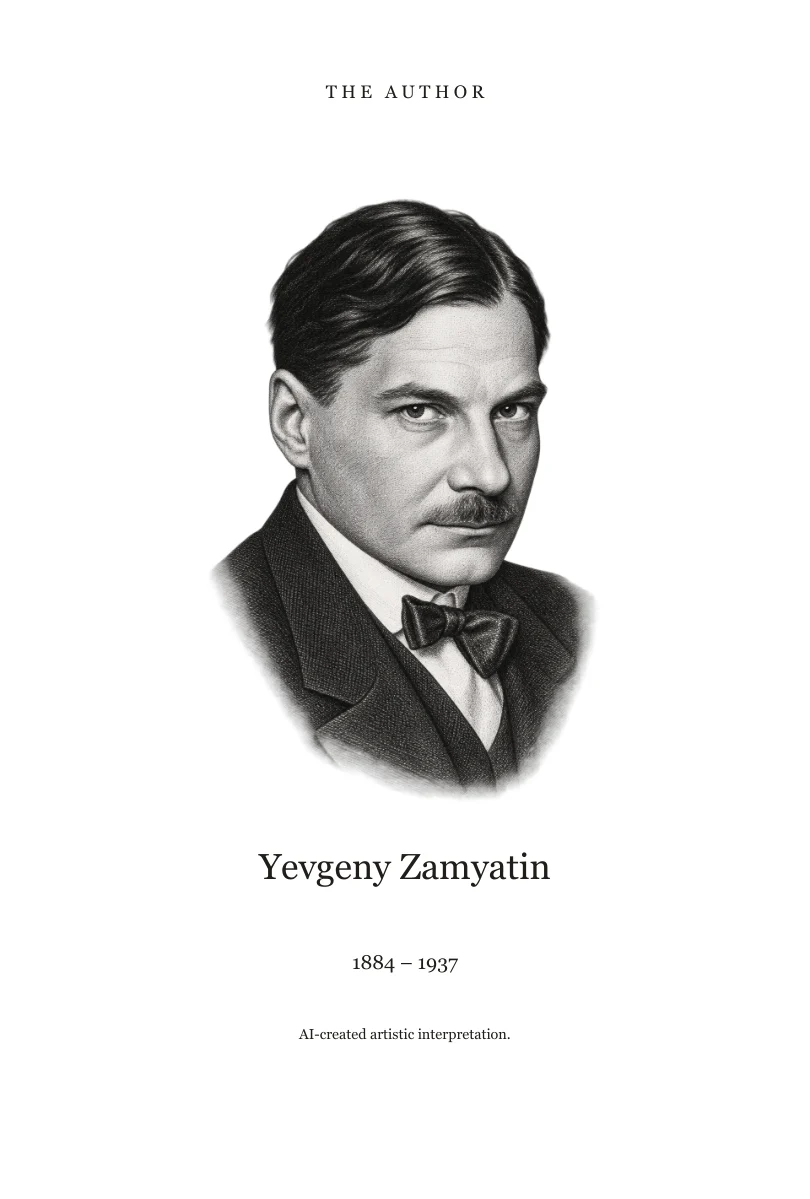
Yevgeny Zamyatin wrote We in Russia around 1920 and 1921, in the first years after the Revolution. It was refused publication at home, and its first appearance in print was an English translation published in New York in 1924. Readers in Russia could not legally buy it until 1988.
George Orwell tracked the book down in a French translation and reviewed it for the London weekly Tribune in January 1946. Three years later he published Nineteen Eighty-Four. Orwell never said in so many words that We was his model, but the likeness is close enough that critics have treated Zamyatin as one of his key sources ever since.
How did Zamyatin’s We influence Orwell?
Put the two books side by side and the echoes are hard to miss. Both are set in an all-powerful state with a godlike leader: Zamyatin’s Benefactor, Orwell’s Big Brother. Both heroes begin as loyal citizens and keep a private record that slowly turns into an act of rebellion. Both are drawn into a forbidden love affair with a rebellious woman who opens their eyes. And in both, the state is less interested in punishing dissent than in making it impossible to think.
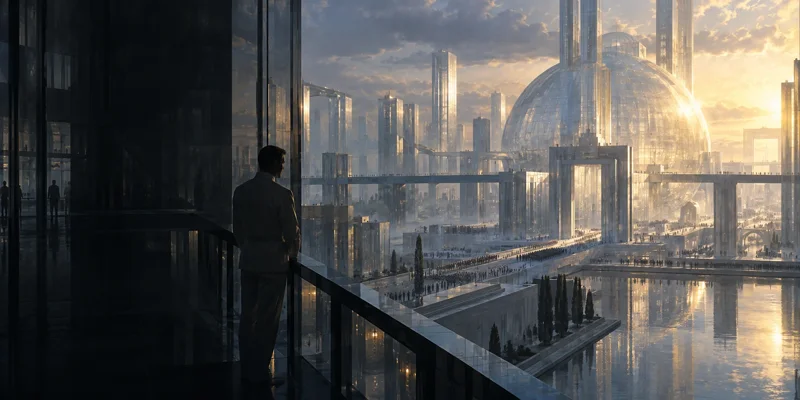
The differences matter too. Zamyatin’s One State is bright and orderly, its people living in glass apartments under a timetable that fixes every hour, even the hour for love. Orwell’s Oceania is grey, shabby and hungry. We is a satire on the dream of a perfectly rational society; Nineteen Eighty-Four is about power for its own sake. Orwell took the shape of the story and filled it with his own darker material.
The book cost Zamyatin dearly. Once copies began circulating abroad, he came under fierce attack in the Soviet press and found it almost impossible to publish. In 1931 he wrote directly to Stalin asking to be allowed to leave the country. Permission came, and he settled in Paris, where he died in 1937, never having seen We published in his homeland.
What is We like to read today?
Stranger and more playful than Orwell. The whole book is D-503’s diary, and Zamyatin writes it in bursts of images, equations and half-finished thoughts, so the narrator’s calm logic visibly cracks as the story goes on. It is short, often funny, and genuinely unsettling once you realise how much D-503 wants to stay obedient.
Zamyatin was a naval engineer who had spent part of the First World War in England supervising the building of Russian icebreakers, and the One State owes something to the factories and timetables he saw there as well as to Soviet planning. That doubled target is why the book still feels current: it is a warning about any system that promises happiness in return for freedom.
It suits readers who loved Nineteen Eighty-Four or Brave New World and want to see where the road began, and anyone who prefers ideas delivered with wit. Some of the prose takes a few pages to get used to; once you are in, it moves quickly. We won’t reveal how D-503’s story ends.
Look closely and you will find much of the genre’s later furniture already in place: names replaced by numbers, love rationed by official coupons, walls made of glass so that privacy is impossible, and a population that has been taught to call its own surveillance happiness.
Other dystopias before 1984
Zamyatin was not the first writer to imagine a nightmare future. H. G. Wells sent a sleeper two centuries forward into a city of masters and slaves in The Sleeper Awakes, and Zamyatin admired Wells enough to write a study of him. Jack London imagined an American dictatorship in The Iron Heel. We follow the whole tradition in Dystopian novels written before Nineteen Eighty-Four, and look at a Victorian underground utopia in Did you know Bovril was named after a science fiction novel?
For the opposite dream, a perfect society that its author meant seriously, see Did you know an 1888 novel imagined the credit card?. Then come back to the original. We is the book that taught the twentieth century what a dystopia looks like, and it is still the most surprising of them all.
Questions readers ask
Did Orwell read Zamyatin’s We?
Yes. George Orwell read We in a French translation and reviewed it in Tribune in January 1946, three years before Nineteen Eighty-Four was published.
How is We similar to 1984?
Both follow a citizen of an all-controlling state led by a godlike figure who keeps a private record, falls in love and is drawn toward rebellion. Many critics see We as a direct influence on Orwell’s novel.
When was We by Zamyatin written?
Zamyatin wrote We around 1920–21. It was first published in English in 1924 and was not officially published in Russia until 1988.