
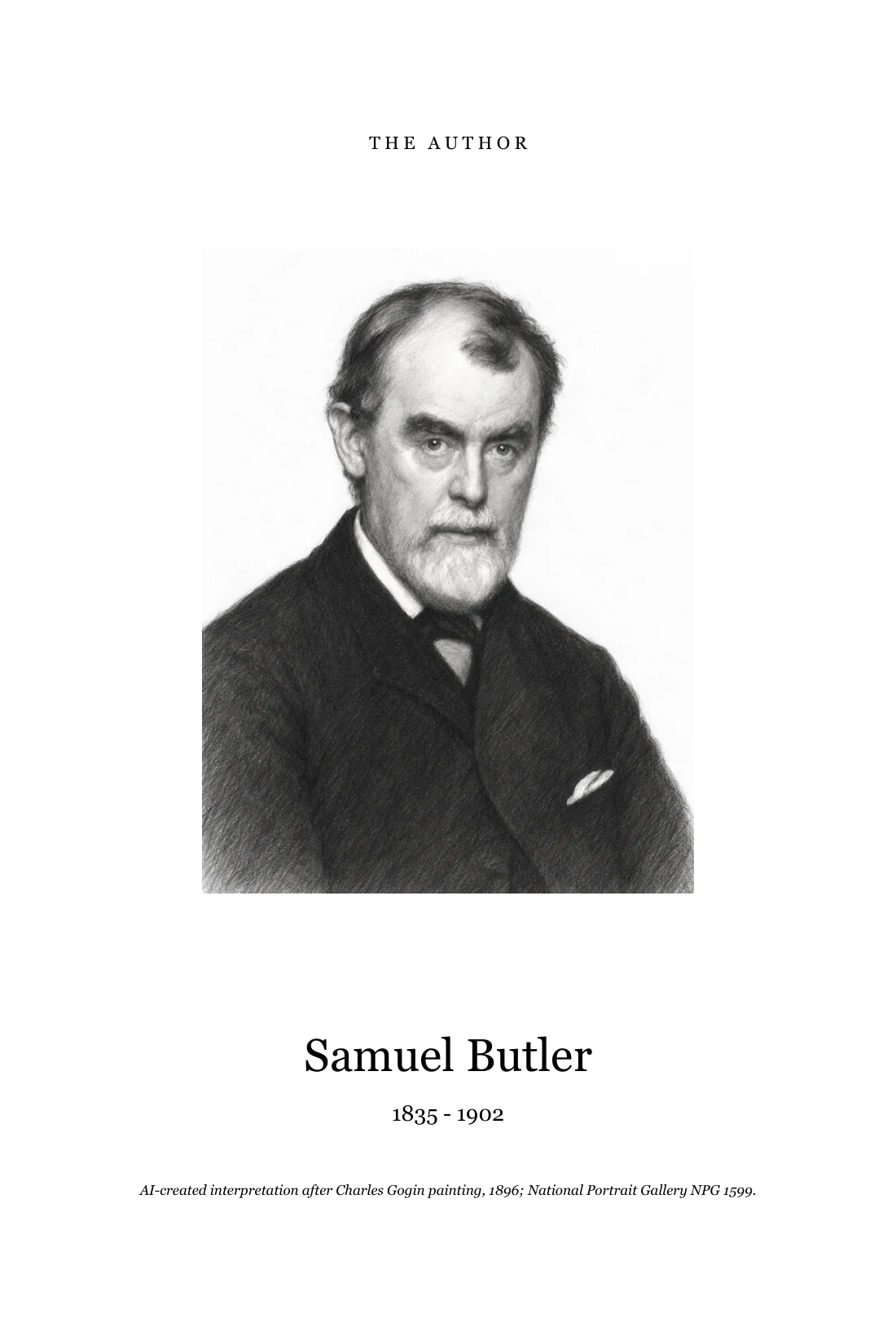
On his deathbed in 1902, Samuel Butler gave his literary executor to understand that a manuscript he had kept for almost twenty years should now be published as it stood. The executor, R. A. Streatfeild, found that two chapters had gone missing, rebuilt them from Butler’s notes, and in 1903 brought out The Way of All Flesh. It became the book Butler is remembered for, and he never saw a printed copy.
Yes, then: The Way of All Flesh was published only after its author’s death, on 18 June 1902. The more interesting question is why a writer who had happily published satire, science and art criticism under his own name sat on his best novel for so long.
Why did Butler not publish The Way of All Flesh?
Probably because it was about his family, and his family was still alive. Its satire on Victorian piety was also, by most accounts, too contentious for its day. Butler was born in 1835 at the rectory in Langar, Nottinghamshire, the son of a clergyman and grandson of a famous headmaster who became a bishop. His father, Thomas, had wanted to join the navy and was pushed into the Church instead. One of Butler’s biographers put it that, having been a servile son, Thomas became a bullying father.
The novel follows four generations of the Pontifex family, from a good-natured village carpenter to his grandson Theobald, a clergyman pressed into holy orders by his own father, and on to Theobald’s son Ernest. Theobald and his wife Christina are the parents nobody would want, and they are very obviously drawn from life. Butler’s father lived until 1886. By then the manuscript had been set aside for good.
Streatfeild’s preface offers gentler reasons too: Butler was busy with other work, professed himself dissatisfied with the book, and always meant to revise it. He never did. Butler’s friend Henry Festing Jones pointed to another. Butler sent every chapter, as he wrote it, to his friend Eliza Mary Ann Savage, who had urged him to write a novel in the first place, and he put her into the book as Ernest’s clever, kindly Aunt Alethea. When Miss Savage died in February 1885, he stopped. According to Jones, he did not touch the novel again.

What is The Way of All Flesh about?
It is a novel of growing up, narrated by Ernest’s godfather, Edward Overton, an amused and worldly bachelor who knew the family for decades. Ernest is drilled, prayed over and beaten as a small boy, sent to a hard public school under the terrifying Dr Skinner, steered into the Church, and only slowly begins to think for himself. The path to freedom runs through a great deal of trouble, much of it his own doing.
Overton’s voice is what makes the book sting rather than merely sulk. He offers mock advice to parents with a perfectly straight face:
To parents who wish to lead a quiet life I would say: Tell your children that they are very naughty—much naughtier than most children.
Samuel Butler, The Way of All Flesh
The best-known scene shows Theobald making little Ernest sing a hymn on a Sunday evening. The boy cannot yet pronounce a hard “c” and keeps singing “tum” for “come”. His father takes it as defiance, drags him from the room and beats him, then rings for the servants to come in to prayers, “red-handed as he was”. Butler never raises his voice. He does not need to.
Is The Way of All Flesh autobiographical?
Heavily, though not slavishly. Dr Skinner was drawn from Benjamin Hall Kennedy, the headmaster under whom Butler was miserable at Shrewsbury School. Theobald and Christina owe a great deal to Butler’s parents. Ernest’s doubts about the faith he was trained for are Butler’s own, and it is tempting to see Overton, the detached older man who stands by him, as the person Butler had become by middle age.
The book Streatfeild published was not quite the book Butler left. Streatfeild altered the text in many places and cut material, and the manuscript version, under Butler’s preferred title Ernest Pontifex or The Way of All Flesh, did not appear until 1964. The 1903 text is the one generations of readers have known, and the one the Modern Library ranked twelfth on its 1998 list of the best English-language novels of the century.
Why did the novel matter so much in 1903?
Published two years after Queen Victoria’s death, it landed among readers ready to laugh at their parents’ certainties. Its attack on pious tyranny at home, on schooling by fear and on respectability as a cover for cruelty made it a founding text for the Edwardian revolt against the Victorians. Its patient attention to how a child is shaped by his upbringing has led some critics to call it ahead of its time.
If you like your coming-of-age stories sharp rather than sweet, see our coming-of-age classics, and for the decade that took Butler up as a prophet, the Edwardian novel. His satirical instincts put him in company with the writers in classic satire.
Start with the old carpenter in the first chapter, whom Overton remembers hobbling about the village when he was a boy, and watch how much changes in two generations. Pick up The Way of All Flesh and meet Theobald while he is still a son, long before he becomes a father.
Questions readers ask
When was The Way of All Flesh published?
It was published in 1903, the year after Samuel Butler died. He had written it between the early 1870s and 1884.
Why was The Way of All Flesh published posthumously?
Its portrait of a bullying clergyman father drew closely on Butler’s own family, and he chose not to publish it in his lifetime. He stopped working on it after the death of his friend and reader Eliza Savage in 1885.
Is The Way of All Flesh based on Samuel Butler’s life?
Yes, in large part. Ernest Pontifex’s parents are modelled on Butler’s own, and the headmaster Dr Skinner is based on Benjamin Hall Kennedy of Shrewsbury School.
What does the title The Way of All Flesh mean?
It comes from the Douay–Rheims translation of 1 Kings 2:2 (3 Kings in its own numbering), “I am going the way of all flesh,” spoken by the dying King David. It means to die.
 Erewhon; Or, Over the Range226 pages · $14.99