
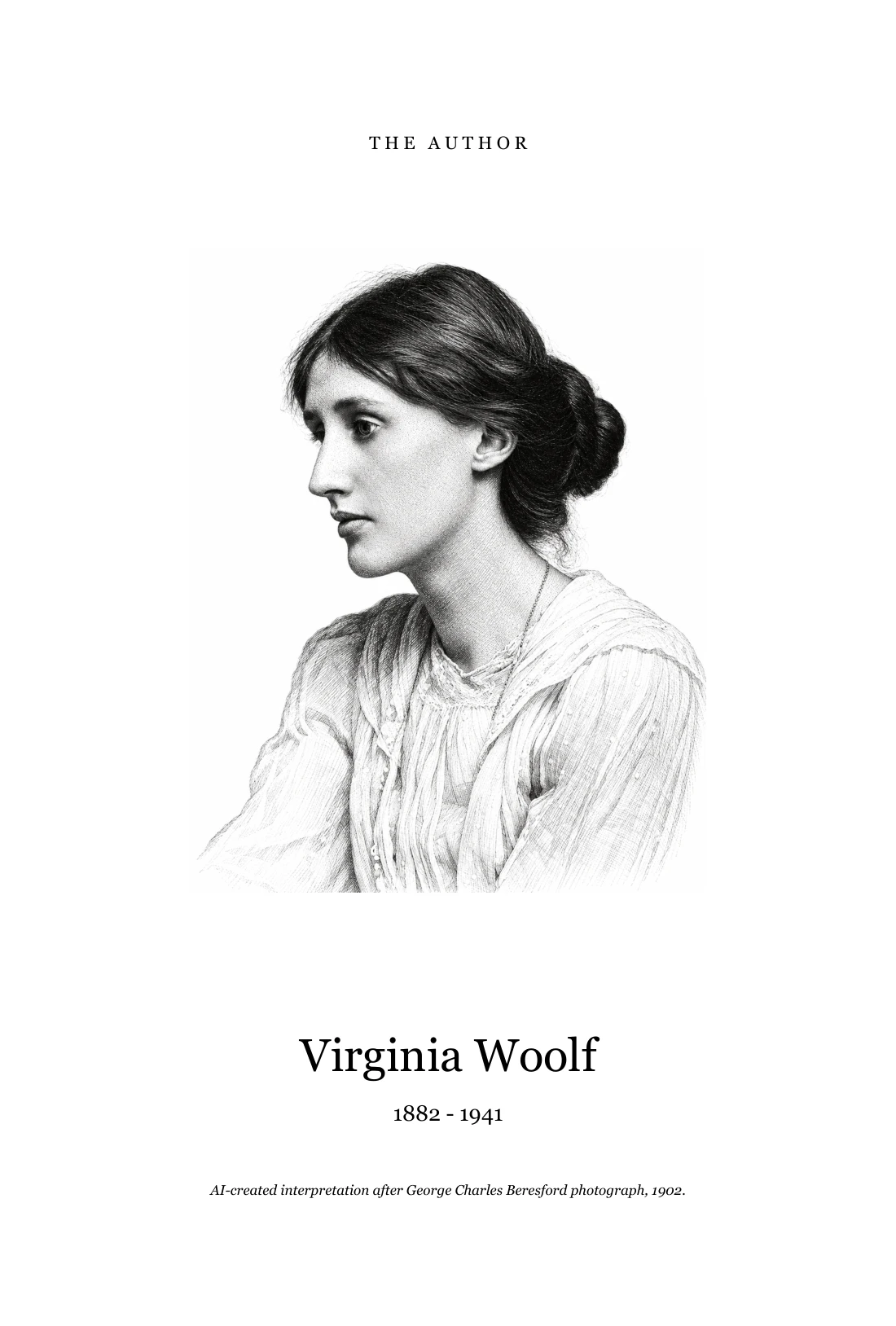
In 1919 Virginia Woolf published two books that seem to have been written by different people. Night and Day, which came out on 24 October, is a long, carefully plotted novel of love and marriage among the London literary classes, with a heroine in Cheyne Walk who is supposed to be helping with a life of her famous grandfather. Kew Gardens, printed privately the same year with woodcuts by her sister Vanessa Bell, is a few pages of colour, light and overheard talk around a single flowerbed, watched partly from the point of view of a snail.
That year is the hinge of Virginia Woolf’s career. Most readers meet her at Mrs Dalloway (1925) or later, and skip what came before. In order, the early books are The Voyage Out (1915), Night and Day (1919), the stories of Monday or Tuesday (1921) and Jacob’s Room (1922), and reading them in sequence is the clearest way to watch a conventional novelist turn herself into a modernist one.
Virginia Woolf’s books in order, 1915 to 1925
- $18.99
The Voyage Out
1915. Rachel Vinrace, twenty-four and sheltered, sails on her father’s ship to a South American resort full of English holidaymakers. Drafted and redrafted for years, and published by Duckworth, the firm her half-brother Gerald had founded.
- $20.99
Night and Day
1919. Katharine Hilbery, granddaughter of a great poet, is engaged to the wrong man, while a young lawyer with literary ambitions, and the suffrage worker who loves him, complicate her plans. Woolf’s most traditional novel, and dedicated to her sister.
- $9.99
Monday or Tuesday
1921. Eight short pieces, including “Kew Gardens”, “The Mark on the Wall” and “An Unwritten Novel”, in which the methods of the later novels first appear. The only story collection she published in her lifetime.
- $13.99
Jacob's Room
1922. Jacob Flanders from a Cornish beach to Cambridge, London and Greece, glimpsed only through the people who see him. The first novel in which she stopped telling a story the old way.
- $12.99
Mrs. Dalloway
1925. Clarissa Dalloway’s day of party preparations in 1923, shadowed by Septimus Smith’s. Every experiment of the previous six years, finally working together.



The Voyage Out: a long apprenticeship
Woolf’s first novel took the best part of a decade. She was at work on it by 1910, perhaps as early as 1907, under the title Melymbrosia, and had a full early draft by 1912; the published book came out from Duckworth in 1915. In 1981 the scholar Louise DeSalvo reconstructed the earlier version, which is franker about sexuality, suffrage and empire than the novel Woolf finally let go.
What survived is still remarkable. On the surface it is an Edwardian story of a young woman’s first voyage and first love. Underneath, it is restless, and it ends in a way no Edwardian romance would have dared. Readers who know Mrs Dalloway will notice the Dalloways themselves boarding the ship for a few chapters, ten years before Clarissa got a novel of her own.
Night and Day: the book Katherine Mansfield disliked
Night and Day is the early Woolf that critics have been hardest on. Katherine Mansfield, reviewing it in The Athenaeum, called it a throwback out of touch with its time, a novel that barely mentions the war that had just ended, and privately she was harsher still. E. M. Forster told Woolf he liked it less than The Voyage Out. The Times Literary Supplement was warmer.
Read now, it is far better than its reputation. It is witty about families, publishing and the comedy of engagement, and it is the novel in which Woolf works out, in a conventional frame, the question that runs through all her later books: how anyone can know what another person is thinking. It is also her most personal dedication.
To Vanessa Bell but, looking for a phrase, I found none to stand beside your name.
Virginia Woolf, dedication of Night and Day (1919)
Monday or Tuesday: where the new Woolf begins
If you read only one of the early books, make it this one. Monday or Tuesday, published by the Hogarth Press in 1921, gathers eight short pieces, and in them you can watch her try out everything at once: a mind drifting from a mark on the wall, a stranger on a train given an imagined life, the snail’s-eye view of Kew. “The Mark on the Wall” had already appeared in Two Stories (1917), the Woolfs’ first publication, which they shared one story each.
She explained what she was after in the essay “Modern Fiction”, later collected in The Common Reader in 1925:
Examine for a moment an ordinary mind on an ordinary day.
Virginia Woolf, “Modern Fiction”, The Common Reader (1925)
Jacob’s Room is that idea at novel length, and it opens on a beach in Cornwall with Betty Flanders writing a tear-stained letter. From there it is a short step to Mrs Dalloway.
Should you read Virginia Woolf’s books in order?
If you love Mrs Dalloway or To the Lighthouse, yes: the early books are the clearest map of how she got there. If you are new to Woolf, it depends on temperament. The Voyage Out is the gentlest introduction because it still has a plot, a ship and a heroine; Monday or Tuesday is the quickest, at a little over fifty pages in our edition; and Mrs Dalloway remains the best single book. The choice is weighed up in Where to start with Virginia Woolf.
For the friends and quarrels behind these books, see Who were the Bloomsbury Group?, and for the movement she helped define, Modernism explained in four books. But if you want to watch a writer change while you read, begin with Rachel Vinrace on the deck of her father’s ship. The Voyage Out is where the journey starts.
Questions readers ask
What order should I read Virginia Woolf’s books in?
In publication order, her early books are The Voyage Out (1915), Night and Day (1919), Monday or Tuesday (1921), Jacob’s Room (1922) and Mrs Dalloway (1925). To the Lighthouse (1927) and Orlando (1928) followed.
What was Virginia Woolf’s first novel?
The Voyage Out, published by Duckworth in 1915. She worked on it for years under the title Melymbrosia before it appeared.
Is Night and Day worth reading?
Yes, especially if you enjoy traditional novels of love and family. It is Woolf’s most conventional book and was criticised for ignoring the war, but it is witty, warm and full of London.
 The Common Reader226 pages · $14.99
 To the Lighthouse196 pages · $13.99
 A Room of One’s Own98 pages · $11.99
 Orlando204 pages · $14.99