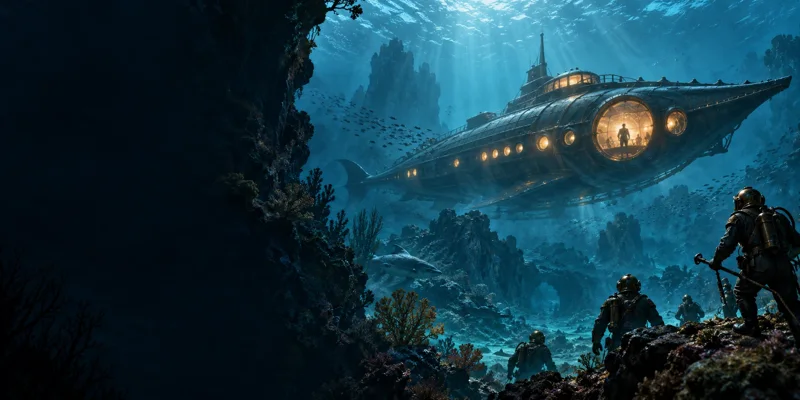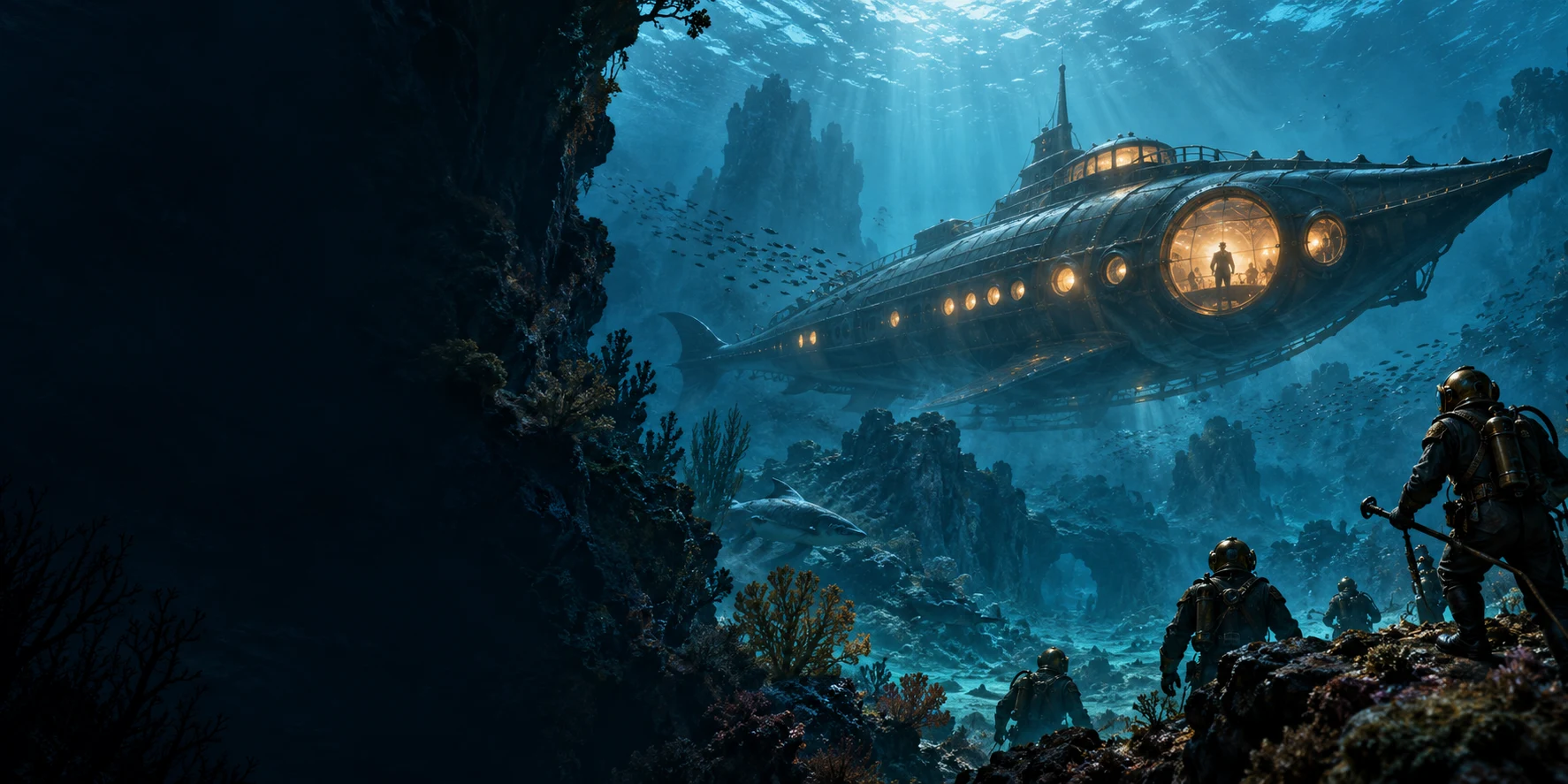

Here is the twenty thousand leagues meaning in a sentence: it is the distance the Nautilus covers on its voyage under the world’s oceans, not the depth it reaches. A league is an old unit of length, and twenty thousand of them come to roughly 80,000 kilometres, or about twice the distance around the Earth.
A depth of twenty thousand leagues would be impossible. The deepest point of any ocean is only about eleven kilometres down, less than three leagues. Read the title as “twenty thousand leagues of travel under the sea” and Jules Verne’s novel makes far more sense: it is a voyage, and a very long one.
What does twenty thousand leagues mean?
The league has meant different lengths in different countries and centuries, but it was always a measure of distance over land or sea, often described as the distance a person could walk in an hour. Verne, writing in France in the late 1860s, would have been thinking of a league of about four kilometres, the metric league in use at the time.
The French title is Vingt mille lieues sous les mers, literally “twenty thousand leagues under the seas”, in the plural. That plural is a clue too. The Nautilus does not dive into one ocean but crosses many: the Pacific, the Indian Ocean, the Red Sea, the Mediterranean, the Atlantic and the waters under the Antarctic ice.
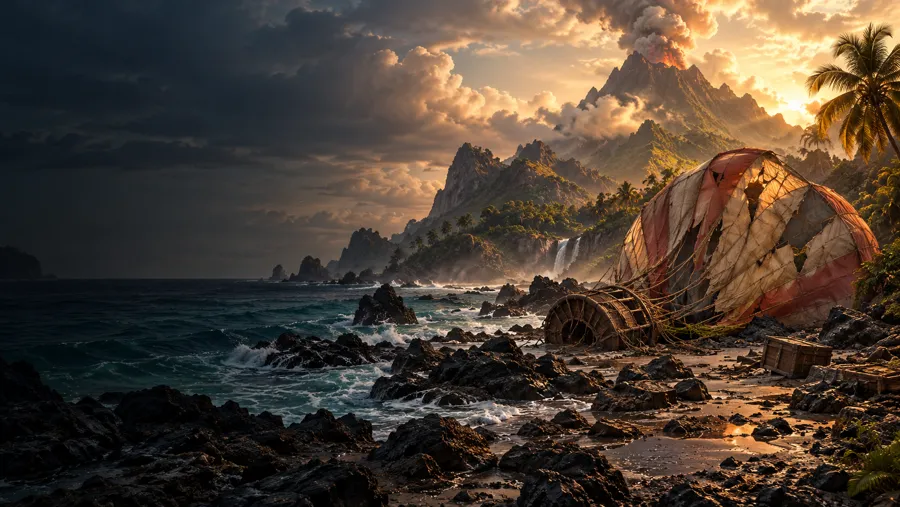
The story of the Nautilus
The book opens in 1866, with ships around the world reporting collisions with a huge, fast-moving creature, perhaps a giant narwhal. Professor Pierre Aronnax of the Paris Museum joins an American expedition to hunt it, with his loyal servant Conseil and a hot-tempered Canadian harpooner, Ned Land. When the monster rams their ship, the three are thrown into the sea, clamber onto its back and discover it is a submarine.
Its commander is Captain Nemo, a brilliant, wealthy and bitter man who has turned his back on the land and all its nations. Aronnax is half prisoner, half guest, and the novel follows his wonder at the underwater world alongside his growing unease about who Nemo is and what he wants. Verne never fully explains Nemo here, and his silence is part of the book’s power.
Verne wrote the novel for his publisher Pierre-Jules Hetzel, and it was serialised in 1869 and 1870. Verne’s letters suggest he first imagined Nemo with a specific political grievance, which Hetzel persuaded him to leave vaguer, fearing it would offend Russia and lose him Russian readers. Whatever the truth, the captain who emerged is one of the great mysterious figures of fiction.
Twenty Thousand Leagues Under the Sea
1870. Professor Aronnax, Conseil and Ned Land aboard Captain Nemo’s submarine, from the Pacific to the Antarctic. Twenty thousand leagues of travel, not depth.
The Mysterious Island
1875. Five castaways escape the American Civil War by balloon and build a life on an unknown island. Read it after Twenty Thousand Leagues; you will see why.
Journey to the Centre of the Earth
1864. Verne’s other great descent, through an Icelandic volcano towards the centre of the earth.


Is Twenty Thousand Leagues Under the Sea hard to read?
It is longer and slower than Around the World in Eighty Days, and Verne loves a catalogue. Aronnax lists fish, coral and molluscs at length, with the enthusiasm of a scientist who has been handed the greatest aquarium in history. Some readers adore these passages; others skim them, and the book survives either approach.
What keeps it moving are the set pieces: an underwater hunt in diving suits, a walk through a drowned forest, a battle with giant squid, a struggle beneath the ice. Translations vary a good deal, since some early English versions cut and altered the text heavily, and a good one makes a real difference.
It suits confident readers from about eleven upward, and makes a gripping family read-aloud for anyone with patience for the fish. Our Greatest sea stories ever written list puts it in good company, and it is a landmark in the science fiction firsts.

What to read next
If you finish the voyage wanting more of Nemo, The Mysterious Island is the book to read; it is best to go in knowing as little as possible. For another Verne title that is not quite what it seems, see Did you know a real reporter raced Phileas Fogg around the world?, and for a guide to the rest, Jules Verne’s Extraordinary Voyages: where to start.
But first, the deep. Join Professor Aronnax on the hunt for a sea monster that is not what anyone thinks, and open Twenty Thousand Leagues Under the Sea.
Questions readers ask
What does twenty thousand leagues mean?
It is a distance, not a depth. Twenty thousand leagues, at about four kilometres to the league, is roughly 80,000 kilometres, the distance the Nautilus travels under the world’s oceans in the novel.
How far is twenty thousand leagues?
Using the metric league of about four kilometres, twenty thousand leagues is roughly 80,000 kilometres, or about twice the circumference of the Earth.
Is The Mysterious Island a sequel to Twenty Thousand Leagues Under the Sea?
In a sense. The Mysterious Island is a separate castaway adventure, but it has a strong link to Twenty Thousand Leagues, so it is best read afterwards.
 Around the World in Eighty Days190 pages · $13.99
 The Master of the World128 pages · $11.99
 Robur the Conqueror158 pages · $12.99
 The Survivors of the Chancellor: Diary of J.R. Kazallon, Passenger170 pages · $13.99