
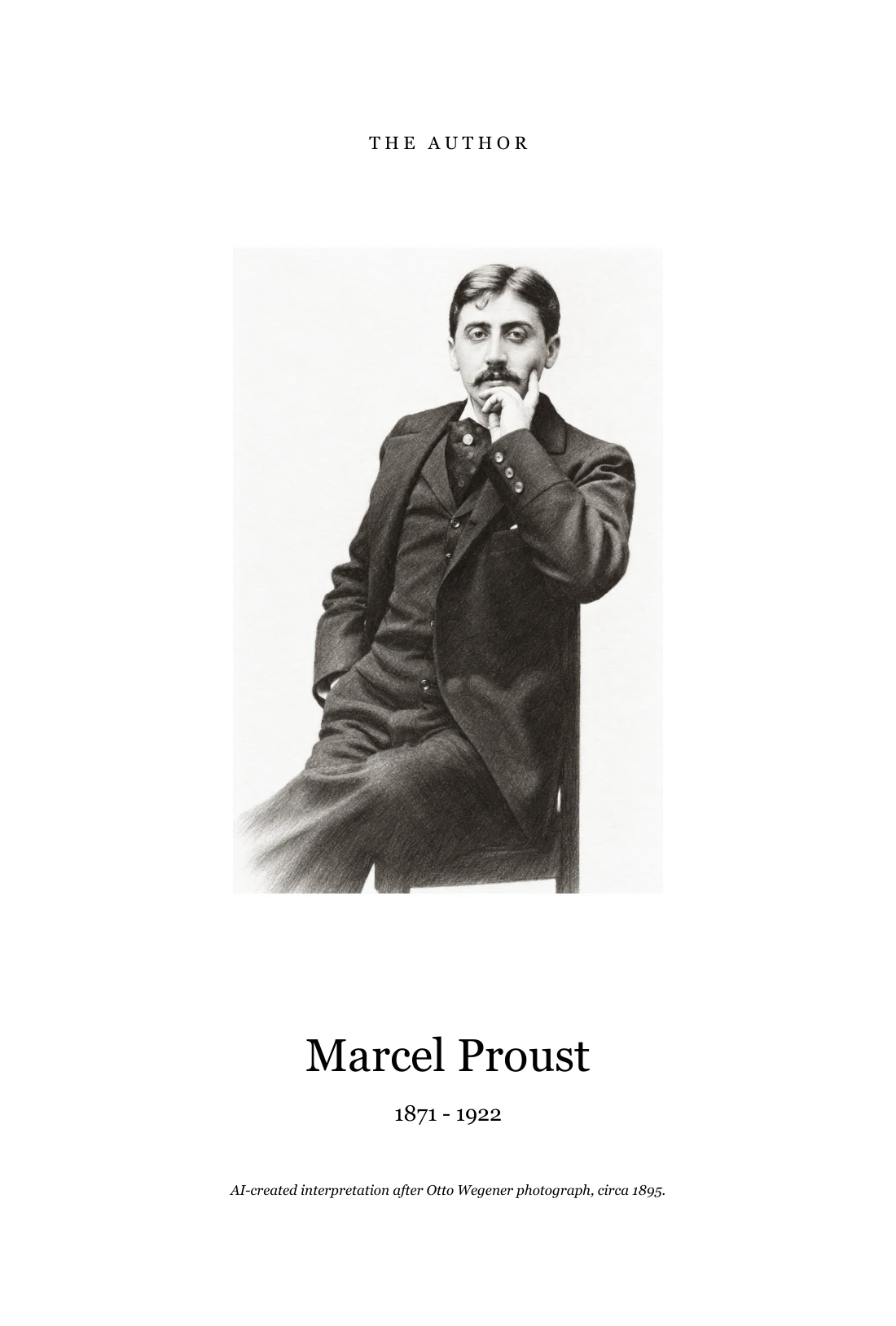
One publisher could not see the point. He might be slow-witted, he admitted, but he could not understand why a gentleman would need thirty pages to describe how he tossed and turned in bed before falling asleep. The verdict came from Alfred Humblot, head of the Paris firm of Ollendorff, and the manuscript he was turning down began with one of the most famous sentences in modern fiction: “For a long time I used to go to bed early.”
That manuscript was Swann’s Way, the first volume of In Search of Lost Time. After Ollendorff, Fasquelle and the Nouvelle Revue Française had all said no, Marcel Proust went to the publisher Bernard Grasset, who agreed to bring the book out on one condition: Proust would pay the costs. He did, from his private fortune, and Du côté de chez Swann appeared on 14 November 1913.
Why was Swann’s Way rejected?
Partly because of what it was. In 1913 Proust was known, if at all, as a society figure with a reputation as a snob and an amateur, the author of a slim, poorly selling collection of early pieces and some translations of Ruskin. Now he was offering a vast, plotless manuscript of memory and sensation, built from sentences that could run half a page. Fasquelle’s reader asked, in effect, what all of it meant. Humblot complained about the thirty pages in bed.
The most painful rejection came from the NRF, the serious literary review behind the publishing house of Gallimard. André Gide, its leading adviser, recommended against the book, reportedly put off by a few minor errors of syntax and by Proust’s reputation as a society snob. Within months he had read the published volume and changed his mind. In early 1914 he wrote to Proust to apologise, calling the rejection the most serious mistake the NRF had ever made.

Did paying for publication pay off?
Eventually, and handsomely. Swann’s Way found admirers, but the next volume did not appear until after the First World War. When it resumed, Proust had moved to Gallimard after all. The second volume, Within a Budding Grove, won the Prix Goncourt in 1919, and Proust, who had paid to be read in 1913, was famous within six years.
His English translator, C. K. Scott Moncrieff, began publishing the novel in English in 1922, the year Proust died, giving it the overall title Remembrance of Things Past, a phrase borrowed from Shakespeare’s Sonnet 30. Swann’s Way was the first volume to appear.
What happens in Swann’s Way?
Very little, and a great deal. The first part, Combray, is the narrator’s memory of childhood holidays in a small French town: his longing for his mother’s goodnight kiss, his great-aunt’s household, two walks the family takes, one towards the house of their neighbour Swann and one towards the estate of the aristocratic Guermantes. Its first section ends with the moment Proust is best known for, when the taste of a madeleine dipped in tea brings that whole lost world back.
And suddenly the memory returns. The taste was that of the little crumb of madeleine which on Sunday mornings at Combray (because on those mornings I did not go out before church-time), when I went to say good day to her in her bedroom, my aunt Léonie used to give me, dipping it first in her own cup of real or of lime-flower tea.
Marcel Proust, Swann’s Way, translated by C. K. Scott Moncrieff
The second part, Swann in Love, steps back to before the narrator’s birth and tells, almost like a separate novel, the story of the elegant Charles Swann’s jealous obsession with Odette de Crécy, a woman who, as he later admits, was not even his type. The short final part, Place-Names: The Name, returns to the narrator’s boyhood in Paris and his first love.

How should you read Swann’s Way?
Slowly, and without worrying. The opening pages about sleep, the ones that defeated Humblot, are the hardest; once the narrator reaches Combray the book opens out into scenes, characters and comedy. Many readers find Swann in Love the easiest way in, and some start there. At over four hundred pages it is a long book, but it is also a complete one. You can read Swann’s Way on its own and stop, satisfied, without committing to the other six.
Swann's Way
1913. Childhood memories of Combray, the madeleine, and Swann’s jealous love for Odette. The volume Proust paid to publish, and the door to the whole of In Search of Lost Time.
Shakespeare's Sonnets
Shakespeare’s sequence of 154 sonnets. Sonnet 30, “When to the sessions of sweet silent thought”, gave Proust’s first English translator his title.


Where to go next
Proust has a natural place in Modernism explained in four books and among The longest classic novels in our library. He also belongs to the French shelf in French classics everyone should read, and if you are weighing up translations, How to choose a translation of a classic will help.
Then go to bed early with Swann’s Way. Give it thirty pages, Humblot’s thirty, and see whether you agree with him or with Gide in 1914.
Questions readers ask
Did Proust self-publish Swann’s Way?
Effectively, yes. After rejections from Ollendorff, Fasquelle and the Nouvelle Revue Française, Proust paid Bernard Grasset to publish Swann’s Way at his own expense in November 1913.
Who rejected Swann’s Way?
The publishers Fasquelle and Ollendorff and the Nouvelle Revue Française, where André Gide advised against it. Gide later apologised, calling it the NRF’s most serious mistake.
Can you read Swann’s Way on its own?
Yes. It is the first of seven volumes of In Search of Lost Time, but it forms a complete book in itself, including the self-contained story Swann in Love.

 The Guermantes Way618 pages · $26.99