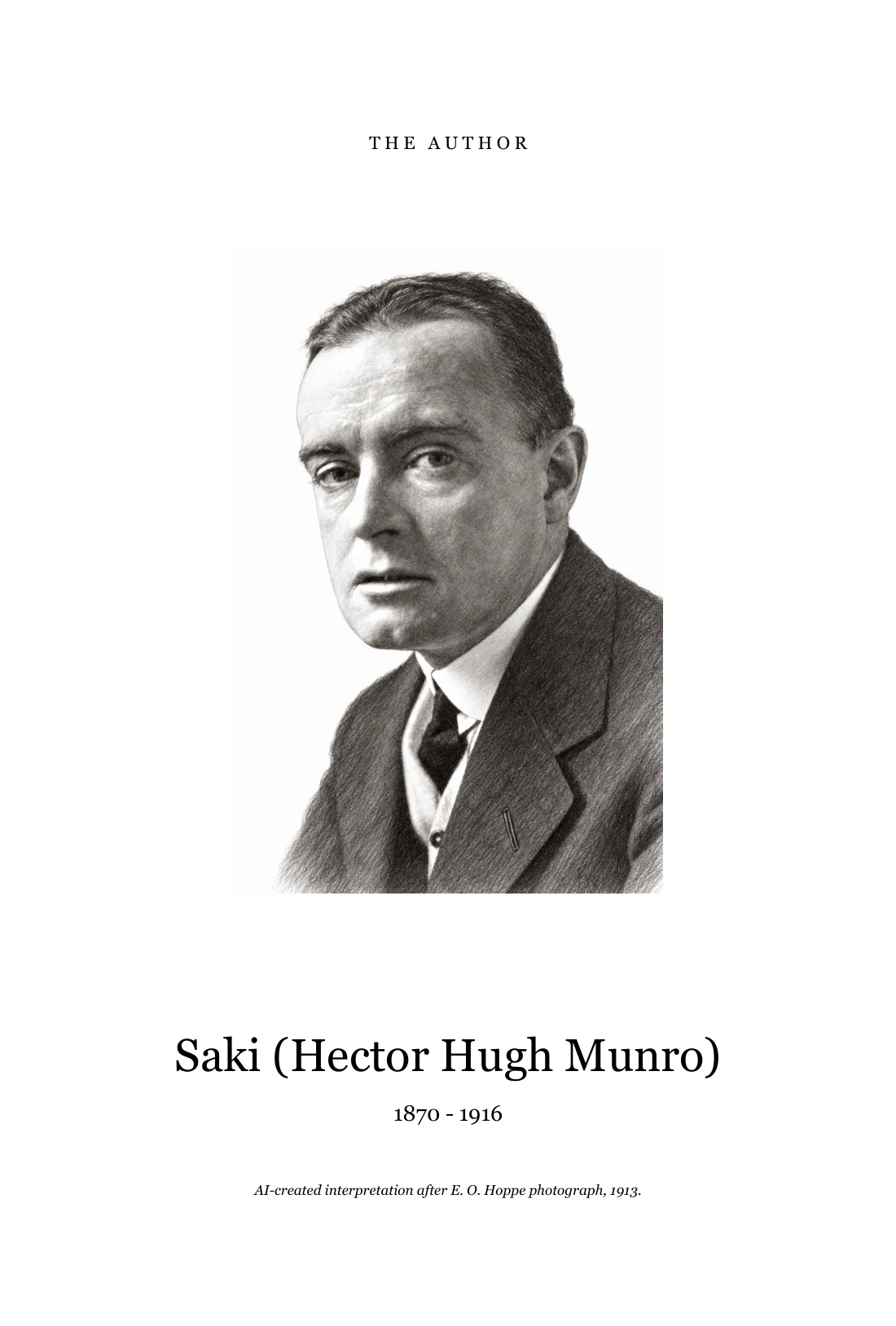
On 14 November 1916, in a shell crater near Beaumont-Hamel on the Somme, a forty-five-year-old lance sergeant of the Royal Fusiliers told a comrade to put his cigarette out. Moments later, according to the account handed down, a German sniper shot him dead. He had been over the age limit when war broke out, had turned down a commission and enlisted as a trooper. His name was Hector Hugh Munro, and he has no known grave. Readers knew him as Saki.
The story of Saki’s death is grim, and fittingly so, because his fiction is full of sudden, deadpan cruelty delivered in the politest possible voice. In little more than a dozen years of writing fiction he turned out stories as perfectly made as any in the language: tales of Edwardian drawing rooms invaded by wolves, practical jokes, malicious children and animals with ideas of their own.
Who was Saki?
Munro was born in Burma, where his father was a senior officer in the Indian Imperial Police. When he was a baby his mother, on a visit to England, was charged by a cow and died soon afterwards. He and his brother and sister were sent to Devon to be raised by their grandmother and two aunts in a strict, joyless household, and those aunts are thought to have been models for the tyrannical guardians in stories such as “The Lumber Room” and “Sredni Vashtar”. His sister Ethel called the aunt in “The Lumber Room” an almost perfect portrait of their Aunt Augusta.
After a short spell in the Burma police, cut off by fever, he became a journalist. He wrote political satire for the Westminster Gazette and spent years as a foreign correspondent for the Morning Post in the Balkans, Russia and Paris, witnessing revolution in St Petersburg in 1905. His first collection, Reginald, appeared in 1904; The Chronicles of Clovis followed in 1911 and Beasts and Super-Beasts in 1914.
What are Saki’s short stories like?
They are rarely more than a few pages long, and they move like a well-told dinner-party anecdote, with a sting in the last sentence. The dialogue is the thing. A dying woman discussing her prospects of reincarnation with a friend in “Laura” manages it like this:
“You are not really dying, are you?” asked Amanda. “I have the doctor’s permission to live till Tuesday,” said Laura.
“Laura”, in Beasts and Super-Beasts (1914)
Saki’s sympathies are always with the outsider and the anarchist, provided they are clever. His children are not sweet: in “The Lumber Room” young Nicholas is in disgrace for insisting there was a frog in his bread-and-milk, and the joke is that there really was. His adults are worse. In “The Story-Teller” a bachelor on a train silences three bored children with a tale about a little girl who was “horribly good”, and what happens to her delights them and appals their aunt.
Where to start with Saki’s short stories
Start with Beasts and Super-Beasts. Published in 1914, it gathers thirty-six stories and includes several of his most famous: “The Open Window”, “The Lumber Room”, “The Story-Teller” and “The Schartz-Metterklume Method”. Five to read first:
- “The Open Window”: a nervous visitor, a self-possessed girl of fifteen and an open French window. One of his best-known stories; don’t read anyone’s summary first.
- “The Lumber Room”: a boy, a forbidden room and an aunt who has met her match.
- “The Story-Teller”: the bachelor, the railway carriage and the horribly good girl.
- “The Schartz-Metterklume Method”: Lady Carlotta, left behind at a country station, is mistaken for the new governess and sees no reason to correct anyone.
- “Laura”: a woman who intends to come back as an animal, and does her best to keep her promise.
Two of his other most celebrated stories live elsewhere. “Tobermory”, about a cat taught to speak who repeats everything he has overheard at a house party, and “Sredni Vashtar”, about a sickly boy who worships a polecat-ferret in the garden shed, are both in The Chronicles of Clovis. Clovis Sangrail, that book’s idle young troublemaker, turns up in Beasts and Super-Beasts too.
Saki’s influence
Saki is often compared with O. Henry, the other master of the twist ending, though the two could hardly be more different in temperament. He learned from Oscar Wilde and Lewis Carroll, and in turn his style left its mark on P. G. Wodehouse, A. A. Milne and Noël Coward. For the American side of the story see Did you know O. Henry began writing stories in prison?, and for the comic tradition he helped shape, Where to start with P. G. Wodehouse. More short fiction from the same years is gathered in the best classic short story collections and on our short reads shelf.
Open Beasts and Super-Beasts at “The Open Window”. It takes about five minutes to read, and you will want to read it again immediately to see how he did it.
Questions readers ask
Who was Saki?
Saki was the pen name of Hector Hugh Munro (1870–1916), a British journalist and writer of witty, often dark short stories. He was killed in action in France in 1916.
What are Saki’s most famous short stories?
The best known of Saki’s short stories include “The Open Window”, “The Lumber Room”, “The Story-Teller”, “Tobermory” and “Sredni Vashtar”.
Why did H. H. Munro call himself Saki?
The name is taken from the cupbearer in Edward FitzGerald’s Rubaiyat of Omar Khayyam, according to Munro’s sister and a close friend.
Which Saki collection should I read first?
Beasts and Super-Beasts (1914) is the best place to start, since it contains “The Open Window”, “The Lumber Room” and “The Story-Teller”.