
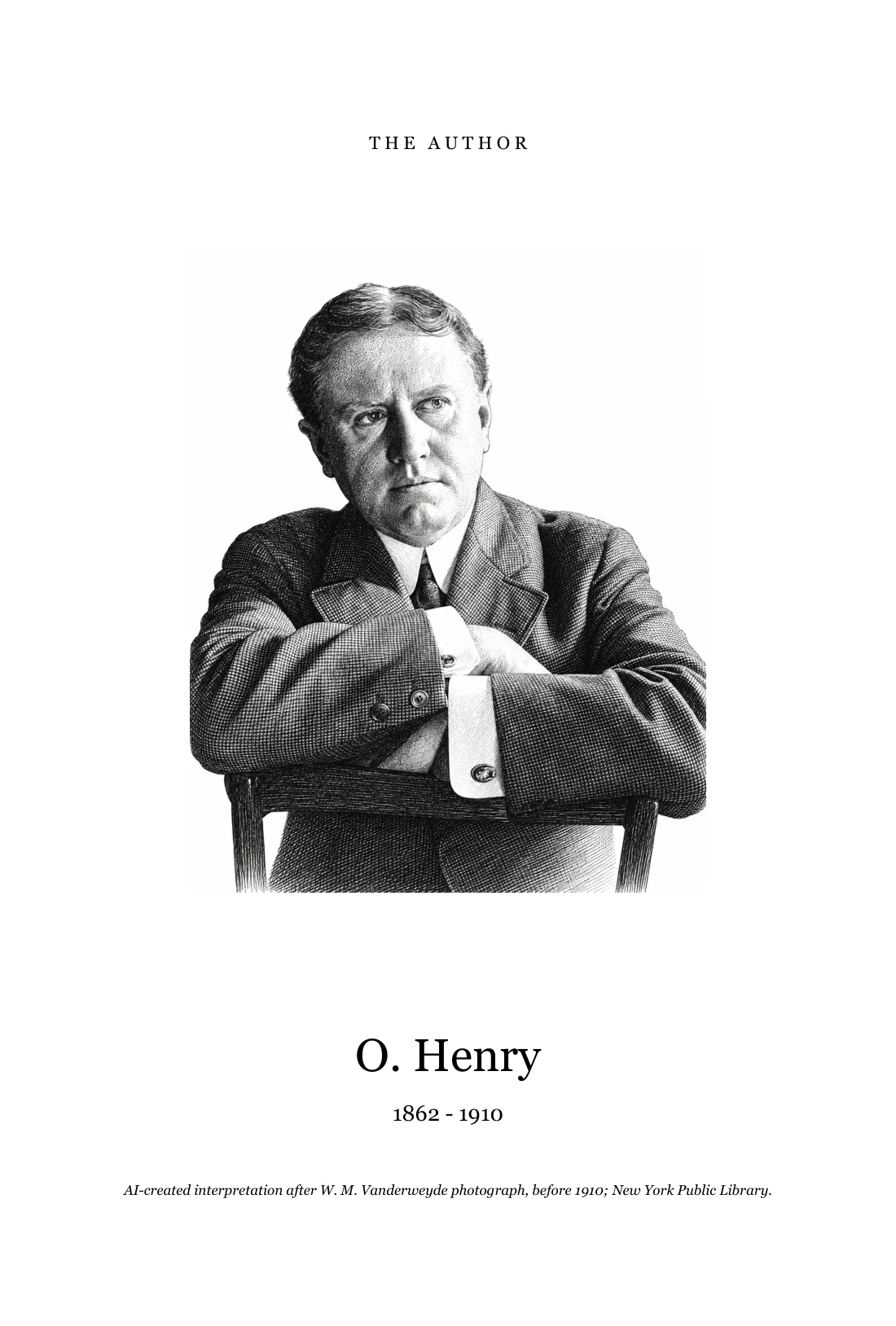
Porter did not begin writing in prison. In Austin, Texas, in the 1890s, he had published his own comic weekly, The Rolling Stone, full of sketches and short pieces, and after it failed he wrote a humour column for a Houston newspaper. What prison changed was not whether he wrote but how he was known. When he walked out in 1901, he had become O. Henry.
- 1862
William Sidney Porter is born in Greensboro, North Carolina, on 11 September.
- 1881
Qualifies as a pharmacist at nineteen.
- 1882
Moves to Texas, working on a ranch and later in Austin.
- 1894–95
Runs a humorous weekly, The Rolling Stone, which fails within a year.
- 1896
Indicted for embezzlement at the bank where he had worked; flees to Honduras.
- 1897
Returns to Austin when his wife is dying, and surrenders.
- 1898
Convicted, and sent to the Ohio Penitentiary in Columbus to serve five years.
- Dec 1899
“Whistling Dick’s Christmas Stocking” appears in McClure’s under the name O. Henry.
- 1901
Released early for good behaviour after three years.
- 1910
Dies in New York on 5 June, aged forty-seven.
What happened to O. Henry in prison?
Porter was convicted in February 1898 of embezzling a little over $850 from the First National Bank of Austin. Because he was a licensed pharmacist, the Ohio Penitentiary put him to work as the night druggist in the prison hospital. He had a room in the hospital wing, and there is no record that he ever spent time in the cell block.
The night shift left him time to write, and he used it. While he was inside, at least a dozen of his stories were published under a variety of pseudonyms. A friend in New Orleans forwarded the manuscripts, so editors had no idea where their author was. One of those names, first seen over “Whistling Dick’s Christmas Stocking” in McClure’s Magazine in December 1899, was O. Henry.

The New York years
After his release he went first to Pittsburgh, where his young daughter Margaret was living with her grandparents, and in 1902 to New York. There he wrote at a ferocious rate, for a time a story a week for the Sunday magazine of the New York World, and turned out hundreds of stories in eight years. His first collection, Cabbages and Kings (1904), drew on his time in Honduras and gave the language the phrase “banana republic”.
The second, The Four Million (1906), is where to begin. Its title answered a society figure who had claimed that only four hundred people in New York society really counted; O. Henry preferred the census taker’s figure, and wrote about shopgirls, clerks, tramps and lodgers in furnished rooms. It contains his most famous story, which opens like this:
One dollar and eighty-seven cents. That was all. And sixty cents of it was in pennies.
O. Henry, “The Gift of the Magi”, The Four Million (1906)
The best O. Henry stories to start with
- $12.99
The Four Million
1906. Twenty-five New York stories, including “The Gift of the Magi”, “The Cop and the Anthem”, “After Twenty Years” and “The Furnished Room”. The essential O. Henry.
- $13.99
The Trimmed Lamp, and Other Stories of the Four Million
1907. More stories of the city’s working people, among them “The Last Leaf”, about two young artists, a dangerous illness and an old painter still waiting to paint his masterpiece.
- $14.99
Heart of the West
1907. Nineteen stories of Texas ranches and cattle towns, drawn from his years in the West. Includes “The Caballero’s Way”, which introduced the Cisco Kid.


Read The Four Million first, a few stories at a time; they are short, and the famous twist endings are best met fresh. Then The Trimmed Lamp for more of the city, and Heart of the West for something different. The Cisco Kid of “The Caballero’s Way” is a ruthless border killer, nothing like the dashing hero of later films and television.

Why do O. Henry’s endings still work?
Because the surprise is rarely a trick for its own sake. In his best stories the last-minute turn changes the meaning of everything before it, so that a story about two foolish young people becomes a story about love, and a story about a tramp trying to get arrested becomes one about how hard it is to change a life. Critics have often found him sentimental. Readers have kept on loving him anyway, and the O. Henry Prize for short fiction still carries his name.
His prison years belong in a remarkable company, which we gather in Classic books written in prison; his pen name in Famous pen names in classic literature; and his city in Classic novels set in New York. One story is enough to start. Count Della’s pennies with her in “The Gift of the Magi”, the second tale in The Four Million, and see how much O. Henry can do in a handful of pages.
Questions readers ask
Did O. Henry start writing in prison?
No. William Sydney Porter was writing and publishing sketches in Texas in the 1890s, before his conviction. But the pen name O. Henry first appeared in print in December 1899, while he was serving his sentence in the Ohio Penitentiary.
Why was O. Henry in prison?
He was convicted in 1898 of embezzling funds from the First National Bank of Austin, Texas, where he had worked, and served three years of a five-year sentence.
What are O. Henry’s most famous stories?
“The Gift of the Magi”, “The Ransom of Red Chief”, “The Last Leaf”, “The Cop and the Anthem” and “After Twenty Years” are among the best known.