In 1904, when Daughters of Nijo appeared, a reviewer in the Baltimore Sun began to wonder aloud whether its author was really Japanese, or even half Japanese. Others soon wondered too. The author’s name on the title page was Onoto Watanna, and by then she had published a string of popular Japan-set romances, one of which had been turned into a Broadway play.
The doubters were right. “Onoto Watanna” was the pen name of Winnifred Eaton, born in Montreal in 1875 to an English father and a Chinese mother. The name sounds Japanese but is not a real Japanese name at all. She invented it, and an entire Japanese persona to go with it, as a young woman in Cincinnati in the 1890s.
Who was Winnifred Eaton?
Her father, Edward Eaton, was an English merchant who had married Achuen Amoy, known as Grace, in Shanghai in 1863. The family moved between England and North America before settling in Montreal, where money was always short and children were plentiful. Winnifred was the eighth of fourteen; two died young.
She left home at about twenty, worked as a stenographer in Jamaica, Cincinnati and Chicago, and wrote stories in her spare time. In Cincinnati she began presenting herself as Japanese, and soon published her first Japanese-themed story, “A Japanese Girl”, in a local newspaper under the name Onoto Watanna. Her first novel, Miss Numè of Japan, came out in 1899, and it is often said to make her the first person of Asian descent to publish a novel in the United States.
Why did Winnifred Eaton pretend to be Japanese?
Partly because Japan sold. At the turn of the century American and British readers were captivated by Japanese art and fashion and by romances set in Japan; Madame Butterfly belongs to the same craze. Partly because being Chinese in North America at the time meant facing open, legal hostility, while Japan was admired. A Japanese persona allowed Eaton to draw on her Asian heritage without carrying the prejudice attached to it.
Her eldest sister took the opposite road. Edith Maude Eaton wrote, as Sui Sin Far, stories of Chinese immigrants in North America and from the mid-1890s asserted her Chinese heritage in print. The contrast between the two sisters, one claiming her Chinese ancestry and one disguising it, has made the Eatons a subject of real interest to modern scholars.
Onoto Watanna’s books
Success came quickly. A Japanese Nightingale (1901) was a hit, translated into several languages, staged on Broadway in 1903 and filmed in 1918. The Wooing of Wistaria, The Heart of Hyacinth and Daughters of Nijo followed, and Tama (1910) sold strongly. She married the journalist Bertrand Babcock in 1901 and lived in New York, where she wrote at a great rate.
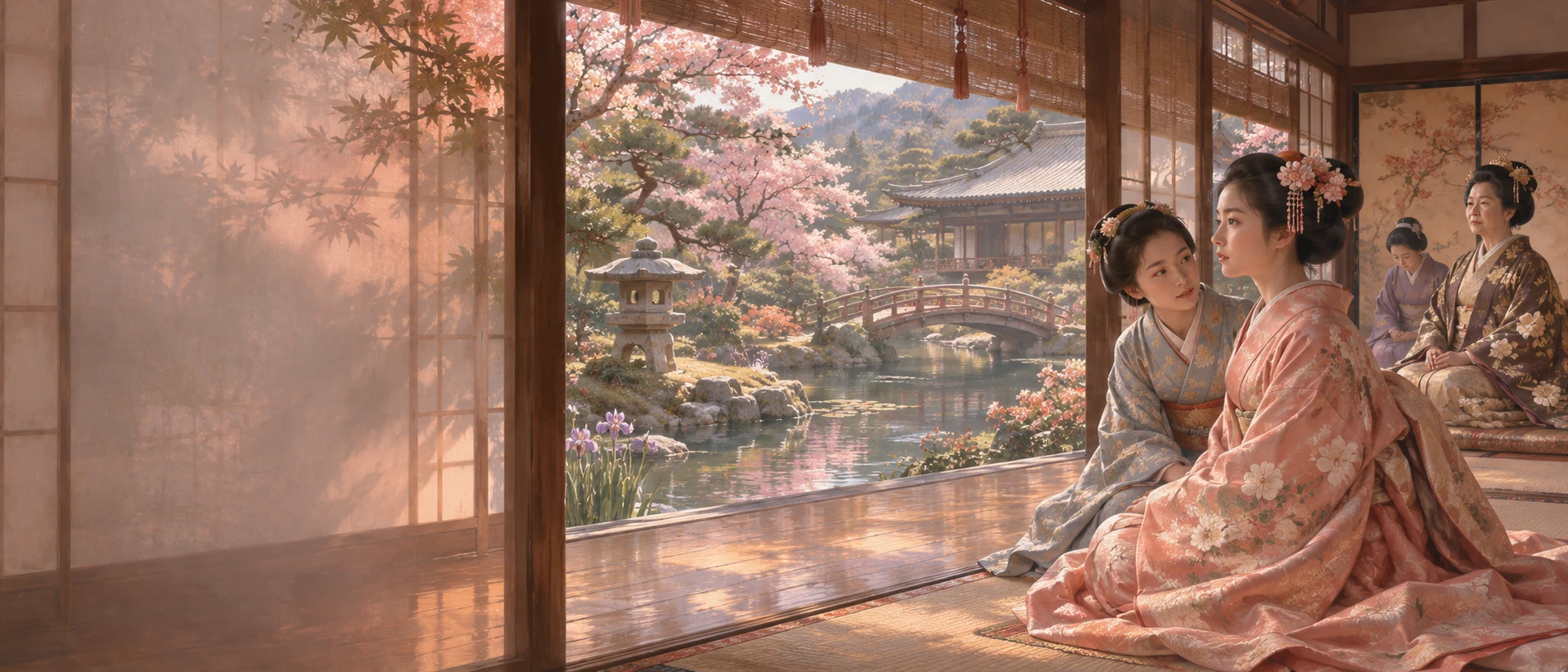
Daughters of Nijo is a good example of her method. It opens in the years of the Meiji Restoration, when a young farmer’s wife catches the eye of a visiting prince. Years later two girls are growing up, one a princess at court and one the daughter of a farmer turned rich Tokyo merchant, who turn out to share a father and a face. The plot turns on what happens when they trade places.
Though each feature of the faces of these two sisters was identically alike, their natures vastly differed.
Onoto Watanna, Daughters of Nijo
It is a novel about identity and disguise by an author who was living one, and it is hard not to read it that way now. Its Japan is a romantic, picture-book Japan of the kind her readers expected, but Eaton writes with real energy, a lively sense of comedy and a sharp eye for the gap between rank and character.
What happened to Winnifred Eaton later?
She reinvented herself again. In 1915 she published Me: A Book of Remembrance anonymously, a thinly fictionalised memoir of her early years. After divorcing Babcock she married Frank Reeve in 1917 and moved to a ranch in Alberta, where she wrote novels of Canadian ranch life such as Cattle (1923). In the mid-1920s she went to work for Universal Pictures, first running its East Coast scenario department in New York and then as a scenario editor in Hollywood, before returning to Calgary in the 1930s. She died in 1954 in Butte, Montana, on the way home from California.
Her life is one of the most surprising in the history of pen names. For others, see our list of famous pen names and the story of Carolyn Keene, who was not a real person. For more books by Asian writers and about Asia, try Asian classics in English.
Read it knowing who wrote it and the book becomes something stranger and more interesting than the romance its first readers bought. Open Daughters of Nijo and start with the farmer’s young wife who wants, just once, to see the procession in town.
Questions readers ask
What is Onoto Watanna’s real name?
Winnifred Eaton (1875–1954), a writer born in Montreal to an English father and a Chinese mother. She published most of her Japan-set fiction as Onoto Watanna.
Was Onoto Watanna Japanese?
No. Winnifred Eaton had no Japanese ancestry. She adopted a Japanese persona and pen name in the 1890s, when Japan-themed romances were popular and Chinese immigrants faced widespread prejudice.
Who was Sui Sin Far?
Sui Sin Far was the pen name of Edith Maude Eaton, Winnifred’s elder sister, who wrote about Chinese immigrants in North America and openly asserted her Chinese heritage.
What books did Onoto Watanna write?
Her best-known novels include Miss Numè of Japan (1899), A Japanese Nightingale (1901), The Heart of Hyacinth (1903), Daughters of Nijo (1904) and Tama (1910).