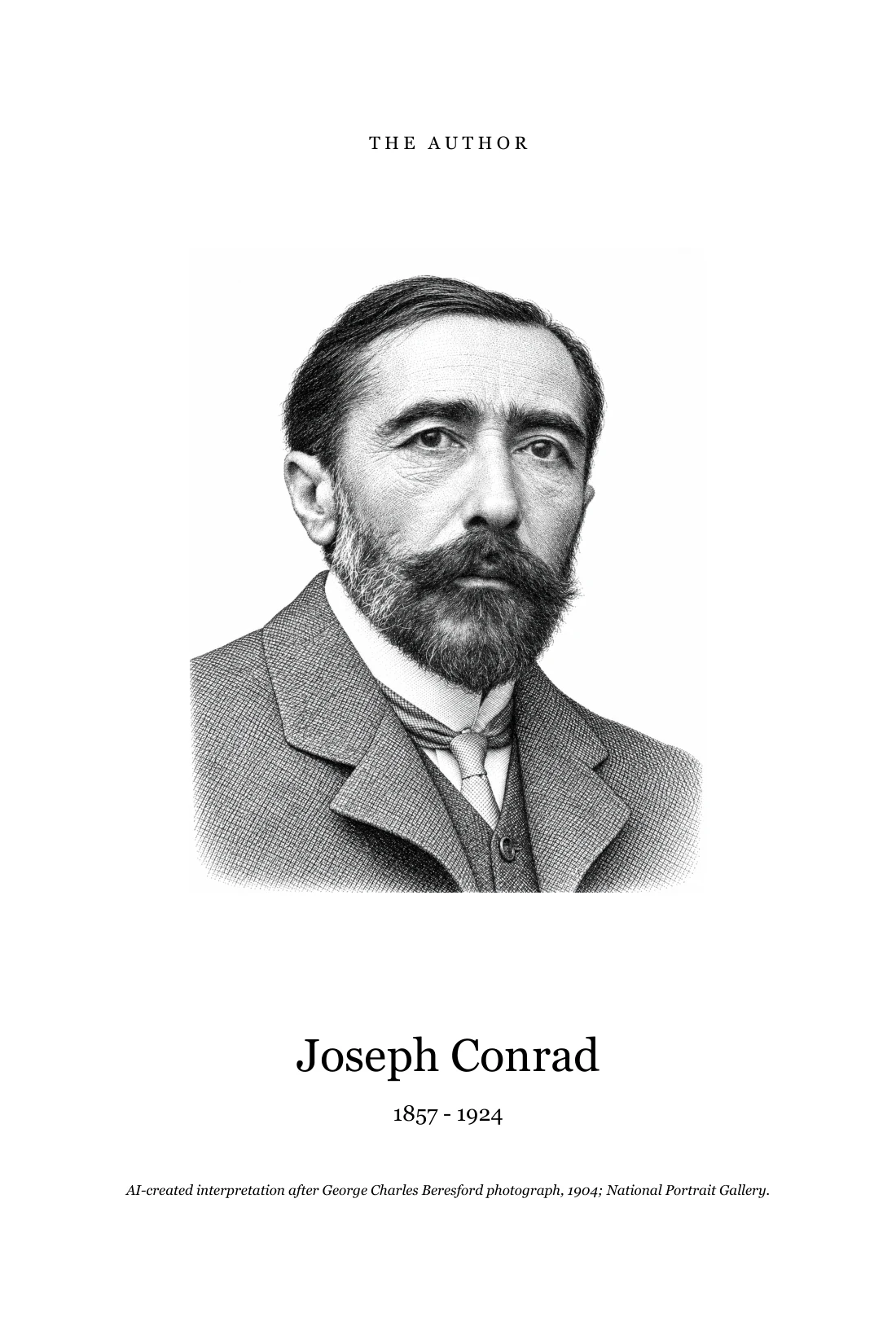
Joseph Conrad was born Józef Teodor Konrad Korzeniowski in 1857, to Polish parents in a part of the Russian Empire that is now Ukraine. Polish was his first language and French his second. English came third, and late: he seems to have started learning it only shortly before he joined his first British ship in 1878, at the age of twenty, and it was years before he spoke it fluently.
Seventeen years later he published his first novel, Almayer’s Folly, in English. By the time he died in 1924 he had written books like Heart of Darkness and Lord Jim that are now counted among the classics of the language. Few writers have ever made a stranger journey to their medium, and the strangeness is part of what makes Conrad’s books feel unlike anyone else’s.
A Polish childhood and a life at sea
Conrad’s father was a poet, translator and Polish patriot who was exiled by the Russian authorities for his political activities, taking his wife and small son with him. Both parents died while Conrad was still a child, and he was placed in the care of his mother’s brother. At sixteen he left for Marseille to go to sea, sailing first on French ships.
In 1878 he joined his first British vessel. Over the next sixteen years he rose through the ranks of the British merchant service, qualified as a master mariner, and became a British subject in 1886. He sailed to Australia, Borneo, Singapore and the Gulf of Siam, and in 1890 he took a job on a steamer on the Congo River, the journey that would become Heart of Darkness.
Why did Conrad write in English?
He could have written in Polish or in French, which he spoke fluently. Conrad himself insisted, in a note written in 1919, that he had not so much chosen English as been adopted by it, and that if he had not written in English he would not have written at all. Critics have long argued over how his Polish and French show through: in his long, rolling sentences, his slightly formal phrasing, and his habit of looking at English life from just outside it.
What is not in doubt is that the sea gave him both the language and the material. Nearly all his early work draws on what he saw as a sailor: storms, isolated trading posts, honour and failure among men far from home.
We live, as we dream—alone.
Joseph Conrad, Heart of Darkness (1899)
The best Joseph Conrad books to start with
Conrad’s reputation for difficulty is partly earned; he liked stories told by narrators within narrators, and his chronology can loop back on itself. But the shorter works are a fine way in, and the big novels repay patience.
Heart of Darkness
1899. Marlow’s journey up an African river in search of the ivory trader Kurtz. Short, haunting and endlessly argued over.
Typhoon
1902. A stolid steamer captain, too unimaginative to fear the weather, sails straight into a typhoon in the China Seas. The best sea storm in English, and a quick read.
Lord Jim
1900. A young officer abandons his ship in a moment of panic and spends his life trying to live it down. Conrad’s great novel of honour and shame.
The Secret Agent
1907. Anarchists, informers and a bomb plot in the back streets of London. Grimly funny, and startlingly modern.
Nostromo
1904. Revolution and a silver mine in an imaginary South American republic. His most ambitious novel, and the one many critics rank highest.


If you like the sea stories, go on to The Shadow Line, a late, autobiographical tale of a young captain’s first command, and Victory, set on a remote island in the Malay Archipelago. Under Western Eyes, about a Russian student caught up in an assassination, is the companion to The Secret Agent.
Heart of Darkness and its critics
Heart of Darkness is Conrad’s most famous book and his most contested. It is a fierce indictment of the brutality of colonial rule in the Congo, but in 1975 the Nigerian novelist Chinua Achebe argued in a celebrated lecture that it also denies its African characters any voice or humanity of their own. Both readings are still taught, and the book is richer for being read with the argument in mind. We look at the real journey behind it in Heart of Darkness and Conrad’s Congo journey, and at its most famous descendant in Apocalypse Now and Heart of Darkness.
Is Joseph Conrad hard to read?
He can be, at first. The sentences are long and the stories rarely move in a straight line. The trick is to let the narrator’s voice carry you and not worry about catching every detail on a first reading. Typhoon and Heart of Darkness are both short enough for a weekend, and once you are used to the rhythm, the novels open up. His sea writing also belongs on any list of the greatest sea stories.
For a first taste, try Typhoon. It is Conrad at his most direct and even his most humorous, and by the end you will understand how a man who learned English from sailors came to write it so well.
Questions readers ask
When did Joseph Conrad learn English?
Conrad grew up speaking Polish and French, and he seems to have begun learning English only shortly before joining his first British ship in 1878, when he was twenty. English was his third language, and he spoke it with a strong accent all his life.
What is Joseph Conrad’s most famous book?
Heart of Darkness (1899) is his best-known work. Lord Jim, Nostromo and The Secret Agent are his most celebrated novels.
Where should I start with Joseph Conrad books?
Start with a shorter work such as Typhoon or Heart of Darkness, then move to Lord Jim or The Secret Agent. Nostromo is his most ambitious book and is best read once you know his style.
Was Joseph Conrad really a sailor?
Yes. He spent around twenty years at sea, first on French and then on British ships, and qualified as a master mariner before he became a full-time writer.
 Victory330 pages · $17.99
 Under Western Eyes298 pages · $16.99
 The Shadow Line: A Confession114 pages · $11.99
 The Rescue334 pages · $17.99