
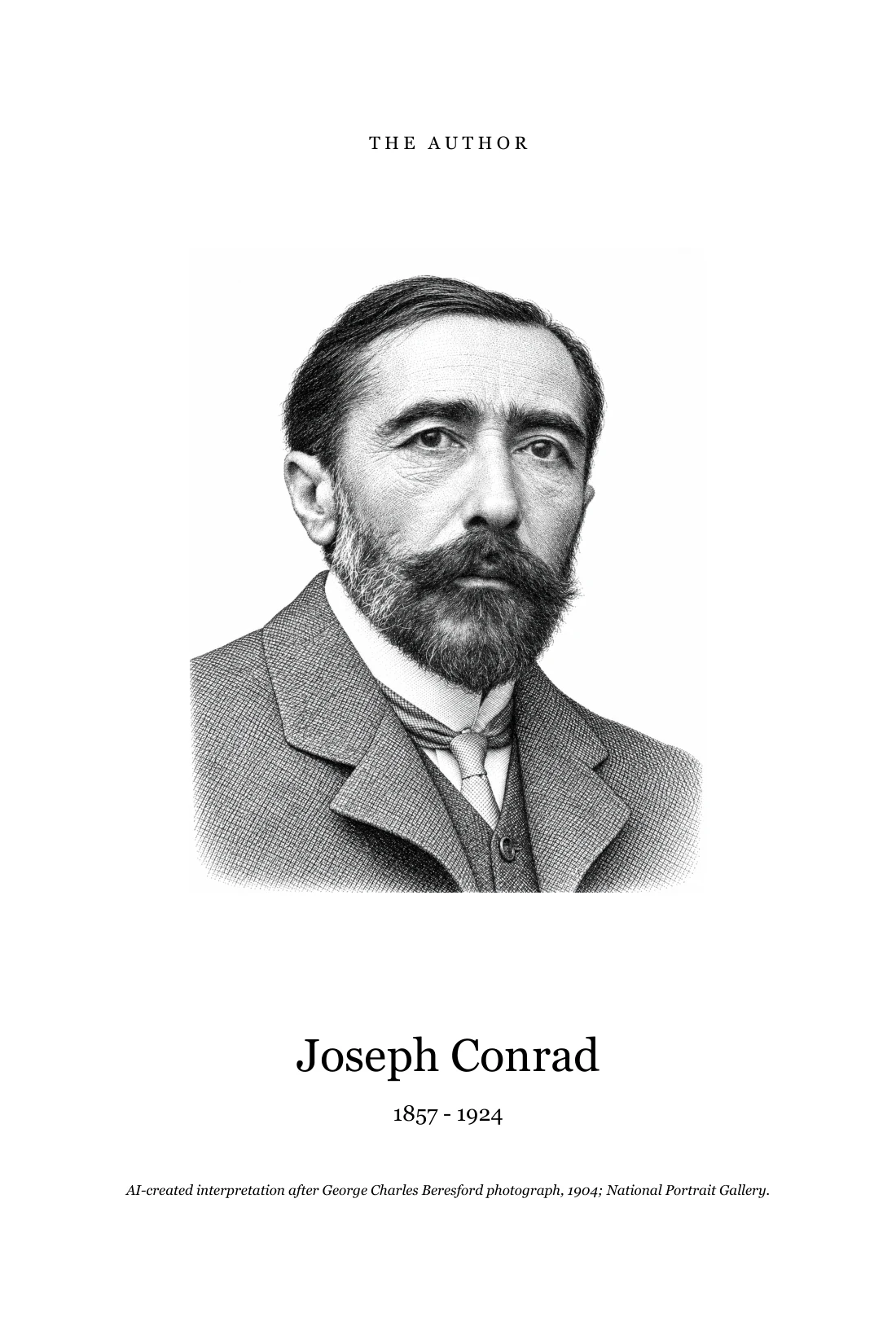
Is Heart of Darkness based on a true story? In large part, yes. In 1890 Joseph Conrad, then a merchant navy officer in his early thirties, took a job with a Belgian trading company in the Congo Free State. He travelled up the Congo River by steamer to the company’s station at Stanley Falls, fell seriously ill, and was back in Europe within about six months. Nearly a decade later he turned the experience into the novella his narrator, Marlow, tells.
Conrad himself described the book as experience pushed only slightly beyond the facts. The places, the brutality and the sense of moral sickness are drawn from what he saw. The story of Kurtz is his invention, built on that foundation.
What happened on Conrad’s journey up the Congo?
Conrad had wanted to go to Africa since childhood. In his memoir A Personal Record he recalls putting his finger, as a boy, on the blank middle of a map of Africa and telling himself that he would go there one day — a memory he gives to Marlow almost word for word.
In 1890 he got his chance, hired to captain a river steamer. Rapids block the lower Congo, so from the coast he made a long overland march to Stanley Pool, and the diary he kept records scenes — a body by the path, abandoned villages, exhausted porters — that reappear in the novella. At the Pool he found the steamer he was meant to command had been damaged, and joined another, the Roi des Belges, for the voyage upriver.
On the return trip a company agent called Georges-Antoine Klein, who had been taken aboard gravely ill, died on the steamer. Klein is often suggested as one source for Kurtz, though Conrad drew on several figures and on his own imagination. Conrad himself was laid low by fever and dysentery, and his health never fully recovered.
It is experience pushed a little (and only very little) beyond the actual facts of the case.
Joseph Conrad on Heart of Darkness, Author’s Note to Youth (1917)
The real horror of the Congo Free State
The Congo Free State was not a colony in the usual sense but the personal possession of King Leopold II of Belgium, who claimed to be bringing civilisation and free trade to central Africa. In practice it was run for profit, first from ivory and then from rubber, through forced labour, hostage-taking and terrible violence against the Congolese people.
When Conrad was there, much of this was still hidden from Europe. In Matadi he met Roger Casement, the Irish-born official who would later expose the abuses in a famous report of 1904. Heart of Darkness, first published in 1899, was one of the books that helped open readers’ eyes to what lay behind the language of progress.
Is Heart of Darkness racist?
This is the great debate around the book, and readers should know about it. In a 1975 lecture, the Nigerian novelist Chinua Achebe argued that Conrad, whatever his criticism of imperialism, presents Africa as a mere backdrop for a European’s spiritual crisis and denies its people language, individuality and full humanity. He called Conrad a racist, and questioned whether a book that dehumanises part of humanity can be called a great work of art.
Others answer that the novella is one of the most damning portraits of colonial greed in English, and that its narrator’s attitudes are part of what Conrad was exposing. Both views have serious defenders. Many readers now find the book does two things at once: it condemns what Europeans did in the Congo, while reproducing many of the prejudices that made it possible. Reading it with that in mind is the best way to read it now.
Heart of Darkness
1899. Marlow’s river journey into the Congo in search of the ivory agent Kurtz. Short, dense and endlessly debated.
Lord Jim
1900. Marlow returns to tell the story of a young officer haunted by one moment of failure — Conrad’s great novel of honour.
The Shadow Line: A Confession
1917. Conrad’s story of a young captain’s first command and a becalmed ship, drawn from his own life at sea.


What is Heart of Darkness like to read today?
Short but slow. It is a novella you could read in an afternoon, but the prose is thick with atmosphere and Marlow’s narration circles, doubles back and refuses easy explanation. Give it your full attention, ideally across two or three sittings, and let the fog and the river do their work. It begins not in Africa but on the Thames at dusk, on a boat waiting for the tide.
“And this also,” said Marlow suddenly, “has been one of the dark places of the earth.”
Joseph Conrad, Heart of Darkness
For how the book became Apocalypse Now, see Did you know Apocalypse Now is based on Heart of Darkness?. For the story of how a Polish sailor became a master of English prose, read Did you know Joseph Conrad didn’t learn English until his twenties?, and for more short masterpieces, classic novellas.
Then join Marlow and his listeners on the deck of the Nellie as the light fades over London. Heart of Darkness is a hard book in more ways than one, and one that every serious reader should meet at least once.
Questions readers ask
Is Heart of Darkness based on a true story?
Partly. It is based on Joseph Conrad’s own journey up the Congo River in 1890 while working for a Belgian trading company, though the character of Kurtz and the plot are fiction.
Was Kurtz a real person?
Not exactly. A company agent named Georges-Antoine Klein died aboard Conrad’s steamer in 1890 and is often suggested as one source, but Kurtz is largely Conrad’s invention.
Why is Heart of Darkness controversial?
Chinua Achebe and others have argued that it dehumanises Africans even as it criticises colonialism. Defenders see it as a powerful indictment of imperialism. Both readings remain widely discussed.
How long is Heart of Darkness?
It is a novella of around 38,000 words that most readers finish in two to three hours.
 The Secret Agent246 pages · $15.99
 Nostromo438 pages · $20.99
 Victory330 pages · $17.99
 Under Western Eyes298 pages · $16.99