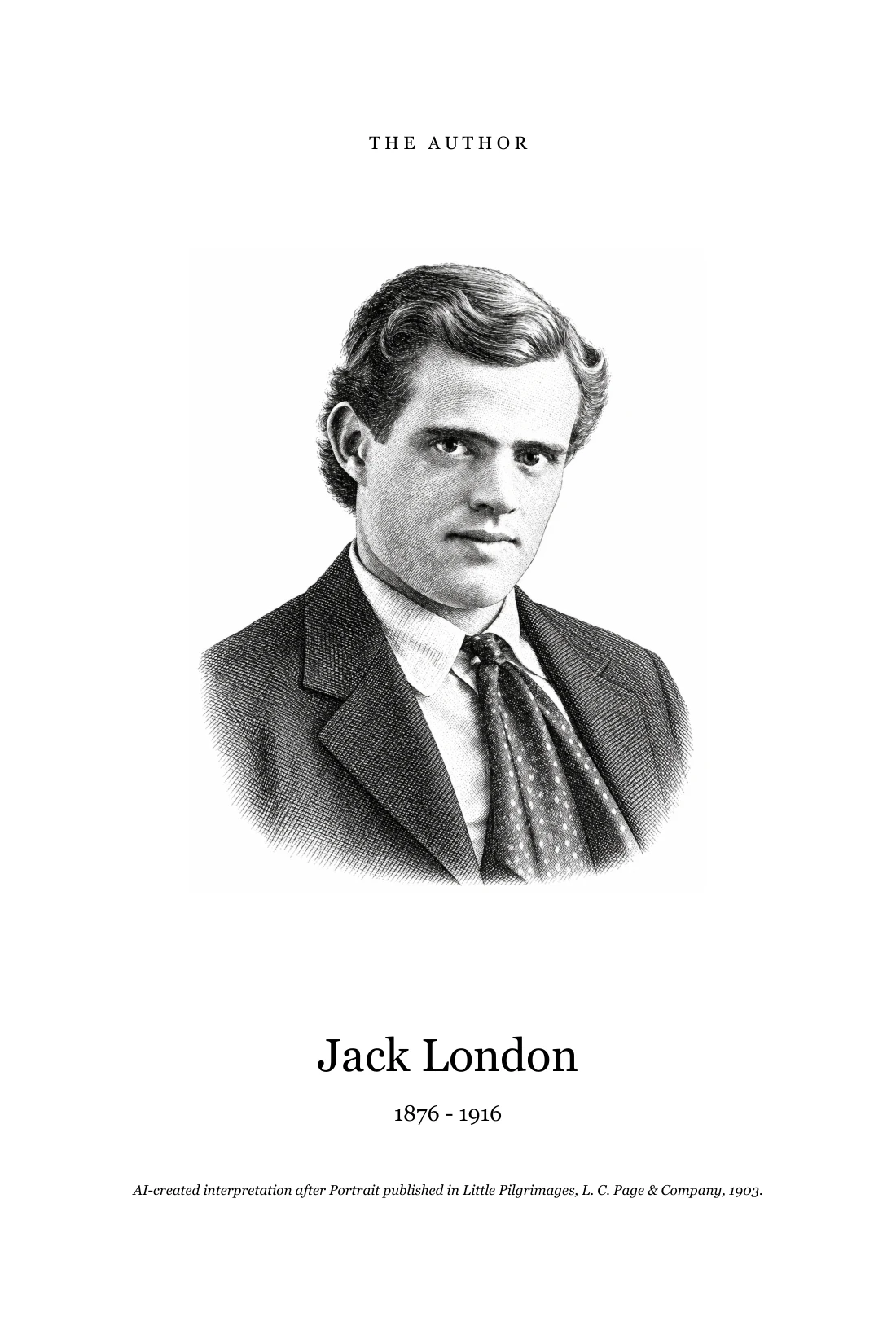
Less than five dollars. That, by the usual account, is what Jack London had to show in gold dust for his year in the Yukon. He sailed north in July 1897, a twenty-one-year-old from Oakland caught up in the Klondike Gold Rush, and he came home the following summer broke, toothless in places and weakened by scurvy.
The prospecting failed. The notebook did not. The Klondike gave London his first published story, his first book and the two novels he is still best known for, The Call of the Wild and White Fang. For the Jack London books that came out of the North, those two are where to begin, and the rest of this post sets out what else grew from that one hard winter.
What happened to Jack London in the Klondike?
London travelled with his brother-in-law, James Shepard, on the steamer Umatilla, then on to Dyea in Alaska, the start of the climb over the Chilkoot Pass. From the top of the pass the stampeders built or bought boats and worked their way down a chain of lakes and rivers towards Dawson City, racing the freeze.
As the river froze, London’s party settled into a cabin on the Stewart River, a tributary of the Yukon short of Dawson, and staked claims that came to nothing. A long winter without fresh food gave him scurvy, and by spring he described himself as almost crippled from the waist down. Unable to get well in Dawson, he set off down the Yukon in a small boat for the Bering Sea, some 1,500 miles away, and worked his passage home.
- July 1897
London sails north from San Francisco on the Umatilla, bound for the goldfields.
- Autumn 1897
He hauls his outfit over the Chilkoot Pass and boats down the lakes towards the Yukon.
- Winter 1897–98
He sits out the winter on the Stewart River and falls ill with scurvy.
- Spring 1898
He floats down the Yukon to the Bering Sea and heads home that summer, penniless.
- January 1899
“To the Man on Trail”, a Klondike Christmas story, appears in the Overland Monthly.
- 1900
The Son of the Wolf, his first book, collects his stories of the North.
- 1903
The Call of the Wild is serialised in The Saturday Evening Post and published as a book.
- 1906
White Fang runs in Outing magazine from May to October, then appears in book form.
- 1912
Smoke Bellew takes London back to the gold rush, this time for comedy.

The dog from Dawson
In Dawson London got to know two brothers, Marshall and Louis Bond, mining engineers from a wealthy family, and their big St Bernard–collie cross. Years later he wrote to Marshall Bond to say that Buck, the hero of The Call of the Wild, was based on that dog. The fictional Buck begins life in comfort on a Santa Clara Valley estate and is stolen and sold north for exactly the reason the novel gives in its opening lines.
Buck did not read the newspapers, or he would have known that trouble was brewing, not alone for himself, but for every tide-water dog, strong of muscle and with warm, long hair, from Puget Sound to San Diego.
Jack London, The Call of the Wild (1903)
The Saturday Evening Post paid $750 for the serial, and London sold the book rights outright to Macmillan for a flat $2,000, which meant no royalties on what became his most famous book. Macmillan promoted it hard, and the first printing of 10,000 copies sold out at once.
The best Jack London books to read, North and beyond
Start with the Klondike pair and you will know quickly whether London is for you. Then follow him out of the snow.
- $11.99
The Call of the Wild
1903. A pampered house dog is kidnapped into the brutal economy of the gold rush and learns, blow by blow, what he is capable of. Short, savage and impossible to put down.
- $13.99
White Fang
1906. The mirror image of Buck’s story: a wolf-dog born in the wild is pulled, slowly and painfully, towards human company. Its opening pages, two men and a coffin pursued by a starving pack, are among his best.
- $11.99
Smoke Bellew
1912. A soft San Francisco magazine writer tags along to the Klondike and turns out to be tougher than anyone expected. London’s gold rush played for laughs, though the cold is never a joke.
- $16.99
Burning Daylight
1910. Its first third belongs to the North, where Elam Harnish makes his fortune; the rest follows him into the even rougher world of San Francisco finance.
- $16.99
The Sea-Wolf
1904. A literary gentleman is fished out of San Francisco Bay by a sealing schooner and its terrifying captain, Wolf Larsen. London drew on his own months on a sealer in 1893.
- $18.99
Martin Eden
1909. A young sailor teaches himself to write and breaks into print against every rejection. Among the most autobiographical of his novels, and the most bitter.



Do you have to read The Call of the Wild before White Fang?
No. They share a setting and a period but no characters, and London wrote White Fang as a companion piece running in the opposite direction, from wildness to domesticity. Reading The Call of the Wild first does make the second book richer, and at a little over a hundred pages it is no great detour. Both appear on our list of classic animal stories, though parents should know that both are frank about violence to animals.
The Sea-Wolf belongs with the greatest sea stories, and Martin Eden is a different kind of survival story altogether: a man fighting poverty and the magazine market rather than the cold. London’s politics run through much of his later work too, most sharply in The Iron Heel, which we include among the dystopian novels written before Nineteen Eighty-Four.
What Jack London took from the Yukon
He stayed less than a year, and some writers have pointed out that one winter could not have supplied all the incident in his northern tales; he listened hard, and borrowed freely from the men around him. What he did bring home was the texture of the place: the way cold works on a body, the economics of a dog team, the silence. His most admired short story, “To Build a Fire”, first written in 1902 and rewritten in 1908, is little more than a man, a dog and a temperature, and it is enough.
London died in 1916 at the age of forty, having written around fifty books. The North was only the beginning, but it is still the best way in. Pick up The Call of the Wild, read the first page, and see how long you can wait before finding out what happens to Buck.
Questions readers ask
Did Jack London find gold in the Klondike?
Very little. He staked claims on the Stewart River in the winter of 1897–98 but came home in 1898 with, by most accounts, less than five dollars’ worth of gold dust and a bad case of scurvy.
Which Jack London books are set in the Klondike?
The Call of the Wild (1903), White Fang (1906) and Smoke Bellew (1912) are the best known, along with the opening of Burning Daylight (1910) and his early story collections, starting with The Son of the Wolf (1900).
What is the best Jack London book to read first?
The Call of the Wild. It is short, it shows London at his most vivid, and it leads naturally on to White Fang and his other Jack London books of the North.
Was Buck in The Call of the Wild a real dog?
He was based on one. London told Marshall Bond, whom he knew in Dawson, that Buck was modelled on Bond’s St Bernard–collie cross.
 The Iron Heel242 pages · $15.99
 Before Adam110 pages · $11.99
 John Barleycorn190 pages · $13.99
 The Jacket (The Star-Rover)282 pages · $16.99