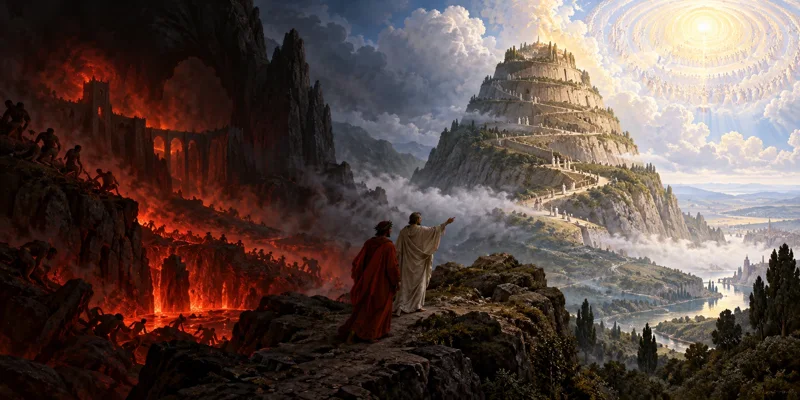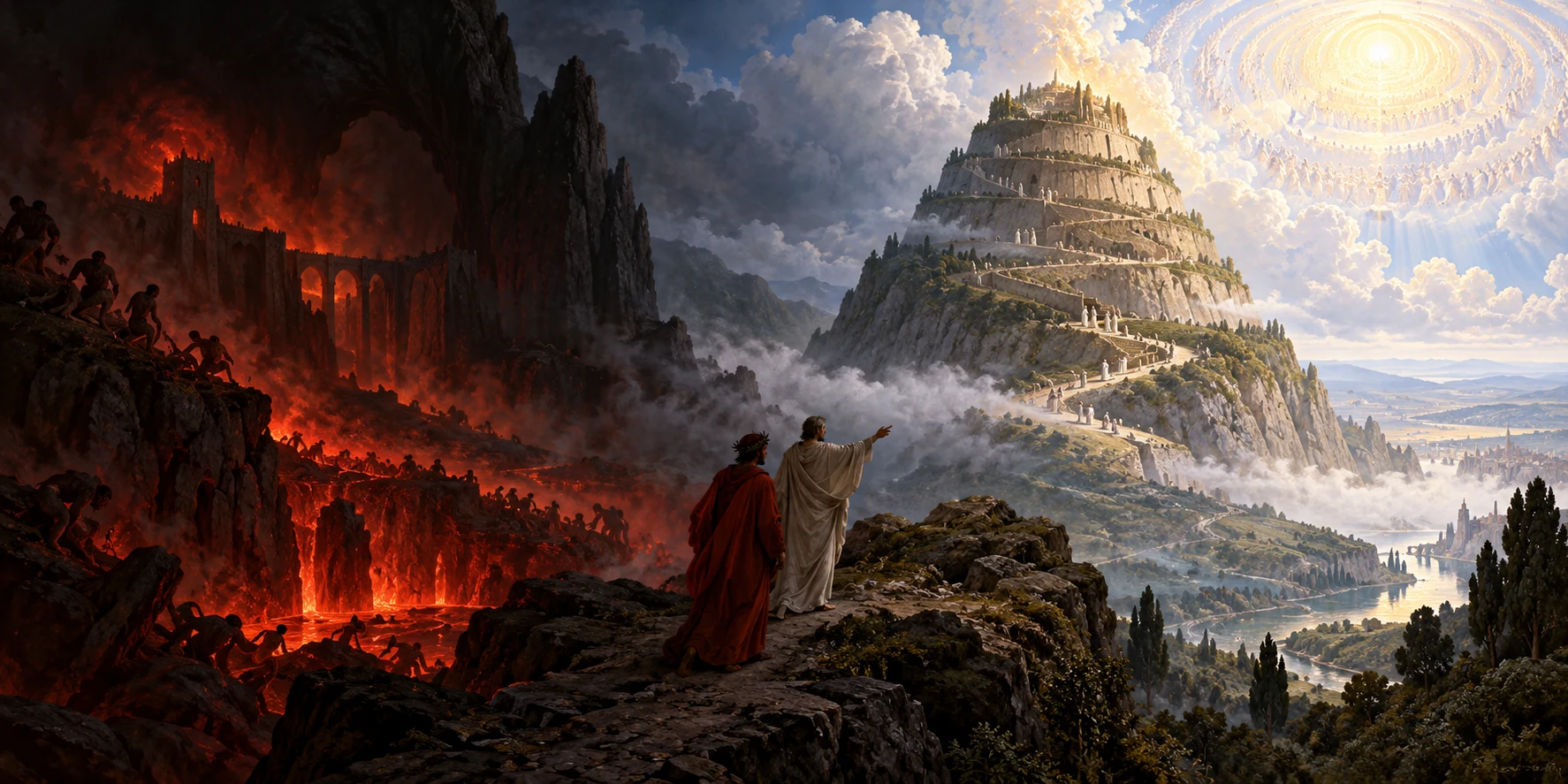
The whole journey of the Divine Comedy takes less than a week. It begins on the night before Good Friday in the spring of 1300, when Dante, aged thirty-five, finds himself lost in a dark wood, and it ends in the days after Easter, at the edge of Paradise, looking at God. Hell, Purgatory and Heaven in about six days: it is a fast-moving story, and that is the best thing to remember when the notes pile up.
So here is the short answer to how to read the Divine Comedy. Read it a canto at a time, in order, starting with Inferno. Keep a simple map of each realm in your head. Glance at the notes when you need them and ignore them when you don’t. And do not stop at the bottom of Hell.
In the midway of this our mortal life, / I found me in a gloomy wood, astray / Gone from the path direct
Dante Alighieri, Hell, Canto I, translated by Henry Francis Cary (1814)
How the poem is built
Dante Alighieri was an architect as much as a poet. The Comedy has one hundred cantos: thirty-three each for Inferno, Purgatorio and Paradiso, plus an opening canto that sets the story going. In Italian it runs to 14,233 lines, written in terza rima, the interlocking three-line rhyme scheme Dante invented for it. Each canto is a self-contained episode of a hundred-odd lines, which in our edition is about six pages.
Each realm has its own geography, and knowing it saves a lot of confusion:
- Hell is a funnel of nine circles under the earth. Sins get worse as you go down, from the lustful near the top to traitors frozen in ice at the bottom.
- Purgatory is a mountain on the far side of the world. Its terraces correspond to the seven deadly sins, and souls climb them slowly, being made fit for Heaven. The Garden of Eden sits on the summit.
- Paradise rises through the nine heavenly spheres of medieval astronomy to the Empyrean, beyond space and time.
Dante has three guides. The Roman poet Virgil leads him through Hell and most of Purgatory; Beatrice, the Florentine woman he loved from childhood, takes over near the top of the mountain; and St Bernard of Clairvaux guides him through the final cantos.
Do you need the notes?
Less than you would think. The difficulty in Dante is not the story, which is simple to follow, but the hundreds of real people he meets: popes, poets, soldiers and the Florentine politicians who had him exiled in 1302. Notes explain who they were, and some readers find it helps to read a short summary before each canto.
On a first reading, though, it is enough to know the type of person in front of you: a lover, a traitor, a glutton, a saint. Let the rest go. You can always come back, and many readers find the second trip through the poem is when the names start to matter.
- Read a canto a sitting. A hundred evenings is a satisfying project, and each canto has its own small drama.
- Read the big set pieces aloud: Paolo and Francesca in Canto V of Inferno, Ulysses in Canto XXVI, Count Ugolino in Canto XXXIII.
- Notice Dante the character. He faints, weeps, argues and occasionally loses his temper. He is not just a camera.
- Keep going past Hell. Purgatorio is the most human of the three parts, full of artists, friends and second chances, and Paradiso is a poem of light and music that rewards the reader who has made the climb.
Which translation is ours?
Our edition uses the blank-verse translation by Henry Francis Cary, an English clergyman born in Gibraltar in 1772. His Inferno came out in 1805 and sold badly, so he paid to publish the complete poem himself in 1814; praise from Samuel Taylor Coleridge in a lecture helped it find readers, and Cary was eventually buried in Westminster Abbey. He gives up Dante’s rhyme for blank verse, the unrhymed metre of Paradise Lost, which keeps the sense close and the pace steady. He also calls the three parts Hell, Purgatory and Paradise.
Other translations make different trade-offs between rhyme, closeness and modern idiom, and Henry Wadsworth Longfellow’s, completed in 1867, is the other famous nineteenth-century version. How to choose a translation of a classic explains how to weigh them.
The Divine Comedy
Henry Francis Cary’s 1814 blank-verse translation of all hundred cantos, from the dark wood to the final vision. Read a canto a night and you finish in just over three months.
The Aeneid
Virgil’s epic of Aeneas, the poem that made Virgil Dante’s chosen guide. Its sixth book, a visit to the underworld, is the Comedy’s great ancestor.


Before you begin
If you are wondering why a poem about Hell is called a comedy, Why is Dante’s Divine Comedy called a comedy? has the answer, and the great epic poems places Dante beside Homer, Virgil and Milton.
Then start where he does, in the middle of the journey of life, lost and afraid in the gloomy wood. Open The Divine Comedy at the first canto, and follow Virgil down.
Questions readers ask
What is the best way to read the Divine Comedy?
Read one canto at a time, in order, beginning with Inferno. Use notes or short canto summaries when you are lost, but don’t try to identify every name on a first reading.
Should I read all three parts of the Divine Comedy?
Yes, if you can. Inferno is the most famous, but the poem is built as a single journey, and Purgatorio and Paradiso are where its meaning and its happy ending arrive.
How long does it take to read the Divine Comedy?
It has 100 cantos, so a canto a day takes just over three months. Our edition runs to 600 pages, which the book card estimates at about twelve hours of reading, though most readers take it more slowly.
Who is Dante’s guide in the Divine Comedy?
The Roman poet Virgil guides him through Hell and most of Purgatory, Beatrice through Paradise, and St Bernard of Clairvaux in the final cantos.
 The New Life (La Vita Nuova)74 pages · $10.99