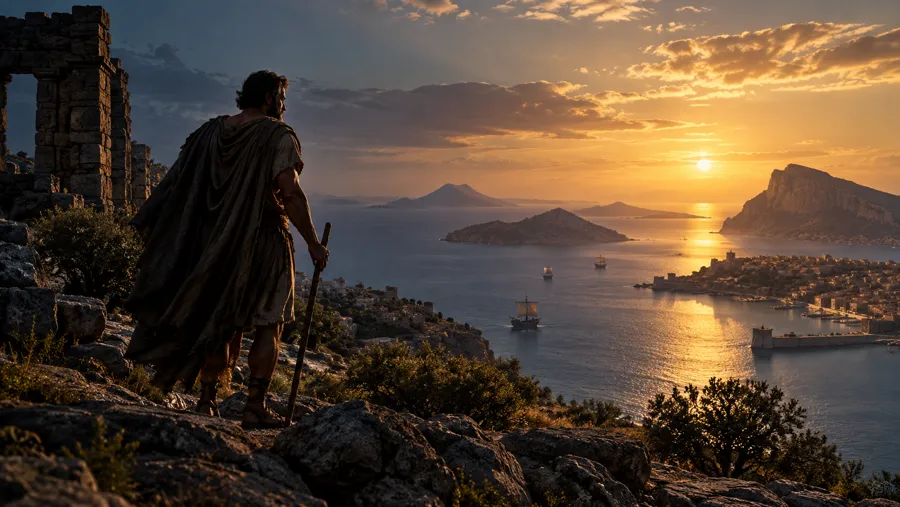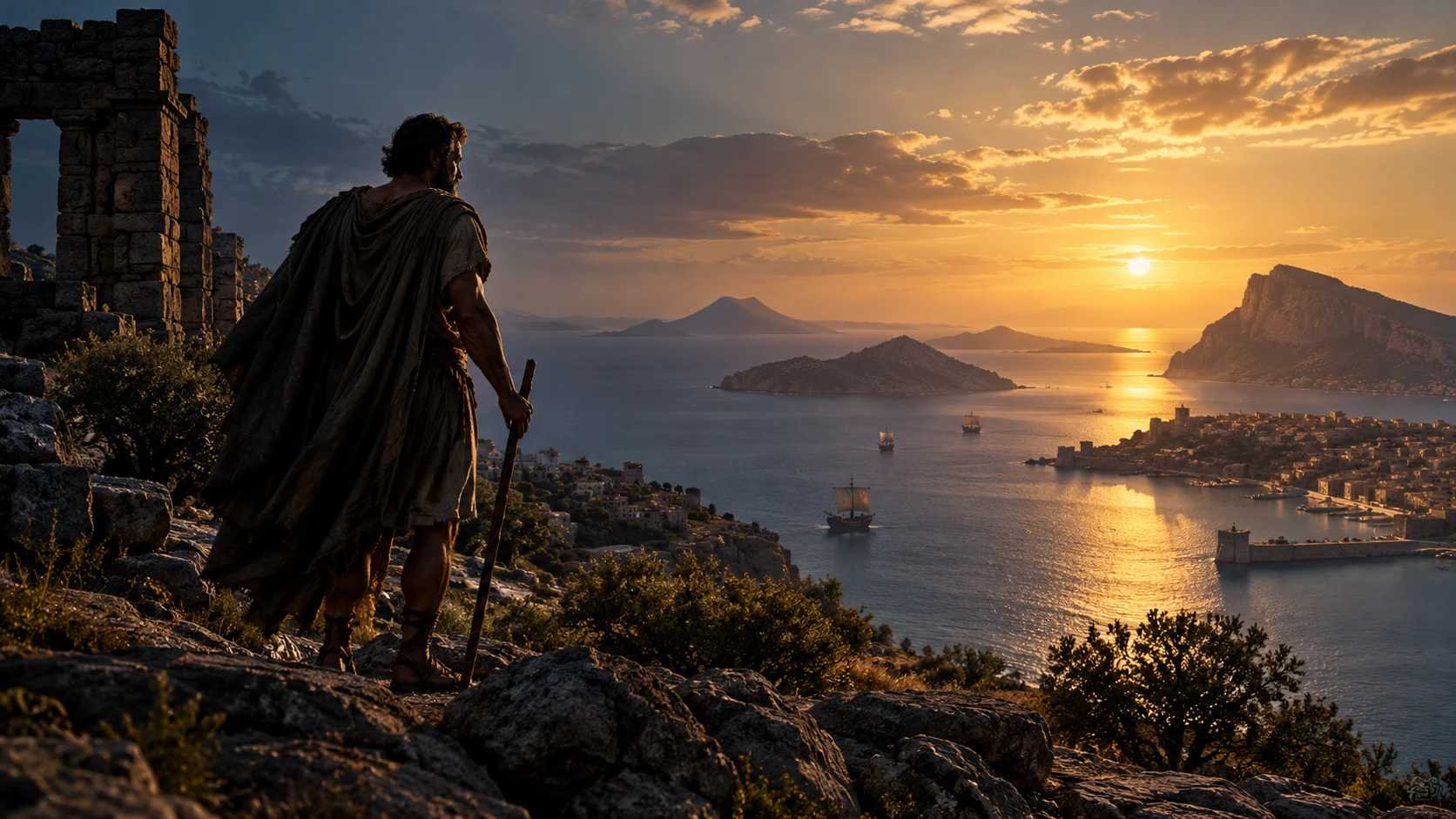
Open Samuel Butler’s translation of The Odyssey and you will look in vain for Odysseus. Butler calls him Ulysses, his Latin name, and the goddess Athena is Minerva, Zeus is Jove and Poseidon is Neptune. In the Gutenberg text of his version, “Ulysses” appears more than six hundred times and “Odysseus” only a handful, almost all of them in the preface.
It is a small thing, but it is typical of what trips up first-time readers of the Odyssey. Almost none of the difficulty is in the story, which is one of the clearest ever told. It lies in the names, the order of events and the habits of an oral poem. Sort those out before you start and the poem reads like an adventure novel.
How to read the Odyssey: know its shape first
The poem opens ten years after the fall of Troy. Every other Greek captain is home or dead; Homer’s hero is stuck on an island, and his house in Ithaca is overrun by young men courting his wife Penelope and eating their way through his estate. From there the twenty-four books fall into four parts.
- Books 1–4: the son. Telemachus, now grown, stands up to the suitors and sails off to ask old comrades of his father for news. Scholars call this section the Telemachy.
- Books 5–8: the castaway. We meet the hero at last, released from the nymph Calypso, shipwrecked and washed up among the Phaeacians.
- Books 9–12: the famous stories. At the Phaeacian court he tells his own adventures, from the Cyclops to Circe to the land of the dead. All of it is told in the first person, after the fact.
- Books 13–24: the homecoming. Back on Ithaca in a beggar’s disguise, he tests who has stayed loyal and plans his revenge.
The point to hold on to is that the Odyssey begins in the middle and goes back for its most famous episodes. If you open it expecting the Cyclops on page one, the first four books can feel like a detour. They are not: they show you the household the hero is trying to reach, and they make the second half land.
She found him sitting upon the beach with his eyes ever filled with tears, and dying of sheer home sickness
Homer, The Odyssey, Book V, translated by Samuel Butler (1900)
That is our first sight of the cleverest man in Greek legend: weeping on a beach. Notice it. The whole poem is about the distance between that man and the one who walks into his own hall in disguise twelve books later.
Is the Odyssey hard to read?
Less than you might think, especially in prose. Butler’s version, which is the translation in our edition, reads like a plain Victorian novel. What takes getting used to is the texture of a poem made for listening.
- Expect repetition. Dawn is rosy-fingered again and again, meals and sacrifices are described in the same words each time, and messages are often repeated in full. Singers relied on these set pieces; once you see them as a kind of refrain, they become restful rather than tedious.
- Keep the names straight. If your translation uses Roman names, a note of the main Greek ones beside you saves confusion when you read anything else about Homer.
- Read the book headings. Butler gives each book a summary line, such as “The Gods in Council—Minerva’s Visit to Ithaca—The Challenge from Telemachus to the Suitors”. Read it first, and you know where you are going.
- Take a book at a sitting. Most take fifteen to twenty-five minutes at an ordinary pace, which makes the whole poem a comfortable month of evenings.
- Watch the hospitality. Who feeds a stranger, who robs him and who insults him is the poem’s moral measuring stick, from the Phaeacian palace to the swineherd’s hut.
The Odyssey
Samuel Butler’s 1900 prose translation: brisk, plain and very readable, with Roman names for the gods and Ulysses for the hero. A good first Odyssey for anyone who finds verse translations slow going.
The Iliad
Alexander Pope’s rhyming Iliad. The war that the Odyssey looks back on, in a grand eighteenth-century voice; read it second if the Odyssey wins you over.


Should you read the Iliad first?
No. The Odyssey stands on its own, and it supplies everything you need to know about Troy through the stories its characters tell. Most new readers find it the easier way into Homer; we weigh the choice in The Odyssey or the Iliad: which should you read first?
It does help to know a few names in advance: Agamemnon, murdered on his return home, whose fate is held up as a warning throughout; Menelaus and Helen, back in Sparta; and Achilles, whom the hero meets among the dead. A one-page summary of the Trojan War covers it.
Which translation should you choose?
Prose or verse is the main decision. Prose, like Butler’s, gets you through the story quickly and clearly; verse gives you more of the music, at the cost of a slower read. Neither is wrong, and many readers go back to the poem in a second translation once they know the story. Our guide How to choose a translation of a classic compares the main options.
Whichever you pick, start with an evening and Book 1, and keep going until the hero is on that beach. Open The Odyssey tonight, and by Book 9 you will be sitting in the Phaeacian hall with everyone else, waiting to hear what happened in the Cyclops’ cave.
Questions readers ask
What is the best way to read the Odyssey for the first time?
Read a clear translation a book at a time, knowing in advance that it starts in the middle of the story. The hero’s famous adventures are told in flashback in Books 9 to 12.
Why is Odysseus called Ulysses in some translations?
Ulysses is the Latin form of his name. Older English translations, including Samuel Butler’s, use Roman names for the hero and the gods, so Athena becomes Minerva and Zeus becomes Jove.
How many books are in the Odyssey?
Twenty-four. In the original Greek the poem runs to about 12,100 lines of hexameter verse.
When does Odysseus first appear in the Odyssey?
He is talked about from the start, but he first appears in person in Book 5, on Calypso’s island. Books 1 to 4 follow his son Telemachus.